


Summary
- JetBlue has successfully secured an EAS contract to serve Presque Isle, Maine.
- The airline will serve the Boston Logan International Airport (BOS)–Presque Isle Northern Maine Airport (PQI) route from September 1.
- The local city supported JetBlue’s bid, with one of the arguments being that JetBlue was a low-cost carrier.
The United States Department of Transportation (DOT) has disclosed that JetBlue has won an Essential Air Service (EAS) contract to provide flights to Presque Isle, Maine, which is served by Presque Isle Northern Maine Airport (PQI). The airline will serve the airport with the Embraer E190 and Airbus A220-300 aircraft.
Beating out three competitors
In total, the DOT received five applications from four different carriers, American Airlines, Boutique Air, which provided two different applications, JetBlue, and United Airlines for the EAS contract. All airlines applied to fly from Boston Logan International Airport (BOS) to PQI daily, with the essential service flights starting on September 1 and ending on August 31, 2026.
Previously, the EAS route was served by United Airlines, which won the previous two-year contract, lasting from June 1, 2022, to May 31. The carrier served the Newark Liberty International Airport (EWR)–PQI route with a Mitsubishi CRJ550. The DOT provided an annual subsidy of $10.8 million.
Photo: Kevin Hackert | Shutterstock
Nevertheless, on January 19, the DOT issued an order for airlines to propose new services to PQI, receiving proposals from the four aforementioned airlines. However, the quarter’s proposals differed in the requested annual subsidy rate, the aircraft, and the origin airports from where they would operate to the airport in Maine.

Related
1st Time Ever: JetBlue Applies For Essential Air Service Contract
The airline wants to connect Presque Isle International Airport in Northern Maine with Boston.
JetBlue’s first EAS contract
The following proposals were made by American Airlines, Boutique Air, JetBlue, and United Airlines. Notably, this was the first time that JetBlue bid for an EAS contract, which subsidizes a specific route to a certain airport within the US, providing air services to more remote and/or underserved communities within the country.
|
Airline |
Annual subsidy (year 1) |
Annual subsidy (year 2) |
Origin airport |
Aircraft used on the route |
|
American Airlines |
$17.3 million |
$17.3 million |
Philadelphia International Airport (PHL) |
Embraer ERJ145 (identified as a 50-seat EMB aircraft) |
|
Boutique Air |
$11.9 million |
$12.57 million ($13.20 million in year 3, $13.86 million in year 4) |
Boston Logan International Airport (BOS) |
Pilatus PC-12 |
|
Boutique Air (option two) |
$11.9 million |
$12.58 million ($13.21 million in year 3, $13.87 million in year 4) |
Boston Logan International Airport (BOS) |
Pilatus PC-12 |
|
JetBlue |
$10.4 million |
$11.2 million |
Boston Logan International Airport (BOS) |
Embraer E190 (first year)/Airbus A220-300 (second year) |
|
United Airlines |
$13.1 million |
$13.1 million |
Newark Liberty International Airport (EWR) |
Mitsubishi CRJ550 |
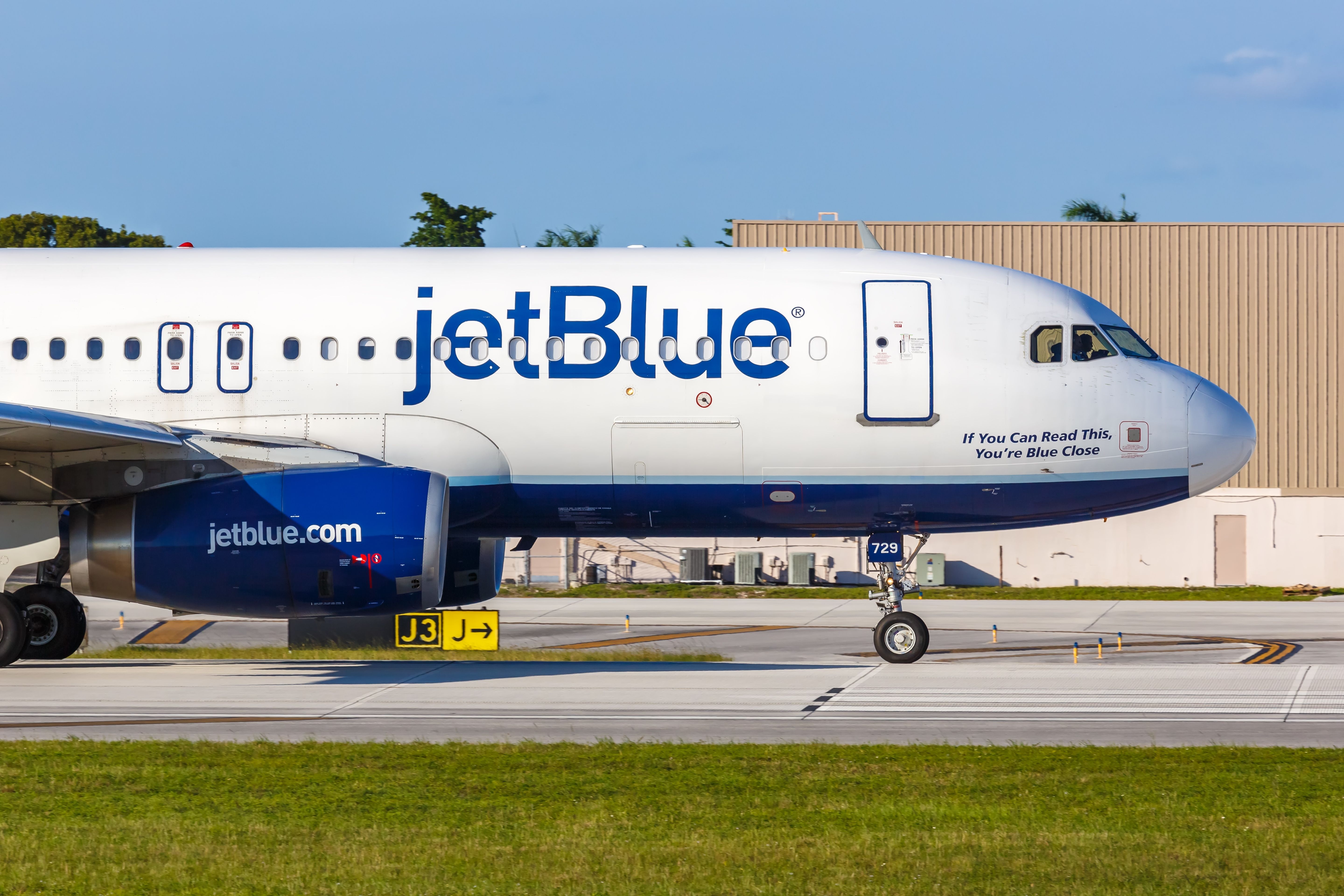
The City of Presque Isle supported JetBlue’s proposal, noting that the airline’s application was favored because of BOS’ connectivity, services with much larger aircraft than other airlines had proposed, and JetBlue’s classification as a low-cost carrier. As a side note, the Department of Justice (DOJ) – successfully – argued that JetBlue was not a low-cost carrier, which resulted in a judge ruling that the JetBlue and Spirit Airlines merger would increase fares and reduce choices for passengers in the US.

Photo: Lukas Wunderlich | Shutterstock
Related
Merger Blocked: What’s Next For JetBlue & Spirit Airlines
Seemingly, JetBlue and Spirit Airlines have to different futures ahead of them following a judge’s ruling against their merger.
Around $2 million in profit
Nevertheless, the DOT filing detailed that JetBlue planned to earn $4.1 million in revenue on the EAS route, with operating costs being $12.7 million during the first year when the airline still plans to operate the Embraer 190. With a $10.4 million subsidy, JetBlue would earn a profit of $1.8 million on the route.

Photo: JetBlue Airways
During the second year of the EAS, the carrier planned to earn $5 million in revenue, offset by $14.2 million in operating expenses when JetBlue would upgauge the route to the Airbus A220-300. However, a $11.2 million subsidy would result in an annual profit of $2.1 million. The A220-300 would add 40 additional seats compared to the E190, the filing read.

Related
JetBlue Now Expects To Save $100 Million In Costs By Swapping Embraer E-190s For Airbus A220s
Every little helps as the carrier strives to return to profitability.
