


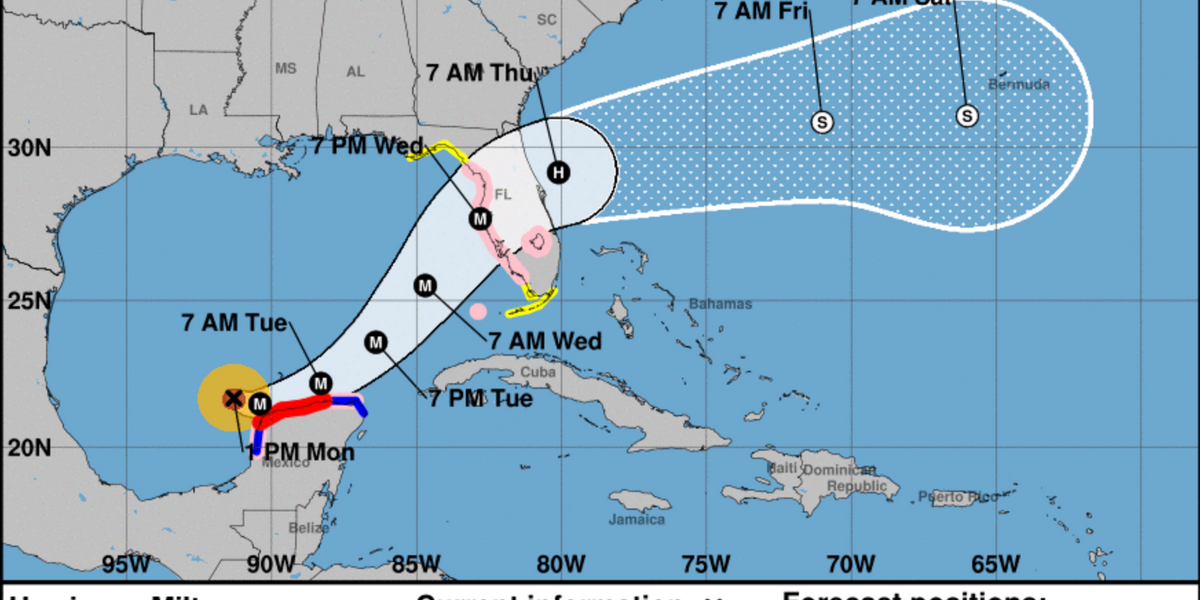
The warm waters of the Gulf of Mexico are brewing up another massive storm this week that is on track to smash into the western coast of Florida by Wednesday morning, bringing a consecutive round of storm surge and damaging winds to the storm-weary state.
Before reaching the U.S., Hurricane Milton will rake the northern coast of Mexico’s Yucatan Peninsula with dangerous weather. But hurricane watches are already in effect for parts of Florida, which could see heavy rainfall, flash and urban flooding, and moderate to major river floods, according to forecasts from the National Oceanic and Atmospheric Administration (NOAA).
That schedule would drop the storm’s angry weight in a region that is already wobbling with the impact of massive power outages and hundreds of deaths throughout the Southeast caused last week by Hurricane Helene and by the supply chain disruptions of a wide-ranging, three-day dockworkers’ strike along the entire East and Gulf coasts.
As it revs its massive engines with fuel from the historically warm Gulf of Mexico, Hurricane Milton could possibly hit Tampa as a Category 5 storm, according to the FEWSION Project at Northern Arizona University, which tracks supply chains throughout the country.
With that much power, Milton could shut down the port and seriously disrupt the fuel supply into western and central Florida, which could then hinder recovery efforts. That’s because fuel supplies for much of Florida, especially central Florida, arrive from Texas and Louisiana through the Port of Tampa. That means that anyone who depends on generators or fuel for critical functions should plan for an extended period without access to fuel. And recovery crews and logisticians should consider bringing their own fuel when responding to the storm, FEWSION said.
One of those disaster recovery efforts will be led by nonprofit group the American Logistics Aid Network (ALAN), which is already mobilizing its forces for Hurricane Milton, even as it devotes other energy to the Hurricane Helene response. “In an ideal world we’d have plenty of time to focus all of our efforts on Hurricane Helene clean-up and recovery,” Kathy Fulton, ALAN’s Executive Director, said in a release. “But in the real world, major hurricanes don’t always wait for their turn. As a result, we are officially activating for Hurricane Milton.”
In the meantime, many weary residents of the region are thinking of moving to another part of the country instead of getting hit by vicious storms several times a year. Nearly one-third (32%) of U.S. residents aged 18-34 say they’re reconsidering where they want to move in the future after seeing or hearing about the damage caused by Hurricane Helene, according to a survey commissioned by real estate brokerage Redfin.
“Scores of Americans flocked to the Sun Belt during the pandemic because remote work allowed them to take advantage of the region’s relatively low cost of living. Some thought Appalachia was insulated from hurricane risk, not realizing that the area is prone to flooding and that hurricanes can sometimes cause flash flooding far away from the ocean,” Redfin Chief Economist Daryl Fairweather said in a release. “Americans are beginning to realize that nowhere is truly immune to the impacts of climate change, and we’re starting to see that impact where people want to live—even people who haven’t experienced a catastrophic weather event firsthand.”
The report is based on a commissioned survey conducted by Ipsos on Oct. 2-3, fielded to 1,005 U.S. adults. After making landfall in Florida in late September, Hurricane Helene wreaked havoc across Appalachia, becoming the deadliest storm to hit mainland America in almost two decades. In North Carolina, the death toll has surpassed 100 and the city of Asheville has been devastated.
