


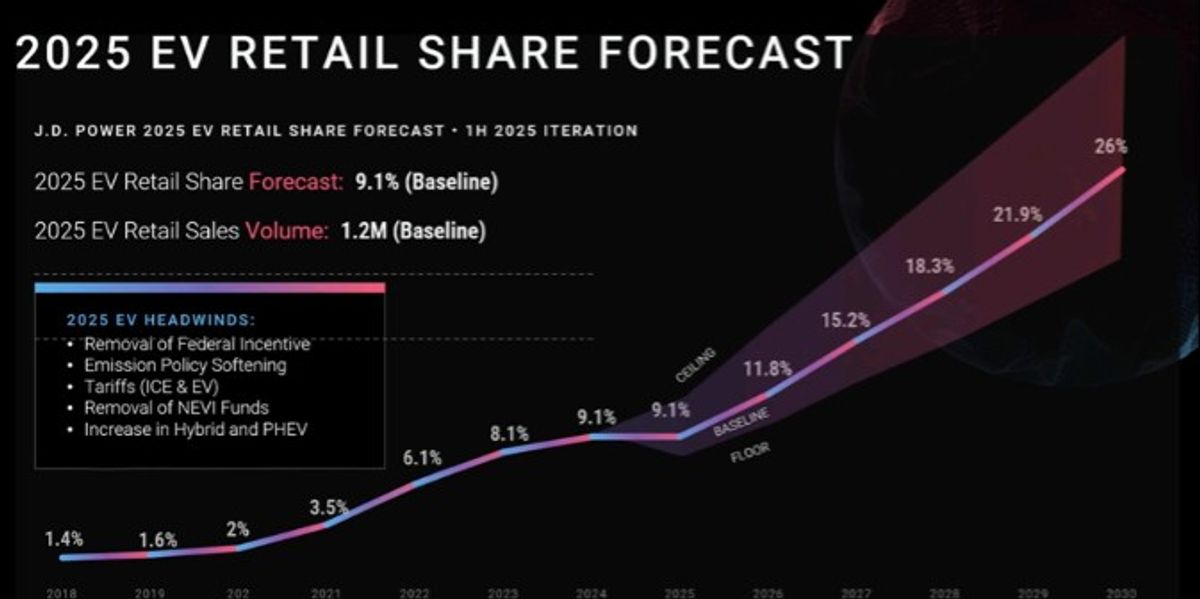
The growth of electric vehicles (EVs) is likely to stagnate in 2025 due to headwinds created by uncertainty about the future of federal EV incentives, possible tariffs on both EV and gasoline-powered vehicles, relaxed federal emissions and mileage standards, and ongoing challenges with the public charging network, according to a report from J.D. Power.
Specifically, J.D. Power projects that total EV retail share will hold steady in 2025 at 9.1% of the market, or 1.2 million vehicles sold. Longer term, the new forecast calls for the EV market to reach 26% retail share by 2030, which is approximately half of the market share the Biden administration targeted in its climate agenda.
A major reason for that flat result will be the Trump Administration’s intention to end the $7,500 federal Clean Vehicle Tax Credit, which has played a major role in incentivizing current EV owners to purchase or lease an EV, J.D. Power says.
Even as EV manufacturers and consumers adjust to those new dynamics, the electric car market will continue to change under their feet. Whereas the early days of the EV market were defined by premium segment vehicles, that growth trend has now shifted to the mass market segment where franchise EV sales rose 58% in 2024, reaching a total of 376,000 units. That success came after mainstream franchise EV sales accounted for just 0.8% of total EV market share in 2021. In 2024, that number rose to 2.9%, as EVs from the likes of Chevrolet, Ford, Honda, Hyundai and Kia surged in popularity, the report said.
This growth in the mass market segment—along with federal and state incentives—has also helped make EVs cheaper than comparable gas-powered vehicles, J.D. Power found. On average, at the end of 2024, the average cost of a battery-electric vehicle (BEV) was $44,400, which is $1,000 less than a comparable gas-powered vehicle, inclusive of hybrids and plugin hybrids. While that balance may change if federal tax incentives are removed, the trend toward EVs being a lower cost option has correlated with increases in sales, which will be an important factor for manufacturers to consider as they confront the current marketplace.
