


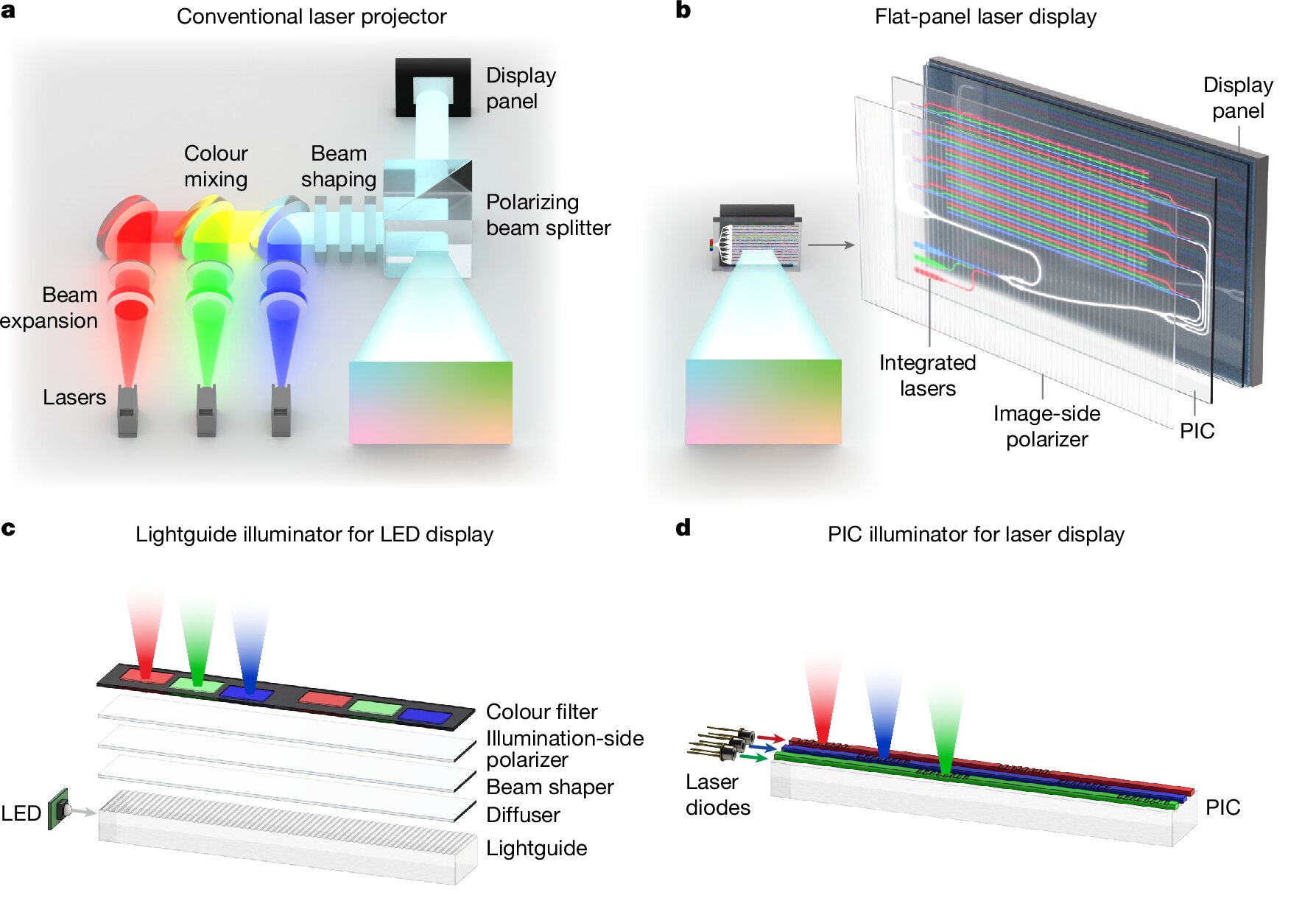
Meta has developed a new flat ultra-thin panel laser display that could lead to lighter, more immersive augmented reality (AR) glasses and improve the picture quality of smartphones, tablets and televisions. The new display is only two millimeters thick and produces bright, high-resolution images.
Flat-panel displays, particularly those illuminated by LEDs, are ubiquitous, seen in everything from smartphones and televisions to laptops and computer monitors. But no matter how good the current technology is, the search for better is always ongoing. Lasers promise superior brightness and the possibility of making the technology smaller and more energy efficient by replacing bulky and power-hungry components with compact laser-based ones.
However, current laser displays still need large, complex optical systems to shine light onto screens. Previous attempts at making flat-panel laser displays have come up short as they required complex setups or were too difficult to manufacture in large quantities.

The breakthrough
Meta’s innovation, however, overcomes these limitations by using a new method to create a flat and ultra-thin display. So how did they do it? The researchers spent around three years on the project, and their solution involves a centimeter-scale photonic integrated circuit, a special kind of chip that combines thousands of components with different optical functions. This means there are no bulky parts.
The new display integrates the tiny photonic chip with a 5-by-5-millimeter liquid-crystal-on-silicon (LCoS) panel. The resulting device is one-eightieth the thickness of conventional LCoS displays and has a much wider range of colors.
The scientists detailed their research in a paper published in the journal Nature. “Our work represents an advancement in the integration of nanophotonics with display technologies, enabling a range of new display concepts, from high-performance immersive displays to slim-panel 3D holography.”
However, despite the advances, there are still some limitations of the technology. For example, laser speckle where grainy or speckled patterns appear in images created by a laser. Also, the display’s light can only be turned on or off at once and not adjusted for specific parts of an image. This wastes a lot of power if the screen is mostly blank or when just showing a few words or icons.
Once the remaining challenges are resolved, there could be a raft of innovations. One of the most exciting applications is more immersive AR glasses. The Meta team created a prototype see-through augmented reality system that seamlessly merged virtual images with real-world scenes in an office environment, offering a new way to experience our surroundings and see the world.
Written for you by our author Paul Arnold,
edited by Robert Egan—this article is the result of careful human work. We rely on readers like you to keep independent science journalism alive.
If this reporting matters to you,
please consider a donation (especially monthly).
You’ll get an ad-free account as a thank-you.
More information:
Zhujun Shi et al, Flat-panel laser displays through large-scale photonic integrated circuits, Nature (2025). DOI: 10.1038/s41586-025-09107-7
© 2025 Science X Network
Citation:
Meta’s new ultra-thin flat-panel display could change the future of screens (2025, August 25)
retrieved 25 August 2025
from https://techxplore.com/news/2025-08-meta-ultra-thin-flat-panel.html
This document is subject to copyright. Apart from any fair dealing for the purpose of private study or research, no
part may be reproduced without the written permission. The content is provided for information purposes only.
