


A team of scientists from China and the U.S. is pioneering the development of bubble-powered robots, which could one day replace needles for painless drug delivery into the body. Inspired by nature, the researchers developed a new technique that harnesses the energy released by a collapsing bubble in a liquid, a process known as cavitation.
The natural world has evolved ingenious ways to exploit cavitation for movement. For example, ferns use it within specialized cells in their sporangia to catapult spores, and mantis shrimps snap their appendages with such force that the resulting bubbles collapse with enough energy to stun their prey.
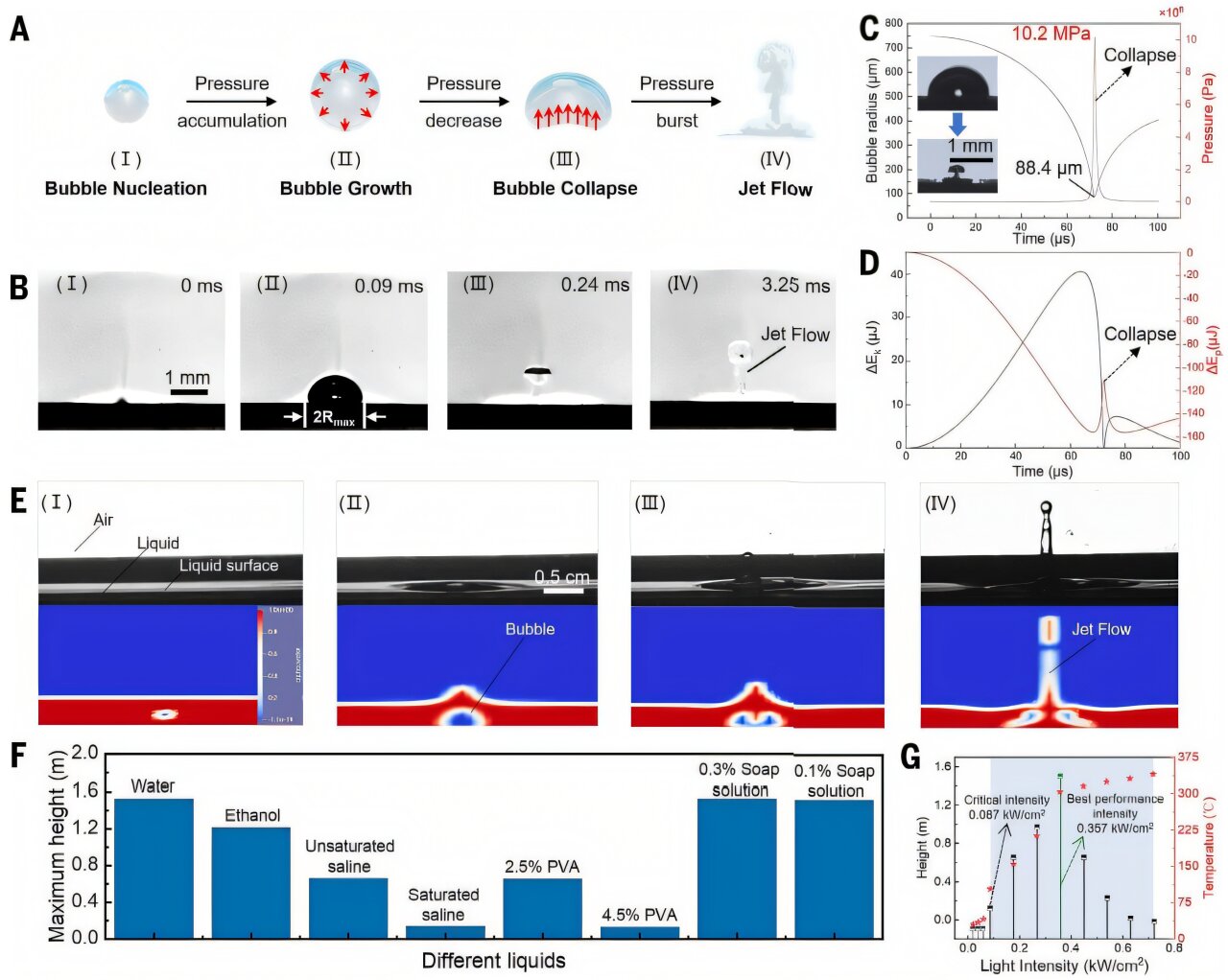
In their study, published in the journal Science, the team details how they used cavitation as a propulsion system for tiny robots. They built millimeter-sized robots, called “jumpers,” out of titanium dioxide, polypyrrole and titanium carbide that heated up quickly when hit by a laser.
This caused the liquid surrounding the devices to form vapor bubbles, which expanded rapidly and then suddenly collapsed, releasing enough energy to launch the devices 1.5 meters in the air with a takeoff speed of over 12 meters per second.
“The rapid transmission of substantial energy during cavitation produces a burst of power and acceleration, imparting high kinetic energy to the launched objects,” wrote the scientists.
As well as demonstrating its jumping ability, the scientists showed that the technology is versatile and controllable. By changing where the laser hits a device, the team could precisely control its launch direction and distance. This launching mechanism is also not limited to lasers. It can be activated by ultrasound and an electrical spark. The research team even created “swimmers” that could move on water at 12 centimeters per second.
Challenges and applications
The technology could be used to power tiny robots and actuators, overcoming the limitations of traditional spring-based systems that can’t store a lot of energy or release it quickly enough. However, the jumpers are currently a proof-of-concept and nowhere near ready to be sent scuttling into a patient’s bloodstream to deliver a drug. Several challenges remain, such as controlling cavitation in complex environments like the human body and ensuring the materials are biocompatible.
Despite these challenges, the technology has numerous potential applications beyond medicine. For instance, bubble-powered robots could be used for the precision assembly of tiny parts in electronics and biomedical devices. They could also be deployed to inspect and repair pipelines or machinery in confined, hard-to-reach spaces.
Cavitation was once thought of as a destructive process, but now scientists have found a way to put its immense power to work for a new generation of micro-robots.
Written for you by our author Paul Arnold, edited by Lisa Lock, and fact-checked and reviewed by Robert Egan—this article is the result of careful human work. We rely on readers like you to keep independent science journalism alive.
If this reporting matters to you,
please consider a donation (especially monthly).
You’ll get an ad-free account as a thank-you.
More information:
Dalei Wang et al, Launching by cavitation, Science (2025). DOI: 10.1126/science.adu8943
© 2025 Science X Network
Citation:
Scientists harness the power of collapsing bubbles to propel tiny robots (2025, September 8)
retrieved 8 September 2025
from https://techxplore.com/news/2025-09-scientists-harness-power-collapsing-propel.html
This document is subject to copyright. Apart from any fair dealing for the purpose of private study or research, no
part may be reproduced without the written permission. The content is provided for information purposes only.
