Support CleanTechnica’s work through a Substack subscription or on Stripe.
The leading Korean automaker Hyundai hit the electric mobility ball out of the park with its popular battery-electric IONIQ lineup, leading one to wonder why the firm is still messing around with fuel cell EVs. That’s a good question. An even better question is why Hyundai is focusing part of its fuel cell strategy on the US, where federal policymakers are trying their best to quash the market for EVs of any sort.
Hyundai Sees Green Gold In US Fuel Cell EV Market
Adding insult to injury, US immigration policy also kicked in last September, when federal officers raided the site of Hyundai’s new EV battery factory under construction in Georgia and put hundreds of workers in cuffs.
Be that as it may, the US is among a select few markets targeted by Hyundai in collaboration with the leading French gas products firm Air Liquide. The two firms have partnering on hydrogen projects through an ongoing Memorandum of Understanding, which they renewed on December 4 at the Hydrogen Council Summit in Seoul while drawing attention to their roles as co-chairs of the trade organization Hydrogen Council.
“This partnership focuses on building a sustainable energy ecosystem across Europe, U.S. and South Korea, encompassing hydrogen production, storage, transportation and utilization,” Air Liquide explains, while noting that fuel cell EVs are just part of a larger picture that covers infrastructure and logistics, as well as something they call “clean energy solutions,” which they bundle under the aim of supporting the global energy transition.
In terms of the hydrogen supply chain, that phrase “clean energy solutions” is subject to interpretation. To support the energy transition as generally understood, green hydrogen from water, biomass, and other renewable resources is the goal.
Some hydrogen advocates have been trying to squeeze hydrogen derived from natural gas or coal into the “clean hydrogen” category, when integrated with carbon capture systems. However, if the energy transition means leaving fossil fuels undisturbed where they lie in the ground, that won’t wash.
What Is This Hydrogen Council Of Which You Speak?
For the record, the Hydrogen Council is an industry group launched in 2017 by founding members Air Liquide, Alstom, Anglo American, BMW Group, Daimler, Engie, Honda, Hyundai, Kawasaki, Shell, Linde, Total, and Toyota, with the stated aim of supporting the 2015 Paris Agreement on climate change. The group now counts 140 members on its list covering all aspects of the global hydrogen economy.
Supporting the Paris Agreement is going to be a tough row for the Hydrogen Council to hoe, considering the deep and sticky fossil energy fingers holding a grip on global hydrogen production. Except for the notable exception of China, the emerging green hydrogen market has been a slow, halting work in progress with many fits and starts along the way.
Europe, for example, has seen a series of project failures and drawbacks in its green hydrogen plans. However, policymakers in the EU and UK are still committed to the long term goal of cutting energy ties with Russia, an aim to be accomplished with the help of green hydrogen. Estonia and other Baltic EU members are particularly keen on the idea.
That, along with the presence of BMW, Shell, Air Liquide, and other leading hydrogen stakeholders on the Hydrogen Council, explains why Hyundai and Air Liquide are focusing their energy on Europe as well as Hyundai’s home nation of Korea.
In that context, the US sticks out like a sore thumb. Fuel cell EVs have struggled for a foothold in the US all through the 2000’s, no thanks in part to Tesla co-founder and CEO Elon Musk, who memorably excoriated fuel cell technology as “bull—t” at an industry event in 2013. Back then, of course, Musk was a highly influential and respected voice in the global EV industry. The “bull—t” canard — among others — stuck with particular force among EV enthusiasts in Tesla’s home nation of the US.
Nevertheless, Hyundai and Air Liquide are determined to to crack the hydrogen mobility market in the US as well as Europe and Korea. “The partnership will focus on scaling up hydrogen use across key regions, including Europe, South Korea and the United States, with specific emphasis on heavy-duty transport, logistics and public transportation,” Air Liquide emphasized, adding that logistics fleets and public buses are the primary targets, along with port operations.
While not committing to a green hydrogen program in full, the collaboration also includes renewable resources in its supply chain priorities, while also supporting an accelerated timetable for bringing new hydrogen technologies to the market.
Hyundai Has A Fuel Cell EV Plan
The US is not particularly ripe territory for such a plan. Musk’s well-poisoning was not the only factor working against fuel cell EVs in the US market, and this year’s disastrous U-turn in federal energy policy has thrown the entire domestic EV industry for a loop.
Still, hope springs eternal. While still committed to a battery powered future — last month Hyundai celebrated the launch of a new BEV workforce training center in Georgia, for example — Hyundai Motor Group has been showing off its latest fuel cell products at the World Hydrogen Expo this week in Korea.
The lineup, including all Hyundai affiliates, showcased water electrolysis for green hydrogen, biomass waste-to-hydrogen systems, and a new ammonia cracker that would presumably support the emerging green ammonia market (see more green ammonia background here). Hydrogen storage and refueling also get a look-see along with a new robotic refueling robot aimed at fully automating the fuel cell refueling process.
Among the mobility applications, Hyundai reaffirmed its commitment to its NEXO line of passenger cars. That’s an all but hopeless market for fuel cell EVs in the US, but Hyundai may have better luck with its newly restyled XCIENT fuel cell truck, which has already surfaced here. The company also showcased improvements to its fuel cell electric buses.
Rounding out the mobility picture is a forthcoming automated fuel cell vehicle for seaport logistics alongside a Kia-produced all-terrain vehicle for specialty uses, a fuel cell boat, agricultural tractor, and forklift.
On the non-mobility side, Hyundai showcased fuel cell power stations and the application of hydrogen to high-heat industrial processes.
All of this is by way of saying that the global fuel cell market is growing, with Hyundai being just one of scores of powerful stakeholders promoting the hydrogen economy of the future. If that future is to be a sustainable one, the hydrogen supply chain must transition out of fossil fuels and into renewable resources.
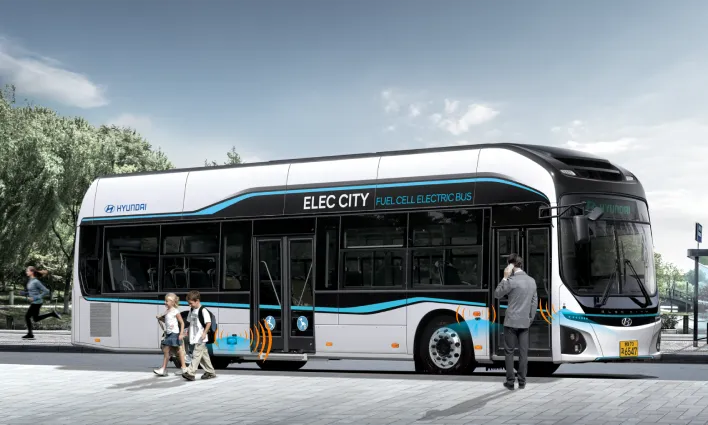
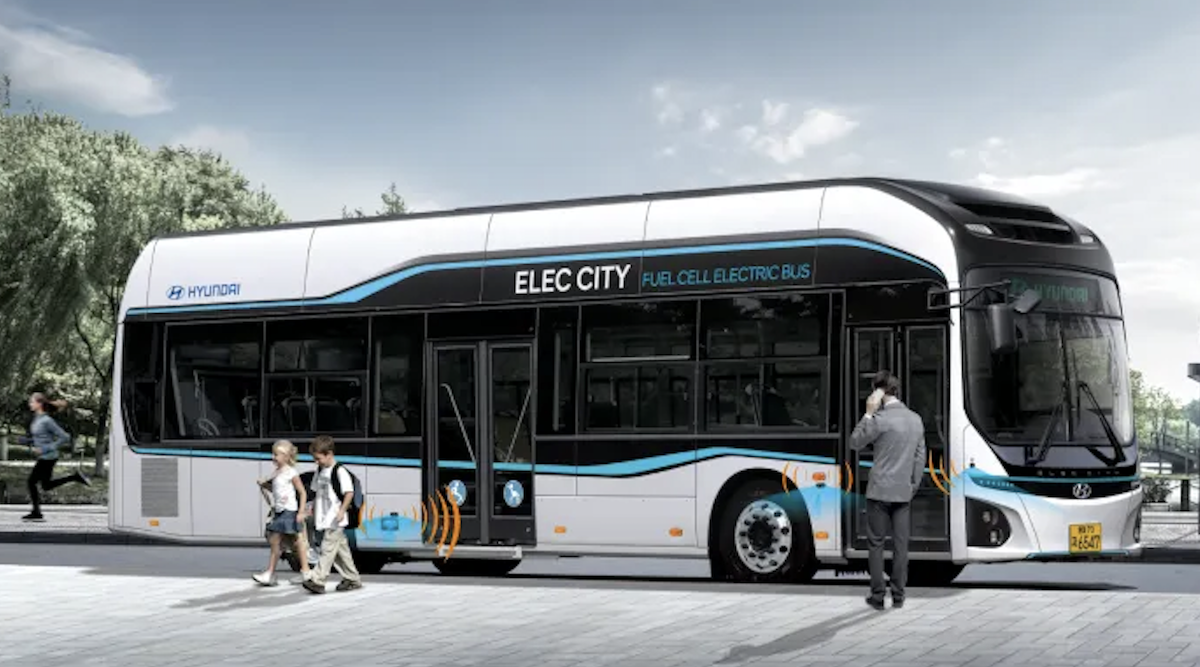
Photo: Hyundai is targeting the hydrogen fuel cell market in the US, Korea, and Europe, with a focus on electrifying public transportation, fleets, and port logistics (courtesy of Hyundai).
Sign up for CleanTechnica’s Weekly Substack for Zach and Scott’s in-depth analyses and high level summaries, sign up for our daily newsletter, and follow us on Google News!
Have a tip for CleanTechnica? Want to advertise? Want to suggest a guest for our CleanTech Talk podcast? Contact us here.
Sign up for our daily newsletter for 15 new cleantech stories a day. Or sign up for our weekly one on top stories of the week if daily is too frequent.
CleanTechnica uses affiliate links. See our policy here.
CleanTechnica’s Comment Policy