


Support CleanTechnica’s work through a Substack subscription or on Stripe.
Despite the current U-turn in federal energy policy, cleantech innovators here in the US continue to push the energy transition globally. The latest example to crop up is the California startup OceanWell, which aims to shrink the heavy footprint of fossil fuels in the desalination industry with a new, energy efficient system that leverages natural water pressure.
Energy Efficient Water Desalination Systems Are Coming For Your Fossil Fuels
The footprint of fossil fuels in the water desalination field is heavy indeed. Conventional desalination systems require pressure to push water through a membrane, and that takes energy. The US Department of Energy estimates that seawater desalination requires a pressure of about 800–1,000 pounds per square inch. “The energy required to run pumps that can achieve these high pressures account for approximately 25% to 40% of the overall cost of water,” the agency observes, indicating that improvements in energy efficiency will have a significant impact on costs.
“Large-scale desalination systems require tens of megawatts to run,” the Energy Department adds.
The archival network Encyclopedia of Desalination and Water Resources (DESWARE) offers some additional perspective through the energy efficiency lens. “There are no major technical obstacles to desalination as a means of providing an unlimited supply of fresh water, but the high energy requirements of this process pose a major challenge,” DESWARE explains.
“Theoretically, about 0.86 kWh of energy is needed to desalinate 1 m3 of salt water,” they elaborate, adding that present-day desalination facilities require 5-26 times the theoretical minimum, depending on the type of process.
“Clearly, it is necessary to make desalination processes as energy-efficient as possible through improvements in technology and economies of scale,” they emphasize.
Here Comes One Now
The OceanWell solution surfaced on the CleanTechnica radar in November of 2024. Instead of constructing expensive, energy sucking desalination facilities on land, the company has been developing a system of modular “pods” that are deployed under water, where naturally occurring water pressure does most of the heavy lifting.
The system is also designed to avoid the disruptive impact on aquatic life typical of conventional desalination systems, both at the intake end and in the outflow of salty brine from the operation.
“Unlike traditional desalination methods that are energy-intensive and threaten marine life, OceanWell’s technology reduces energy consumption by up to 40 percent, while protecting marine life and eliminating toxic brine disposal,” OceanWell explains.
Innovate Locally …
OceanWell also includes freshwater purification in its target markets as well as seawater desalination. “This technology ensures ultra-clean water by filtering out salts, bacteria, viruses, pesticides, and PFAS,” OceanWell notes.
In 2023, OceanWell nailed down an agreement for a pilot test of its first “water farm” with the Las Virgenes Municipal Water District, to be located at the freshwater Virgenes Reservoir in the City of Westlake Village, California. While that was under way, two dozen state water authorities in California formed a working group in support of the technology. The US Navy has also lent the use of a simulation facility to OceanWell.
Adding further support to the effort is the legacy water infrastructure firm Kubota Corporation, a branch of Kubota Group. In November of 2024 OceanWell closed an $11 million round of Series A funding, with Kubota among the participants. More than financial support, Kubota also stated its intention to provide technology assistance as well.
“Given our expertise developed in advanced pump technology, we are also exploring joint development with OceanWell of long-lasting, highly reliable, and efficient pumps capable of operating under deep-sea high-pressure conditions,” Kubota explained in a press statement.
… For Global Impact
Last week, OceanWell stepped onto the global stage with the forthcoming launch of a new pilot test in France, to be hosted by the public water and sanitation utility Régie Eaud’Azur. The utility covers the 51 municipalities of the Nice Metropolis.
The test is slated to begin later this year, and OceanWell CEO Robert Berstrom already sees it as a first step towards other agreements. “This partnership marks another step toward our goal of delivering sustainable water at scale to coastal communities worldwide,” Bergstrom said.
Further underscoring OceanWell’s global intention, the company has established a European headquarters in Nice, with a funding assist from the city’s Business Landing program.
“The collaboration with Eau d’Azur expands OceanWell’s presence beyond North America, where the company is advancing Water Farm 1,” OceanWell emphasized, referring to the planning stages of its first commercial-scale water desalination facility, to be located in Santa Monica Bay off the coast of Malibu.
As for Europe, if all goes according to plan the new “Mediterranean Water Farm” demonstration project in Nice will undergo a period of environmental and engineering assessments for about 12 months, towards the potential for commercial deployment to sometime between 2028 and 2030.
Energy Efficient & Modular, Too
Although a 40% reduction in energy consumption is a key element in OceanWell’s business model, it’s not the only one. The offshore facilities also save space on land, which can be costly and hard to come by in coastal areas, and the modular pod system provides for ease of transportation and scaleup.
In addition, the undersea location is buffered from fires, floods, algae blooms, and other circumstances that can interfere with the operation of a land-based desalination plant. As an extra benefit, the OceanWell system produces fresh water at colder temperatures than a conventional plant, making it a good fit for data centers and other onshore operations with cooling needs.
OceanWell also points out that its system offers more opportunities to integrate with renewable energy resources on shore, partly because its energy requirements are lower.
US innovators are also working to shrink the carbon footprint of water desalination from other angles. Among the examples to surface recently is the Utah startup Eden Technology, which is developing a retrofit-able, centrifuge-based desalination solution that avoids the cost of building new desalination facilities.
On the academic side, assistant professor of engineering Yangying Zhu at the University of California–Santa Barbara has been working on a distillation-based system that deploys solar thermal energy. In 2024 Zhu received a $500,000 grant from the Energy Department’s ARPA-E office for transformative energy projects, in support of fine-tuning the system.
“The work will enhance thermal transport processes to utilize energy more efficiently, which can significantly reduce energy consumption compared to existing industrial desalination processes,” ARPA-E explains.
The grant period is over in July this year, so keep an eye out for an update on the project.
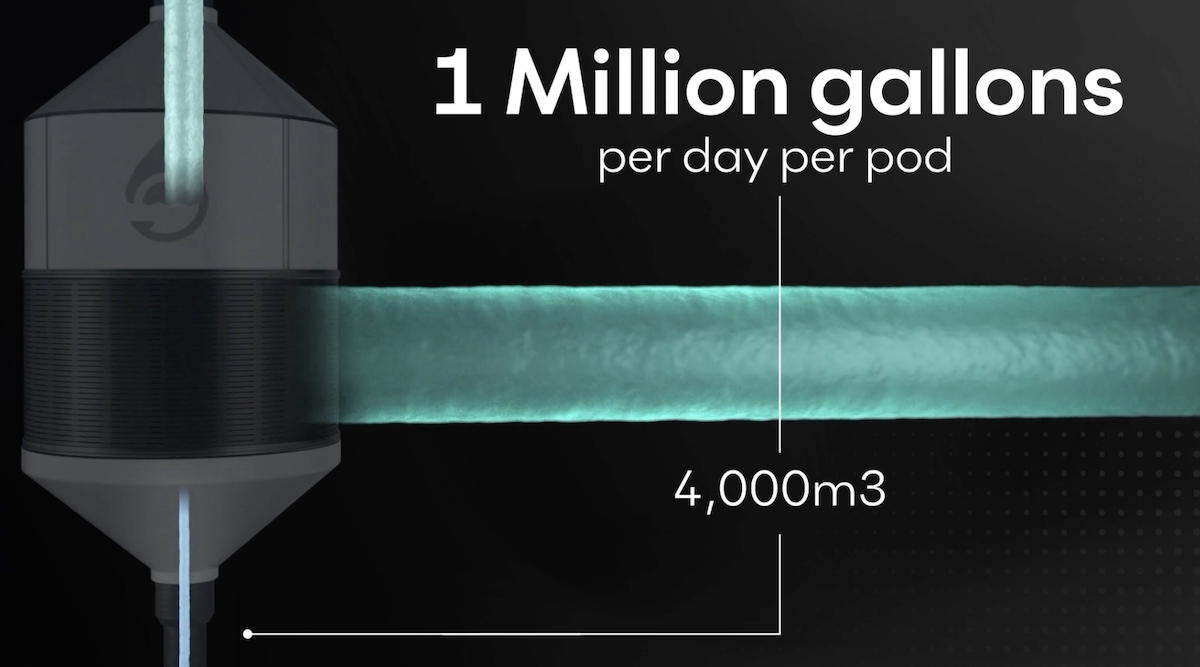
Image: A new, energy efficient desalination system leverages natural water pressure to make a 40% cut in energy consumption (screenshot via Vimeo, courtesy of OceanWell).
Sign up for CleanTechnica’s Weekly Substack for Zach and Scott’s in-depth analyses and high level summaries, sign up for our daily newsletter, and follow us on Google News!
Have a tip for CleanTechnica? Want to advertise? Want to suggest a guest for our CleanTech Talk podcast? Contact us here.
Sign up for our daily newsletter for 15 new cleantech stories a day. Or sign up for our weekly one on top stories of the week if daily is too frequent.
CleanTechnica uses affiliate links. See our policy here.
CleanTechnica’s Comment Policy
