


Support CleanTechnica’s work through a Substack subscription or on Stripe.
Or support our Kickstarter campaign!
One argument Elon Musk and Tesla fans have made for ages — for about a decade — is that the extra costs of sensors like lidar and radar for self-driving vehicles are not worth it, are illogical, and will be the death of a company like Waymo. Just use cameras and cut costs. The AI software will do the rest.
Well, one thing we’ve seen in recent years, especially in 2025, as Tesla has tried to reach true self-driving and robotaxi deployment, is rising AI infrastructure costs. Like, seriously rising costs.
It’s not 100% clear what Tesla is spending on this, because the costs are rolled into a broader category of costs. However, as I noted in my article earlier today, Tesla’s operating expenses rose a whopping 39% in the 4th quarter while income from operations dropped 11%, and Tesla actually acknowledged that these rising costs were “driven by AI and other R&D projects and SG&A.” Vague, but you get the point.
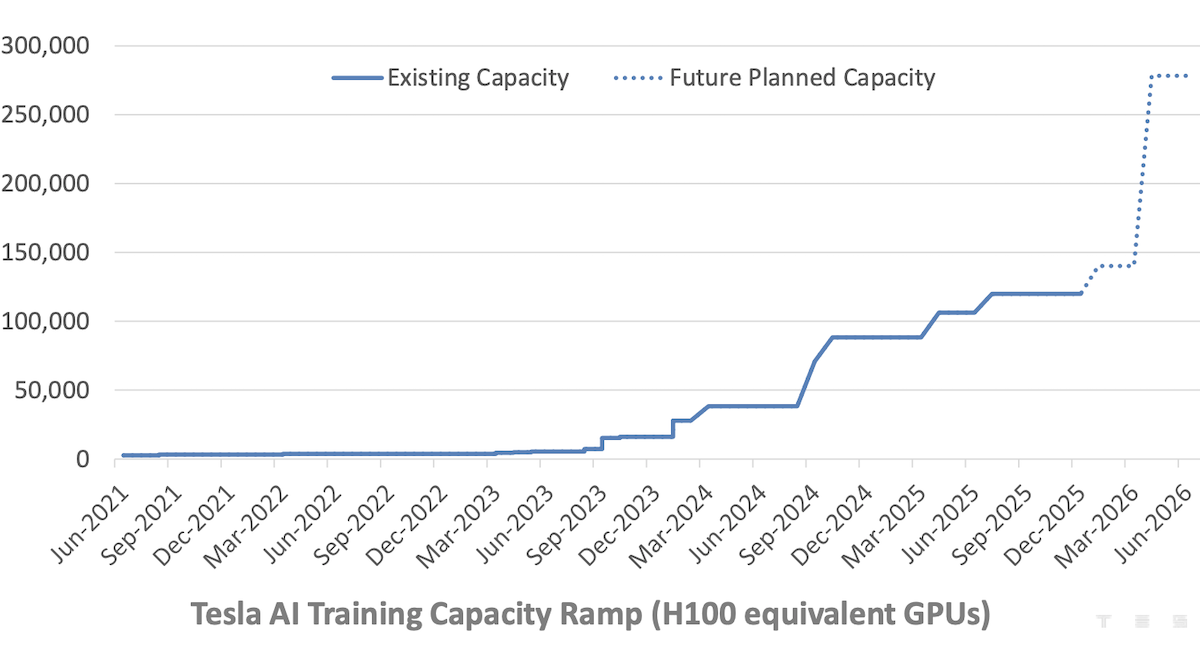
Digging into Tesla’s shareholder letter a little further, there’s more on this topic. First of all, there’s this graph:

That graph made my jaw drop and my eyes pop. You can see a significant rise in AI training capacity throughout 2025, but it’s nothing compared to what the company is projecting for 2026! How much is all of that going to cost? (And, by the way, is Tesla powering that with highly polluting fossil gas power plants?)
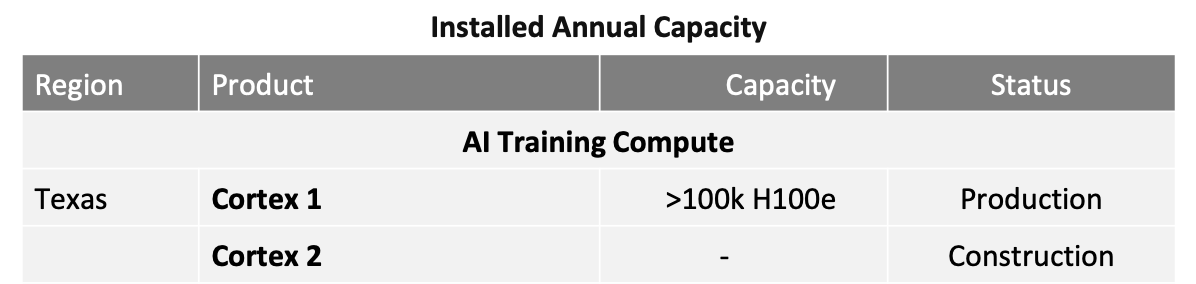
In the text portion of the shareholder letter, Tesla wrote the following under the “AI Training Compute” subheading:
“We are currently building Cortex 2 at Gigafactory Texas to further increase our AI training compute capacity. In the first half of 2026, we plan to more than double the size of onsite compute in Texas (in terms of H100 equivalents). We aim to maximize capital efficiency by scaling training compute judiciously, including when the training backlog gets too long or in anticipation of greater demand from our engineers to support our AI-related offerings.”
Catch that at the end? Clearly, this is very costly, and so the idea is that they will just expand capacity when it’s really, really needed. Apparently, they can’t really afford to expand capacity ahead of time — or, at least, that might look really bad.
Despite the hype, Tesla doesn’t yet have fully driverless robotaxis deployed without human supervisors. They’ve just removed human supervisors from a couple of cars in Austin, but there are still trailing cars with humans in them following these robotaxis. All of this rising AI compute capacity has been in an effort to get to robotaxi deployment.
Also, despite saying for about a decade that they’d basically be able to flip a switch and turn on robotaxi capability across the fleet all at once — counter to how Waymo does it, one city at a time — it appears that Tesla has to go the city-by-city route, too. It’s at one stage in Austin, another stage in San Francisco, and aims to roll out in fewer than 10 cities by the end of 2026. And remember that’s the plan according to someone who has missed such rollout targets for about a decade and who said approximately 6 months ago that Tesla robotaxis would cover around half of the US population by the end of 2025.
I said last year that it seemed Tesla was in a kind of race against time or race against itself in this regard. It needs to reach deployment soon to stimulate more vehicle sales and make more money on customer services, or else those rising AI costs are going to put the company’s finances in the negative. Of course, even that could be fine for a while, since Tesla is sitting on tons of cash, but it certainly wouldn’t be a good look or a positive thing to go from quarterly profits back to quarterly losses.
We’ll have to wait and see what Q1 2025 brings, but I think we can count on those operating expenses continuing to rise.
Oh yeah, then there’s also Tesla’s $2 billion coming investment xAI, despite TSLA shareholders voting against it in 2015. That’s another story, though.
Support CleanTechnica via Kickstarter

Sign up for CleanTechnica’s Weekly Substack for Zach and Scott’s in-depth analyses and high level summaries, sign up for our daily newsletter, and follow us on Google News!
Have a tip for CleanTechnica? Want to advertise? Want to suggest a guest for our CleanTech Talk podcast? Contact us here.
Sign up for our daily newsletter for 15 new cleantech stories a day. Or sign up for our weekly one on top stories of the week if daily is too frequent.
CleanTechnica uses affiliate links. See our policy here.
CleanTechnica’s Comment Policy
