


Support CleanTechnica’s work through a Substack subscription or on Stripe.
Or support our Kickstarter campaign!
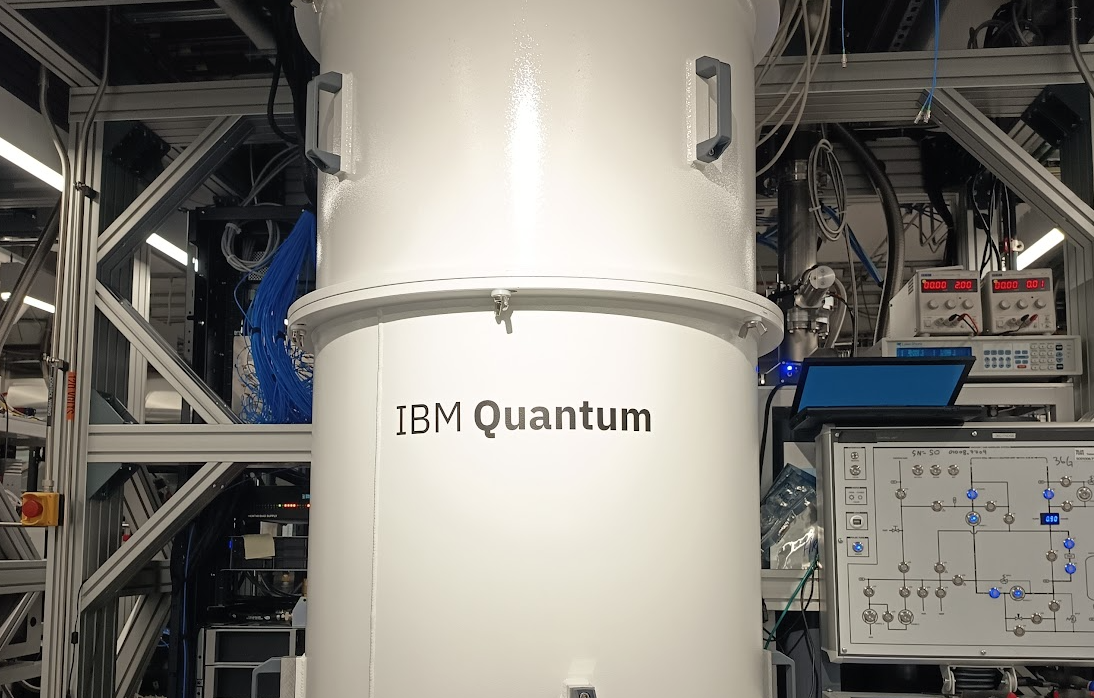
I visited IBM’s headquarters in Yorktown last December, arriving just after a snowstorm had rolled through the Hudson Valley. The timing was fitting. Quantum computing, like winter weather, is something people talk about constantly but many don’t experience directly.
At IBM’s Quantum Technology labs, you can at least hear the system’s pulse — literally — and see how far the company has pushed past theoretical promise toward something operational.
IBM’s latest step is the Nighthawk processor, a 120-qubit system unveiled in November 2025 that now anchors the company’s roadmap toward fault-tolerant quantum computing. Unlike earlier generations designed primarily to demonstrate feasibility, Nighthawk is explicitly engineered for scaling depth — not just qubit count — which is where most quantum roadmaps quietly break down.
The processor is paired with IBM’s Loon chip, designed for error isolation rather than brute-force correction. This matters because noise and decoherence remain the fundamental constraints on quantum usefulness. Instead of pretending those problems disappear at scale, IBM is attempting to localize failure and keep the rest of the system productive — a more realistic strategy for near- and mid-term applications.
Together, Nighthawk and Loon underpin IBM’s target of reaching 1,000 logical qubits by 2028, tightly integrated with classical high-performance computing. This hybrid approach is not a concession; it is an admission that quantum computing will not replace classical systems, but selectively augment them where combinatorial complexity overwhelms GPUs and CPUs.
Scaling strategy
Technically, Nighthawk uses a square lattice topology, enabling each qubit to connect directly to four neighbors. This allows quantum circuits of up to 5,000 two-qubit gates — roughly a 30% increase in circuit depth over IBM’s previous Heron processors. IBM plans to push that limit to 7,500 gates by late 2026 and 10,000 by 2027, assuming error isolation performs as advertised.
That emphasis on gate depth is more meaningful than headline qubit numbers. For cleantech applications — materials science, electrochemistry, nuclear modeling — shallow circuits are useless. If you cannot maintain coherence long enough to explore complex state spaces, the theoretical advantage never materializes.
By late 2025, Nighthawk systems are expected to become accessible to select users through IBM’s Quantum Network, signaling IBM’s transition toward what it calls “quantum-centric supercomputing.” In practice, this means QPUs handling tightly scoped subproblems while classical GPU clusters do the heavy lifting elsewhere. IBM is targeting early demonstrations of quantum advantage by 2026 — not general superiority, but narrow wins that justify integration.
Longer-term plans include fault-tolerant systems exceeding 1,000 qubits, fabricated on 300-mm wafers for yield improvement and assembled into modular, networked architectures. Partnerships with companies like Cisco point toward distributed quantum systems spanning multiple data centers — a vision that aligns more with infrastructure planning than lab experimentation.
IBM Heron: proof of concept
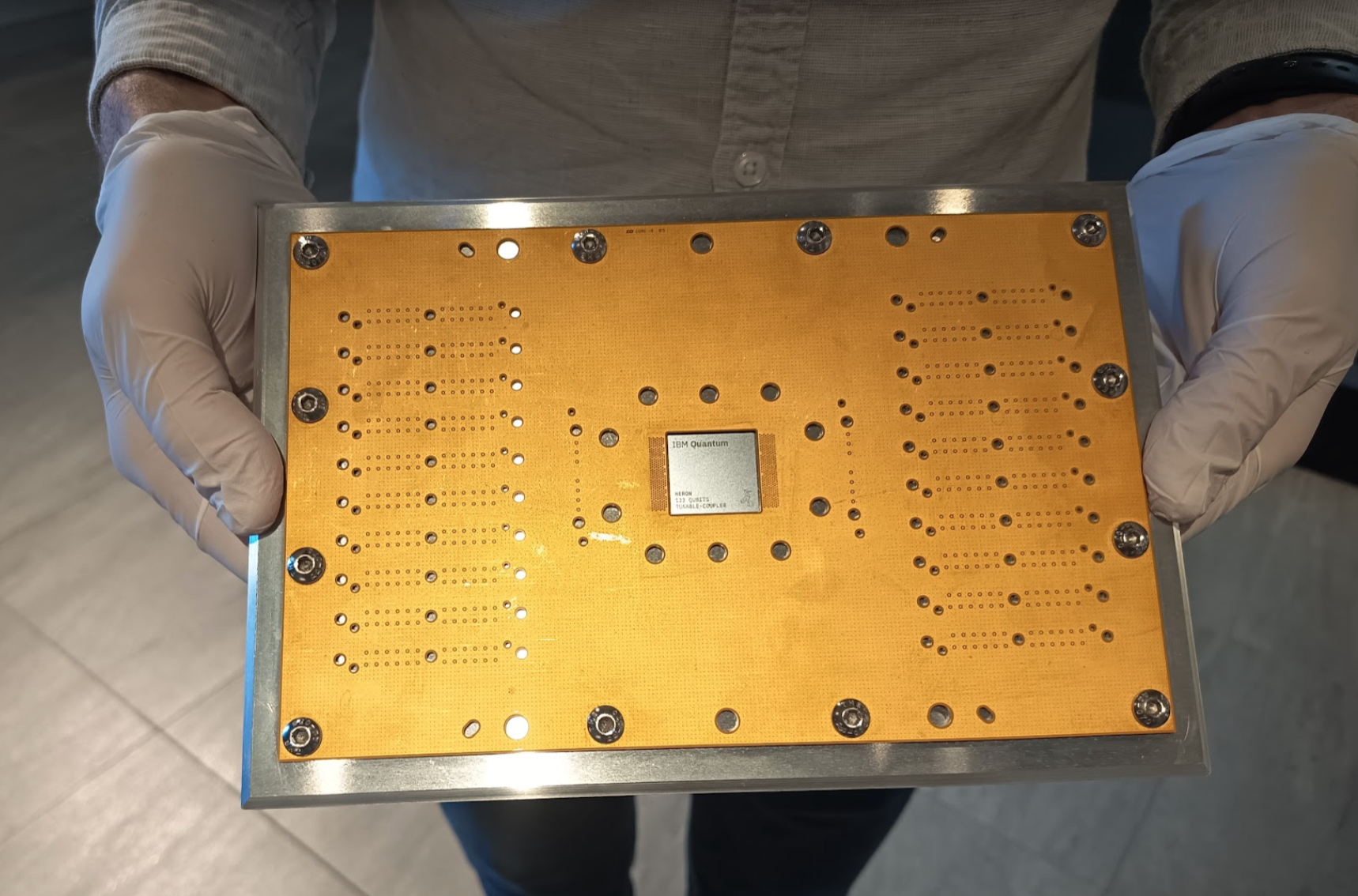
IBM Heron is a 133-qubit superconducting quantum processor introduced by IBM in 2023 as a pivot away from headline-driven qubit scaling toward higher-fidelity, more controllable quantum hardware. Rather than chasing raw size, Heron focused on improving gate accuracy and stability, making it better suited for short, well-defined quantum circuits. It marked IBM’s transition from laboratory experimentation toward early, utility-oriented systems that could be meaningfully integrated with classical computing.
At the same time, Heron exposed the limits of that approach. Despite improved fidelity, it is not fault-tolerant and cannot sustain the deep quantum circuits required for most industrial and cleantech applications. Error rates and decoherence still cap usable circuit depth, reinforcing a critical lesson for the sector: qubit count alone does not unlock quantum advantage. That realization directly informed IBM’s shift toward processors like Nighthawk, which prioritize circuit depth and error isolation — a necessary step if quantum computing is ever to impact energy, materials, and climate-relevant research at scale.
Where quantum might matter for cleantech
The cleantech relevance of quantum computing hinges on one question: does it materially compress R&D timelines in places where physics, chemistry, and systems interactions defeat classical simulation?
In photovoltaics, quantum systems can model molecular degradation pathways and defect propagation under variable climate conditions — problems that scale poorly on classical machines. This is particularly relevant for Asia-Pacific deployments, where heat, humidity, and land scarcity push developers toward agrivoltaics and other dual-use configurations.
In nuclear energy, quantum algorithms can explore neutron interactions and fission dynamics at resolution levels that remain computationally prohibitive today. This could improve reactor safety modeling and, eventually, fusion research — though timelines here remain long and speculative.
Fuel cells and electrolyzers are more immediate candidates. Catalyst discovery, electrolyte optimization, and membrane stability are fundamentally quantum-mechanical problems. If quantum systems reduce platinum loading or extend catalyst lifetimes, the impact on green hydrogen economics would be real — not academic.
Battery research sits somewhere in between. Quantum simulations can explore lithium-ion degradation pathways and solid-state electrolyte behavior far more efficiently than classical methods. IBM cites simulations involving thousands of variables — such as those conducted with BMW — completing in minutes instead of geological timescales. Whether that translates into commercial breakthroughs depends less on compute speed than on how well those insights integrate into manufacturing constraints.
Industry partnerships
IBM’s partner ecosystem provides early signals, about enough proof, of quantum’s cleantech relevance.
BMW Group has worked with IBM on quantum tools for years, applying them to supply-chain optimization, powertrain efficiency, and fuel-cell modeling. BMW’s broader quantum strategy also includes Nvidia, Classiq, and Pasqal — suggesting diversification rather than full commitment to any one platform.
Airbus uses IBM’s systems for hydrogen aircraft research under its ZEROe program, modeling storage and combustion to meet future emissions targets. Other partners reportedly include ExxonMobil for carbon-capture modeling and national laboratories studying grid-scale renewables, though details remain limited.
IBM acknowledges the remaining barriers: error rates are still too high for production-critical workflows, and most cleantech firms lack internal quantum expertise. The company’s response — Qiskit and a rapidly expanding Quantum Network — is an attempt to build a developer ecosystem before the hardware fully matures.
The sober takeaway
Quantum computing will not “solve” climate change, and it will not replace classical supercomputing this decade. But if IBM’s roadmap holds, it may meaningfully shorten development cycles for batteries, electrolyzers, nuclear systems, and advanced materials — areas where incremental gains compound across the energy system.
For a 1.5°C pathway, that distinction matters. Faster iteration in chemistry and materials science can unlock cost declines that policy alone cannot force. IBM’s Nighthawk does not guarantee that outcome — but it is one of the first quantum platforms that treats cleantech as an engineering problem, not a marketing slide.
Support CleanTechnica via Kickstarter

Sign up for CleanTechnica’s Weekly Substack for Zach and Scott’s in-depth analyses and high level summaries, sign up for our daily newsletter, and follow us on Google News!
Have a tip for CleanTechnica? Want to advertise? Want to suggest a guest for our CleanTech Talk podcast? Contact us here.
Sign up for our daily newsletter for 15 new cleantech stories a day. Or sign up for our weekly one on top stories of the week if daily is too frequent.
CleanTechnica uses affiliate links. See our policy here.
CleanTechnica’s Comment Policy
