


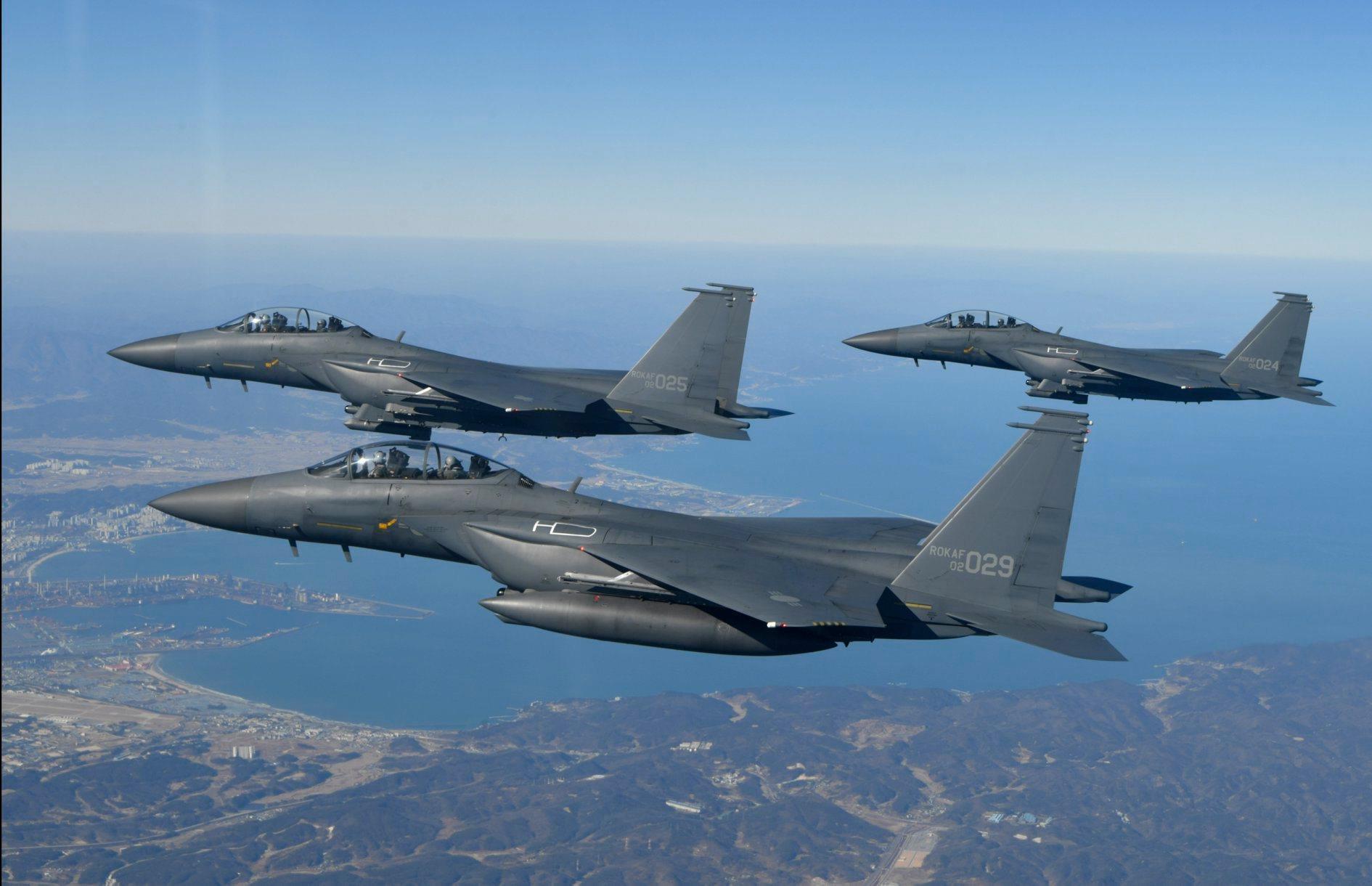
South Korea is moving to upgrade the ROKAF’s F-15K Slam Eagle fleet to a configuration similar to the F-15EX Eagle II, significantly enhancing its long-range strike and survivability capabilities.
Boeing has been awarded a contract for the upgrade of the Republic of Korea Air Force’s (ROKAF) F-15K Slam Eagle fleet. The development follows the launch of the upgrade program in 2022 by the Defense Acquisition Program Administration (DAPA) the approval of a Foreign Military Sale (FMS) by the U.S. in November 2024.
The Slam Eagles are the mainstay of the Republic of Korea Air Force’s (ROKAF) multirole missions, with a particular ‘heavy hitting’ long-range strike role. According to the available data, the country operates 59 F-15Ks out of 61 which were initially fielded in 2005.
The Upgrade
The contract, worth $2.806 billion, covers “the design and development of an integrated suite of aircraft systems to support modification of the F-15K,” reads the notice published by the U.S. Department of Defense. The U.S. Air Force Life Cycle Management Center is mentioned as the contracting activity, acting on behalf of the ROKAF and DAPA.
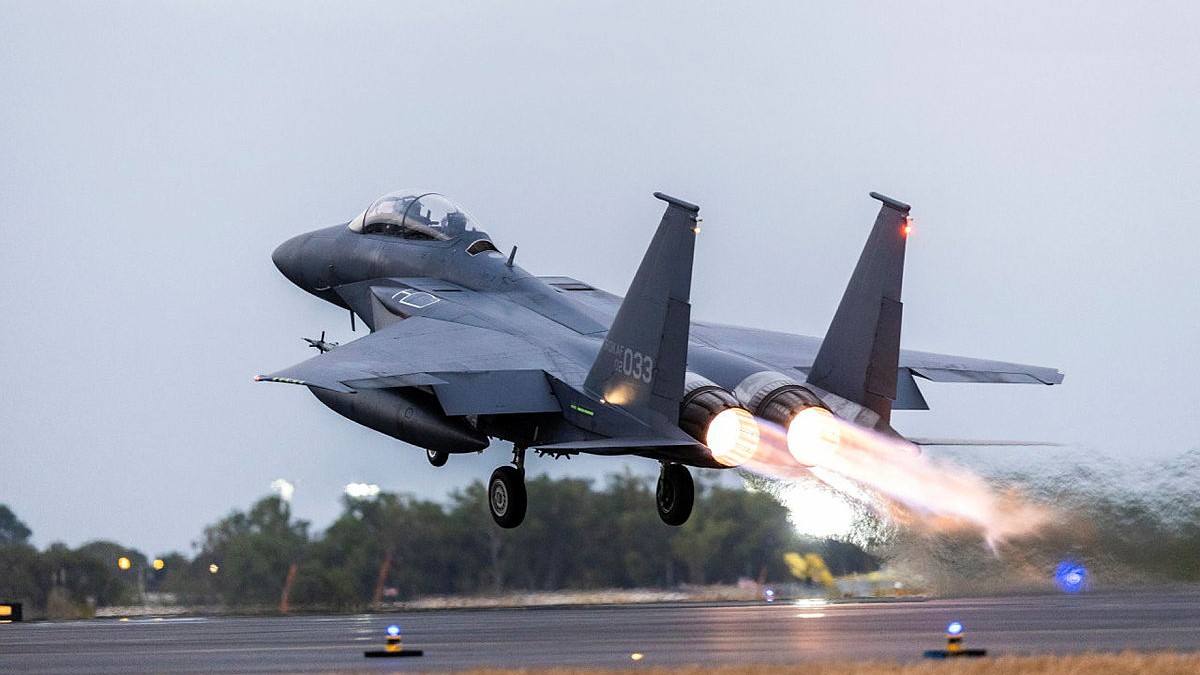
The notice further mentions that the work will be performed at Boeing’s facilities in St. Louis, Missouri, and is expected to be complete by Dec. 31, 2037. The timeline is broadly in line with what was initially planned by the DAPA, from 2024 to 2034, taking also into account the delay in the contract award.
The FMS authorized in 2024 mentioned an estimated cost of $6.2 billion, which would include both the design and development covered by the contract awarded to Boeing and the equipment and work for the upgrade of the aircraft.
As part of DAPA’s program, the Defense Security Cooperation Agency’s (DSCA) FMS notice says a number of components were requested for the upgrade, including 96 Advanced Display Core Processor II (ADCP II) mission system computers, 70 AN/APG-82(v)1 Active Electronically Scanned Arrays (AESA) radars, seventy 70 AN/ALQ-250 Eagle Passive Active Warning Survivability System (EPAWSS) electronic warfare (EW) suites and 70 AN/AAR-57 Common Missile Warning Systems (CMWS).
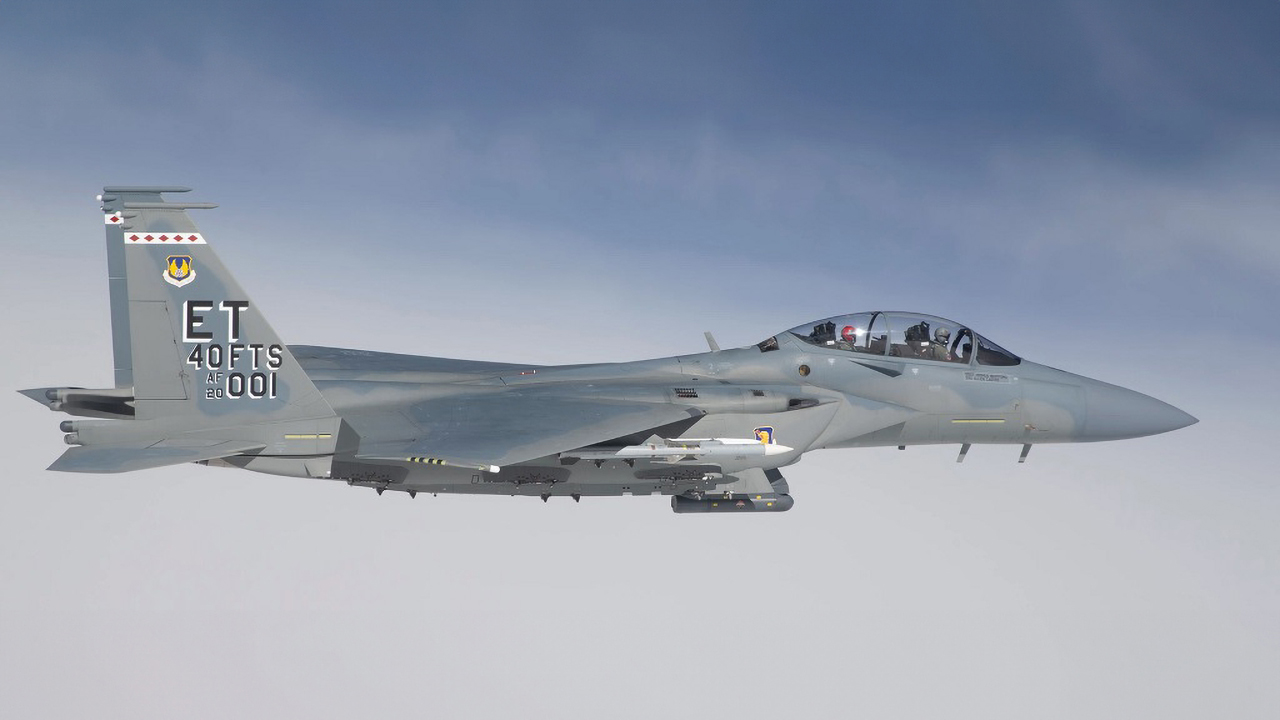
The components included in the sale indicate that the ROKAF intends to upgrade its entire fleet of F-15Ks to a configuration similar to the new F-15EX Eagle II currently being delivered to the U.S. Air Force. Interestingly, the Korean configuration will also include the CMWS, currently not installed on the EX, so the F-15K will also require some structural modifications to add the blisters on each side of the canopy rail where the sensors are installed.
The inclusion of aerial refueling support and aircraft ferry support in the FMS notice suggested that at least the initial aircraft could be ferried to the United States for the modifications before the rest are modified in country. The mention of the work to be conducted in St. Louis further points to that possibility.
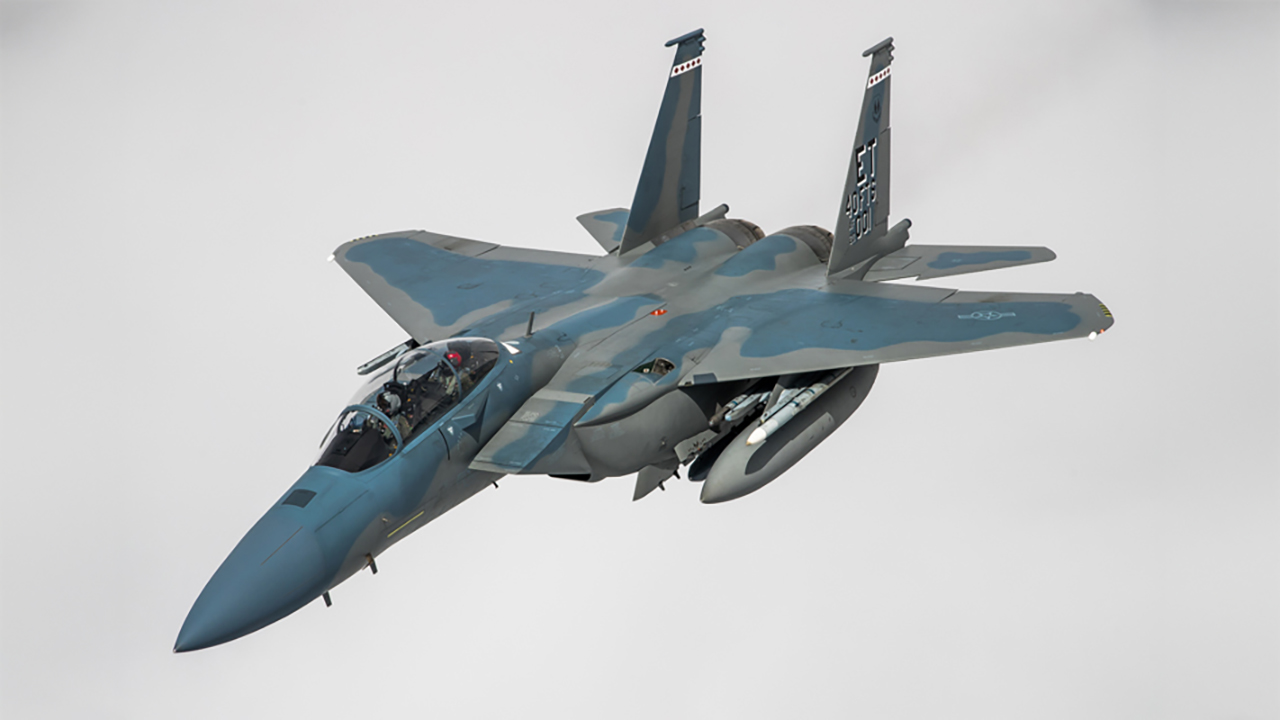
The F-15K Slam Eagle
The F-15K is a variant of the F-15E Strike Eagle built for the Republic of Korea Air Force’s (ROKAF) with almost half of the components manufactured locally. The aircraft emerged as the winner of the F-X fighter program against the Rafale, Typhoon and Su-35 in 2002, resulting in an order for 40 F-15s equipped with General Electric F110-129 engines. In 2005, a second order for 21 aircraft equipped with Pratt & Whitney F100-PW-229 engines was signed.
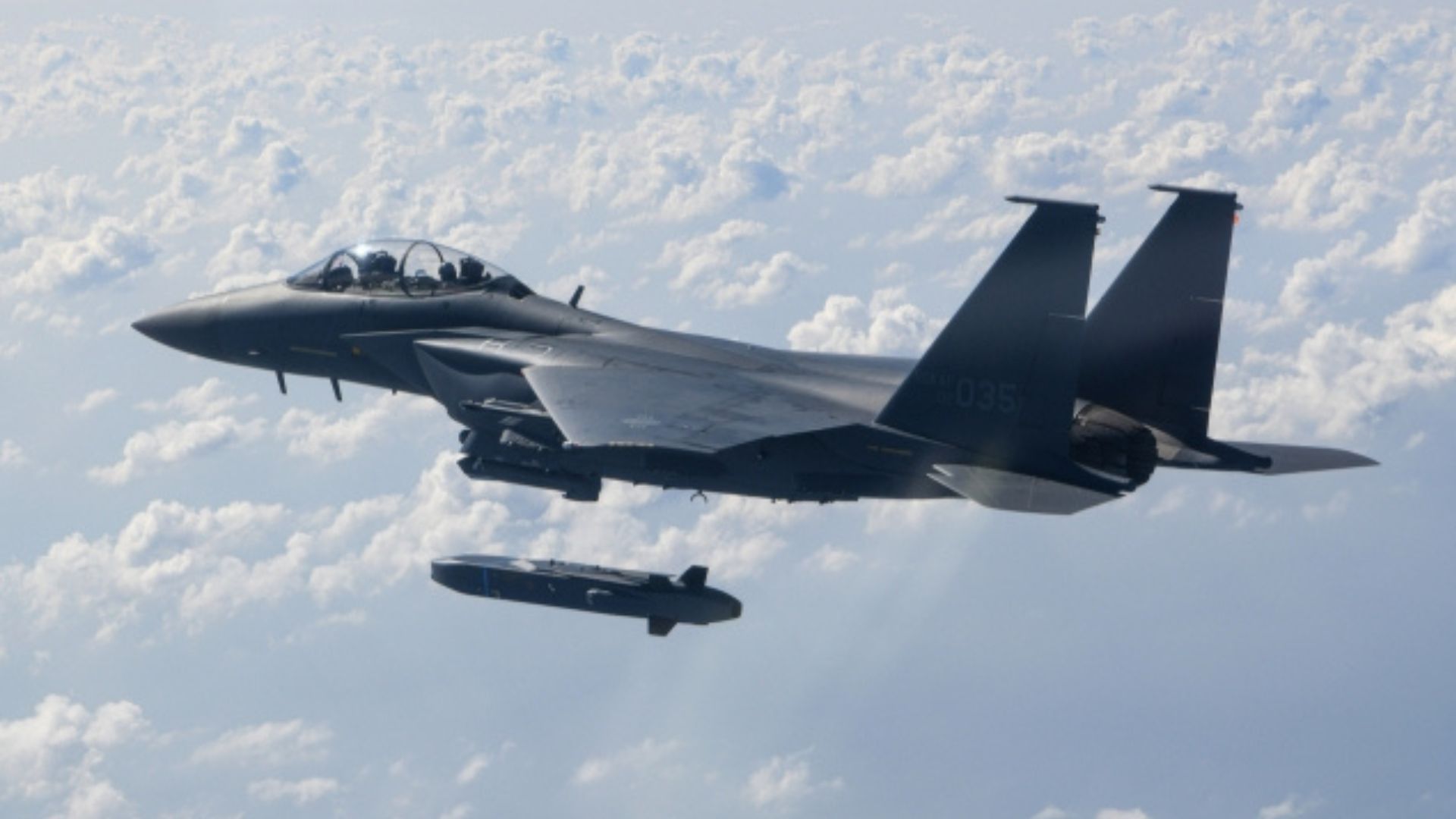
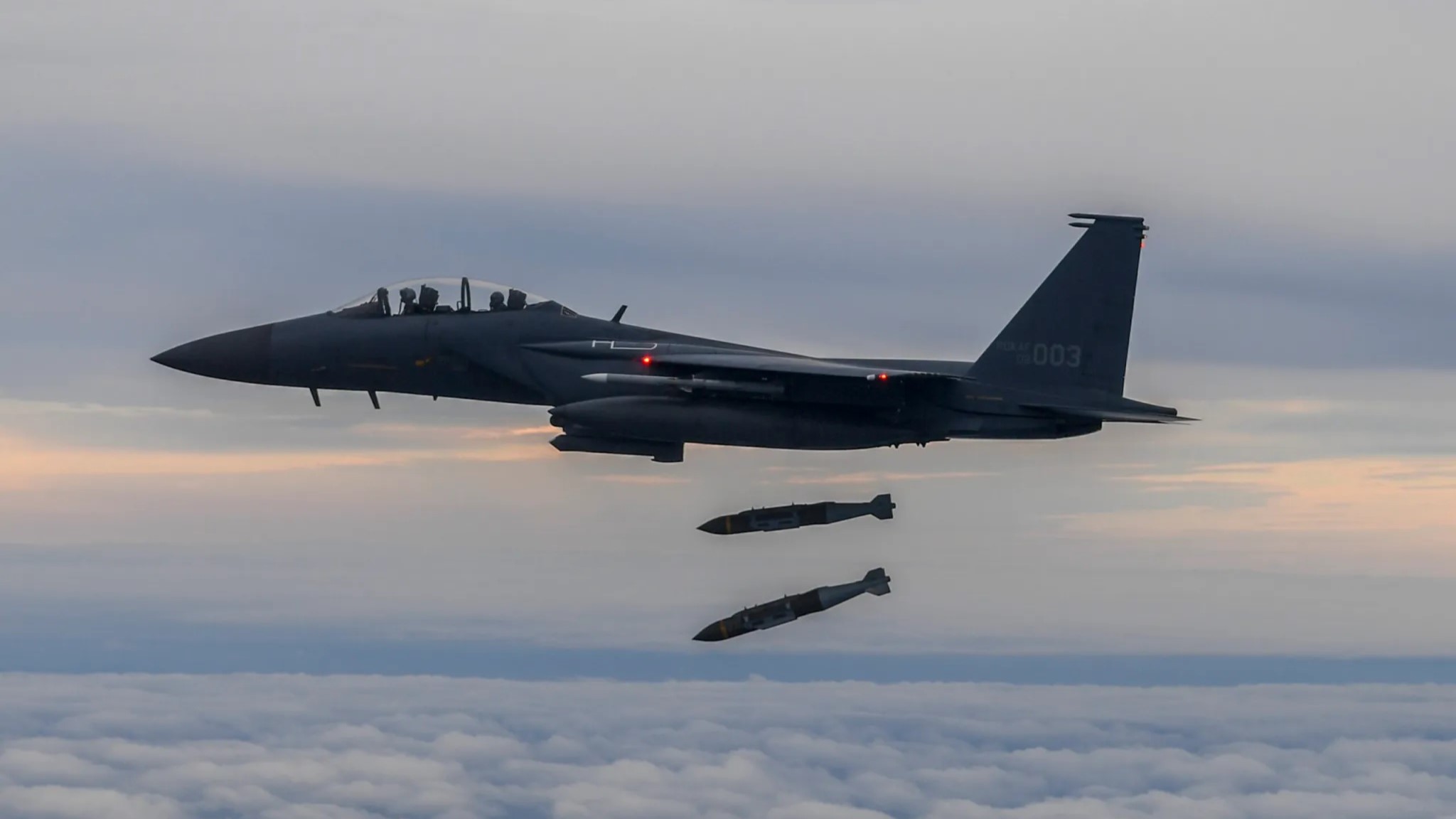
The Slam Eagle name is derived from the F-15K’s capability to employ the AGM-84H SLAM-ER standoff cruise missiles, with the Taurus KEPD 350K being another weapon exclusive to the ROKAF jet. The F-15K is employed as a fully multi-role aircraft and is considered ad one of the key assets of the Korean armed forces.
With the aircraft averaging an age of 16 years and expected to be in service until 2060, the Defense Acquisition Program Administration (DAPA) launched in 2022 an upgrade program for the F-15Ks. The upgrade, expected to run from 2024 to 2034, is committed to strengthening the mission capabilities and survivability of the jet.
The F-15K currently equips three squadrons at Daegu Air Base, in the southeast of the country. Although based far from the demilitarized zone (DMZ), the F-15K with its SLAM-ER and KEPD 350 missiles can still hit strategic targets deep behind North Korean borders.
The F-15EX-Derived New Capabilities
It is not yet clear if the F-15K will receive a new cockpit, since its configuration will be similar to the Eagle II. In fact, the F-15EX has a full glass cockpit equipped with a 10×19-inch touch-screen multifunction color display and JHMCS II both in the front and rear cockpit, Low Profile HUD in the front, stand-by display and dedicated engine, fuel and hydraulics display, in addition to the standard caution/warning lights, switches and Hands On Throttle-And-Stick (HOTAS) control.
Either way, the systems will be powered by the Advanced Display Core Processor II, reportedly the fastest mission computer ever installed on a fighter jet, and the Operational Flight Program Suite 9.1X, a customized variant of the Suite 9 used on the F-15C and F-15E, designed to ensure full interoperability of the new aircraft with the “legacy Eagles”.
The F-15K will be equipped with the new AN/APG-82(V)1 Active Electronically Scanned Array (AESA) radar. The radar, which has been developed from the APG-63(V)3 AESA radar of the F-15C and the APG-79 AESA radar of the F/A-18E/F, allows to simultaneously detect, identify and track multiple air and surface targets at longer ranges compared to mechanical radars, facilitating persistent target observation and information sharing for a better decision-making process.
The AN/ALQ-250 EPAWSS will provide full-spectrum EW capabilities, including radar warning, geolocation, situational awareness, and self-protection to the F-15. Chaff and flares capacity will be increased by 50%, with four more dispensers added in the EPAWSS fairings behind the tail fins (two for each fairing), for a total of 12 dispenser housing 360 cartridges.
EPAWSS is fully integrated with radar warning, geo-location and increased chaff and flare capability to detect and defeat surface and airborne threats in signal-dense and highly contested environments. Because of this, the system enables freedom of maneuver and deeper penetration into battlespaces protected by modern integrated air defense systems.
The AN/AAR-57 CMWS is an ultra-violet based missile warning system, part of an integrated IR countermeasures suite utilizing five sensors to display accurate threat location and dispense decoys/countermeasures. Although CMWS was initially fielded in 2005, BAE Systems continuously customized the algorithms to adapt to new threats and CMWS has now reached Generation 3.
The Timing of the F-15K Upgrade
The upgrade of the F-15K is part of a broader modernization of the ROKAF’s fighter fleet. In fact, the service is also upgrading its KF-16s Block 52 to the V configuration, integrating a new AESA radar, mission computer, self-protection suite, with works expected to be completed by 2025.
These programs complement the acquisition of the F-35A Lightning II and the KF-21 Boramae. The upgrades would allow improved interoperability and effectiveness in today’s combat scenarios.
The decision to upgrade the F-15K comes as South Korea faces an increasingly complex threat environment driven by North Korea’s expanding ballistic missile arsenal and China’s rapidly modernizing air force. The scale of the modernization effort suggests South Korea intends to keep the Slam Eagle relevant for high-end conflict well into the 2040s and potentially beyond.
The Slam Eagle remains the ROKAF’s primary long-range strike platform capable of carrying heavy stand-off weapons such as the Taurus KEPD 350 and SLAM-ER. While Seoul is acquiring more advanced fighters such as the F-35A and the indigenous KF-21 Boramae, these currently lack a similar stand-off capability in ROKAF’s service.
However, the KF-21 is expected to be equipped with the new Korea Air-Launched Cruise Missile (KALCM) as part of the expanded air-to-ground capabilities which will be brought by the Block 2 variant. According to reports, the initial air-to-ground capability is expected to be applied to mass-produced KF-21 aircraft starting in 2027.
Future
The combination of the new ADCP II mission system computers, APG-82 AESA radar, EPAWSS electronic warfare suite and CMWS sensors will significantly enhance the F-15K’s ability to operate in heavily contested environments, including against modern integrated air defense systems.
This could enable the F-15K to assume a larger supporting role when working in conjunction with the F-35A, especially in standoff strike missions where the Slam Eagle could act as missile truck. Among the aspects that would be critical in such scenarios is the improved capability to share data with other assets for improved situational awareness and targeting capability.
Also, by aligning the F-15K’s configuration closely with the U.S. Air Force’s F-15EX Eagle II, South Korea would maximize interoperability with American forces operating in the region. In fact, as the F-15EX will be soon deployed to Kadena Air Base, Japan, this would not only simplify joint training and logistics, but also strengthen combined strike capabilities in a potential regional contingency and the ability to deploy the F-15EX in South Korea.
