


Support CleanTechnica’s work through a Substack subscription or on Stripe.
Or support our Kickstarter campaign!
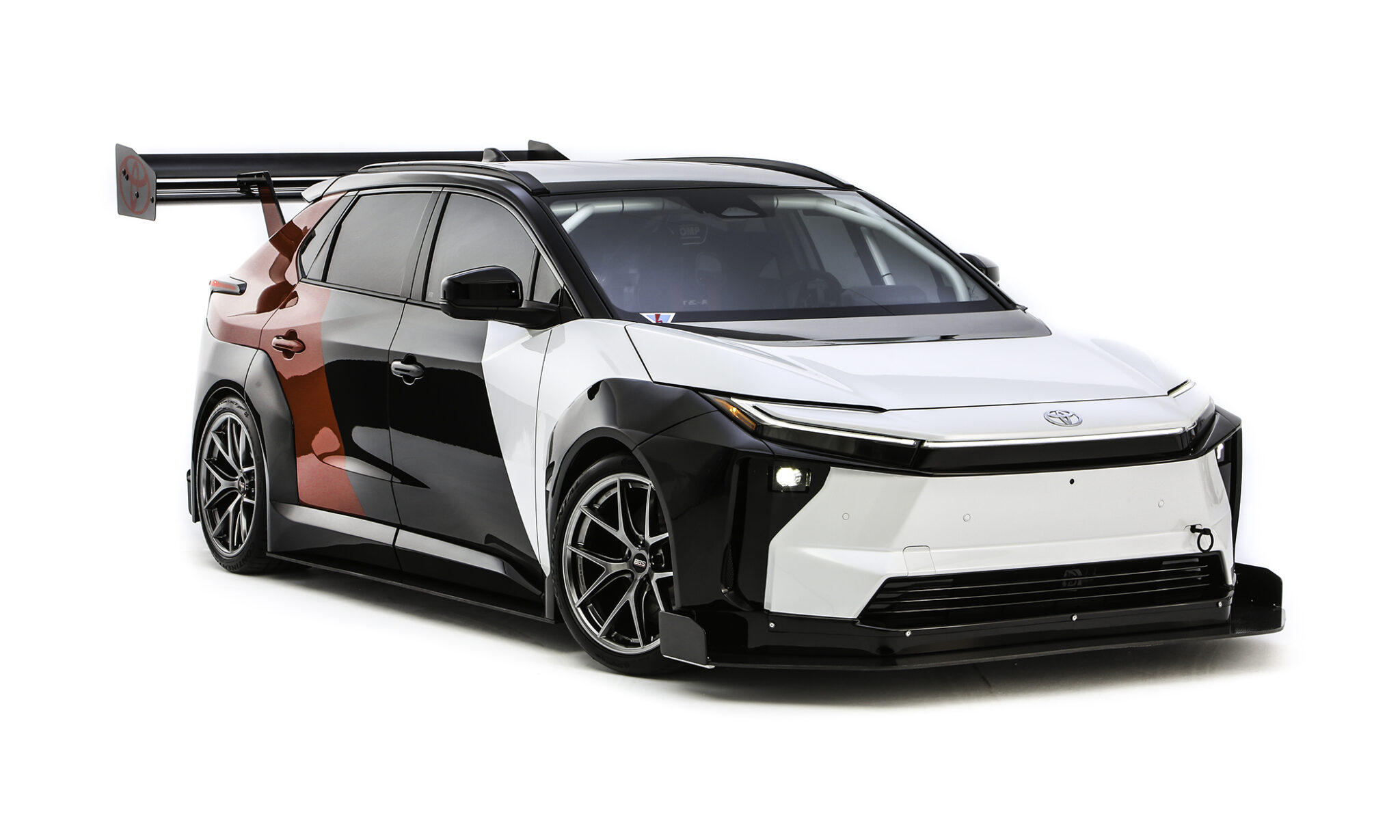
At the 2025 SEMA Show, Toyota presented a battery-electric concept car that signals how the company is thinking about motorsport in an electric future. The bZ Time Attack Concept was developed not as a styling exercise, but as a functional prototype to evaluate how a BEV platform behaves under racing conditions such as time attack and hill climb events.
Toyota describes the project as an engineering study rather than a competition entry. The car was built to test sustained power delivery, thermal management, chassis rigidity, and aerodynamic efficiency — areas that become more complex when batteries and electric motors replace internal combustion engines.
The concept is based on the upcoming 2026 all-wheel-drive bZ platform. In production form, the AWD bZ produces 338 horsepower and accelerates from 0 to 60 mph in under five seconds. For this prototype, Toyota engineers recalibrated the dual-motor system and control electronics to deliver more than 300 kW, or over 400 horsepower, focusing on short-duration performance rather than road-car efficiency.
Unlike production EVs, where packaging and ride height prioritize comfort and range, the Time Attack Concept was engineered around motorsport constraints. Ride height was reduced by approximately six inches, the track widened significantly, and the chassis reinforced with a full FIA-spec chromoly roll cage. Suspension and braking hardware were adapted from Toyota’s existing circuit-racing programs, including components previously used in one-make and touring car series.
Aerodynamics presented a particular challenge. EV platforms require careful airflow management to balance cooling needs for batteries and motors while minimizing drag. Toyota addressed this by developing a bespoke widebody and aero package using laser scanning, CAD modeling, and large-scale 3D printing. Fender extensions, splitters, side skirts, and a rear wing were digitally designed, prototyped, and finished by hand to achieve precise fitment and structural integrity.
The project also served as a trial for additive manufacturing within Toyota’s motorsports workflow. Rapid prototyping allowed the team to iterate designs quickly, reducing development time while maintaining race-grade tolerances. According to Toyota, this process is likely to influence how future motorsport and concept vehicles are developed, particularly as EV architectures demand more custom solutions.
Toyota has not announced any competitive debut for the bZ Time Attack Concept, nor has the vehicle been recorded as running in sanctioned motorsport events to date. Its role is explicitly developmental. Engineers are using it to collect data on battery behavior under repeated high-load operation, aerodynamic stability at speed, and the interaction between electric power delivery and chassis dynamics.
In earlier reports reaching CleanTechnica, there were plans to do track testing of the engineering unit for the bZ Time Attack, but this has not yet happened. The company says insights from the project will inform future EV development, including both road cars and potential racing applications. Toyota’s Gazoo Racing (GR) Team will be responsible for the bZ Time Attack Concept testing, we are told, and testing parameters for its battery-electric platforms are now being evaluated as serious performance tools rather than conceptual novelties.
Historically, Toyota already has a racing pedigree in EVs. A prototype RAV4 EV competed and won in a Scandinavian rally, demonstrating the viability of the platform before it was widely released.
Support CleanTechnica via Kickstarter

Sign up for CleanTechnica’s Weekly Substack for Zach and Scott’s in-depth analyses and high level summaries, sign up for our daily newsletter, and follow us on Google News!
Have a tip for CleanTechnica? Want to advertise? Want to suggest a guest for our CleanTech Talk podcast? Contact us here.
Sign up for our daily newsletter for 15 new cleantech stories a day. Or sign up for our weekly one on top stories of the week if daily is too frequent.
CleanTechnica uses affiliate links. See our policy here.
CleanTechnica’s Comment Policy
