


Support CleanTechnica’s work through a Substack subscription or on Stripe.
Or support our Kickstarter campaign!
A voiceover previewing a new sci-fi movie narrated, “The newcomers had killed their planet, just like we are.” The ominous fiction rings true to today’s reality. US President Donald J. Trump has rejected any gesture of global climate cooperation from allies and has withdrawn the US from the Paris climate accord. He made good on his promise to Big Oil donors to expand oil and gas production. He bullies other countries to buy more US oil and gas. The pollution continues on unabated under Trump: all LNG export terminals that were fully operational at the end of 2024 violated the Clean Air Act, according to a report by the Environmental Integrity Office.
Trump is trying really, really hard to twist the truth that fossil fuels are competitive with renewables. If that were so, fossil fuels would stand alone — the US president wouldn’t have to be shilling for them instead of withdrawing permits for wind and solar projects.
Nonetheless, renewable energy is still expanding faster than fossil fuels around the world despite US policy changes, according to the International Energy Agency. In fact, the IEA suggests that oil demand could possibly peak “around 2030.” Is it naive to be hopeful about US clean energy?
Trump has done his best to stymie as many domestic renewable energy projects as possible. He’s putting pressure on energy companies to rethink the clean energy policies they embraced during former President Joe Biden’s tenure.
Sure, the Biden administration’s Inflation Reduction Act was unveiled humbly, and, as a result, its investment in electric vehicles and renewable energy did not impact voters in the 2024 US presidential election as much as it might have. Regardless, Bloomberg has reported that banks had already generated almost $3.5 billion in revenue from climate-focused financing by late 2025, compared with roughly $2.6 billion from their work with oil, gas, and coal companies. The increase in sustainable finance volumes should lead to “technological developments that will allow for the decarbonization of high-carbon sectors over the longer term,” says Bloomberg Intelligence analyst Grace Osborne.
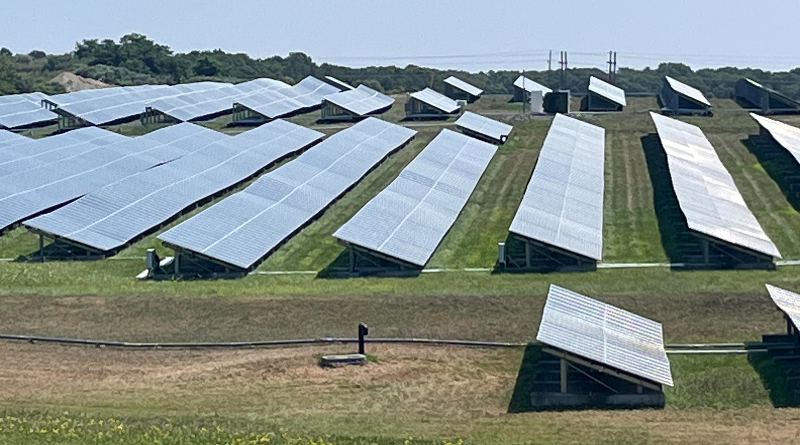
Wind and solar energy are now the least expensive sources of energy, bringing cleaner air, stronger communities, and new economic opportunities. States like Massachusetts are laying out comprehensive roadmaps for investing in and scaling climate resilience action over the coming decades.
Countries Where Renewables Are Taking The Lead
Sustainability is a subset of corporate profitability quotients and geopolitics. No longer is the power and place of renewables an either/or debate. If the US government has turned its proverbial back on renewables, that’s not the case in many other countries.
How much of South Australia’s electricity consumption is provided by renewables, do you think? 74%. Yup. And the state plans to increase that number to 100% by 2027. Wind, solar, and battery generated 100% of the state’s electricity for 99 days (27% of the time) in 2024. Wholesale electricity prices there fell in Q4 2025 to $37 AU per megawatt hour (US$26.22) — the lowest wholesale electricity price across the Australian continent. Why? It’s simple. South Australia has a lot of wind, solar, and battery power, and output was high late last year.
And we’ve all heard about how China has become a clean energy manufacturing powerhouse. With its determination to meet an absolute emissions reduction target of at least 7% by 2035. China has combined “industrial ambition, economic ambition, and scientific realism,” Isabel Hilton, retired journalist and founder of Dialogue Earth, told Inside Climate News. China built the foundational investment “in every aspect of every technology that was going to be required for renewables,” Hilton continued.
China invested $625 billion in renewable energy in 2024 — nearly a third of all clean energy funding in the entire world. According to the Center for Strategic and International Studies, China spent roughly $230 billion on EV subsidies and direct support between 2009 and 2023 alone. China is piloting a megawatt-class airborne wind platform that, during a January test, reportedly produced about 385 kilowatt-hours of electricity. The list of China’s transition to clean energy goes on and on and on…
Data Centers: Hope For Clean Energy Flexibility?
Data centers and AI are the primary culprits responsible for the rising demand for electricity. “For years, Silicon Valley symbolized progress,” Aaron Zamost wrote in an opinion piece in the New York Times. “Its retreat from its core values leaves no clear heir — no other industry fights for the future in the same way.”
It’s clear that the US is struggling to generate the energy it needs to power growth in its tech industry without including wind and solar. However, long-duration energy storage, often defined as storage capable of discharging for eight hours or more, is increasingly seen as a missing piece in the hope for clean energy replacement for fossil fuels power. These systems include a wide range of technologies, from pumped hydro and compressed air to thermal storage, flow batteries, metal-air systems, and liquid CO₂ designs.
“Long-duration energy storage is engineered to operate for eight to one hundred hours or more, which makes it uniquely capable of replacing fossil-fuel peaker plants,” Anna Siefken, director for policy and markets, North America, Long Duration Energy Storage Council, explained to Forbes this week. Unlike short duration batteries, these systems can deliver power across multiple days, support grid recovery after outages, and provide capacity during periods of low renewable generation.
Just as importantly, they allow renewable energy to be used more effectively by reducing curtailment.
With co-located storage systems being developed specifically to serve large loads, the ability to absorb power when it is plentiful and release it during periods of scarcity will increase exponentially. “Renewables are critical, but they are often underutilized because of variability,” Siefken adds. “With long duration storage in place, renewables can do their job better. They can deliver power when it’s most needed.”
As the 2026 Foley & Lardner LLP data development report outlines, strategies exist to create an ideal energy mix for data centers that can be dominated by renewables and battery storage. Strategies to capture this opportunity without getting stuck in regulatory limbo include:
- a hybrid approach where data centers try to avoid paying for the grid entirely;
- a green island microgrid in which a solar/wind facility is paired with massive battery storage that is physically disconnected from the utility grid; or,
- a virtual PPA where the data center stays on the grid, but the company builds a new renewable project at a specific location that relieves the local stress caused by their energy use.
Resources
“Banks earn more Fees from green bonds than Big Oil issuance.” Tim Quinson. Bloomberg. October 28, 2025.
“China is leaving America in the dust on clean energy.” Steve Curwood. Inside Climate News. February 14, 2026.
“Foley & Lardner LLP: 2026 data center development report.” January 28, 2026.
“Electricity prices down 30% in Australia expose idiocy of Trump’s attacks on wind, solar.” Juan Cole. Common Dreams. February 16, 2026.
“Flexible data centers soon to run on renewables and energy storage.” Anna Broughel. Forbes. February 16, 2026.
“I worked all over Silicon Valley. This is how it lost its spine.” Aaron Zamost. New York Times. November 12, 2025.
“Renewables outpace fossil fuels despite US policy shift: IEA.” Laurent Thomet and Catherine Hours. Barron’s. November 12, 2025.
“Terminal Trouble.” Environmental Integrity Project. October 2025.
Support CleanTechnica via Kickstarter
Sign up for CleanTechnica’s Weekly Substack for Zach and Scott’s in-depth analyses and high level summaries, sign up for our daily newsletter, and follow us on Google News!
Have a tip for CleanTechnica? Want to advertise? Want to suggest a guest for our CleanTech Talk podcast? Contact us here.
Sign up for our daily newsletter for 15 new cleantech stories a day. Or sign up for our weekly one on top stories of the week if daily is too frequent.
CleanTechnica uses affiliate links. See our policy here.
CleanTechnica’s Comment Policy
