


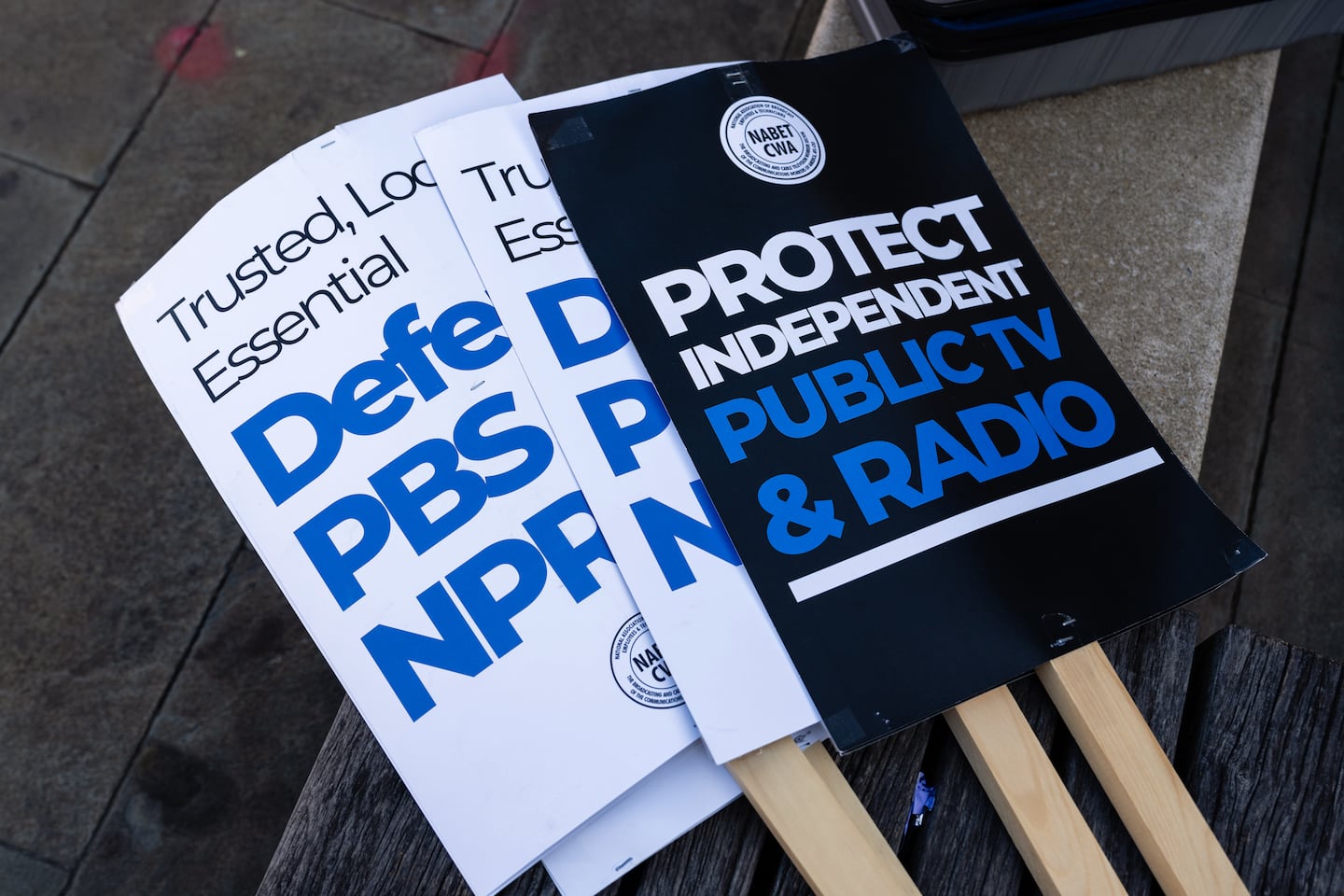
Goldberg’s remarks come as GBH, WBUR, and many other public broadcasters across the country have so far weathered the $1.1 billion in federal cuts, thanks to a surge in donations and grants. But public media executives fear that the relief is temporary and that as many as 100 or more stations could go dark. Such a contraction would put existential strain on the entire network — including larger stations such as WBUR and GBH.
That has prompted some leaders to think big about transforming their stations, including the possible consolidation of two of public media’s most prominent organizations. Boston is one of the only markets in the country with two sizable public media organizations.
Goldberg believes a merger would make “a lot of sense for the future,” but added that it “takes two to tango.” And so far, GBH doesn’t have a dance partner.
In an interview Monday, WBUR chief executive Margaret Low said that while she “will always have an open mind … there’s nothing on this front to report,” referring to a merger with GBH.
Then on Wednesday, she told the Globe in a statement that while WBUR has “no plans to merge,” she is “always open to new collaborations.”
“As you can imagine, conversations about how to navigate these uncertain times are happening all across the NPR Network and across all media,” Low added. “And those conversations should be happening.”
After this story published Thursday morning, both Goldberg and Low wrote to their respective staffs and doubled down on their beliefs about a merger, according to the messages that were obtained by the Globe. Low wrote that “WBUR and GBH have no plans to merge. Full stop.”
Goldberg, meanwhile, said she had shared in staff meetings that a merger would make sense, and felt it was important to share her belief publicly.
“By eliminating competition for donors and sponsors, and finding efficiencies in the ways we operate, a merged organization could invest even more in journalism, becoming more sustainable and making a bigger impact in the communities we serve,” Goldberg wrote. “Isn’t that the point of it all?”
Despite the noncommittal stance from WBUR, Goldberg’s belief that a merger would make sense marks a significant shift. Just two years ago, she told the Globe she didn’t “see any reason why Boston — a place like Boston, my gosh, the smartest people in the world — can’t support two wonderful news organizations like BUR and GBH.”
That has been the prevailing view among local public media leaders since 2009 when GBH committed to more local news programming on its radio station, bringing it even more directly in competition with WBUR.
While the stations compete in some areas, they also have their differences. Both are increasingly focused on digital products including podcasts, newsletters, and distributing content on YouTube, TikTok, and other platforms. Each also operates NPR news stations and oversees local newsrooms. The stations diverge in that GBH is the largest producer of PBS television programs in the country, whereas WBUR focuses largely on audio.
Additionally, some public media executives and observers believe that having multiple choices is better for audiences, but only if each is sustainable and continues to serve the public.
“Capitalists understand this: more is more,” said Josh Shepperd, an associate professor at the University of Colorado who is co-writing an official history of public media. “In the end, what’s good for public media is more access.”
But he warned that as stations lean more on donors and corporate sponsors to survive, it could undermine their noncommercial and community-based public mission.
Only a small portion of the annual income for both stations — 8 percent for GBH and 3 percent for WBUR — came from the now-defunct Corporation for Public Broadcasting, meaning the loss of those funds is not going to force either to shut anytime soon.

Both stations are on sound short-term footing. After layoffs two years ago at WBUR, and cutbacks for the past two years at GBH, neither station anticipates needing to make cuts as they approach the end of the June 30 fiscal year.
Goldberg said GBH has added 40,000 new members since launching a $225 million funding campaign in October. Low said WBUR has received donations from thousands of new supporters plus additional funding from thousands of existing members.
“When Congress cut all our federal funding, Boston stepped up,” Low said. “The important thing for us to convey, and it’s difficult, is that this isn’t a one-time fix. We need people in our corner for the long haul.”
The future is weighing heavily on the minds of both stations’ leaders.
The uncertainty facing smaller stations in more rural areas poses a threat to the entire network of public stations.
The nonprofit Public Media Company lists 115 organizations that it says are at risk of shutting down, and has committed $31 million so far to stations through a bridge fund supported by philanthropic groups such as the Knight Foundation and Barr Foundation.
That funding, however, is only temporary.
“We’re worried,” said Tim Isgitt, chief executive of Public Media Company. “We’re just trying to help everybody buy some time.”
The closure of those stations means there would be fewer to pay to carry the programming that organizations such as GBH and WBUR produce.
Traditionally, GBH and WBUR have used federal funds and revenue from sources including donors and sponsors to produce shows. National organizations such as NPR and PBS distribute those programs to local stations, which in turn use their federal money and other sources to pay for those programs through member fees.
Now, that network will have to continue without federal funds.
Low said WBUR forecasted an absolute worst-case scenario of losing half of its revenue from syndication of its national programs “Here and Now” and “On Point.” But so far, there hasn’t been a change, thanks to the short-term funding support across the network.
“We have to stay on the lookout for what will happen when those early flowing dollars disappear,” Low said.
GBH has already seen a ripple effect from the federal cuts as it now gets less from PBS for licensing its shows. Goldberg said there “is an extra layer of complexity when that federal money goes away.”
Outside of Boston, public media executives believe that consolidation of some form could make sense for many stations in order to consolidate costs such as engineering, human resources, or other expenses. Other stations have merged in recent years, including two in New England: Vermont Public, which brought together Vermont Public Radio and Vermont Public Television in 2022, and Ocean State Media, the combination of Rhode Island PBS and The Public’s Radio in 2024.
“We think there are some mergers that could take place,” Isgitt said. He added that it wasn’t only a way of reducing expenses, but also “finding new ways to serve your community.”
GBH and WBUR are both trying to find new ways of serving audiences. GBH has launched programs such as “The Curiosity Desk” and “GBH News Rooted” while also gearing up for the nation’s 250th anniversary with a new children’s show and special episodes on programs such as NOVA.
And WBUR has been doubling down on live events. That includes holding its inaugural WBUR Festival last May, which is returning again in two months. It also launched a new Breakfast Club series at CitySpace, its events venue, which opened in 2019.
The new initiatives underscore both leaders’ beliefs that they cannot afford to be complacent at a time of great uncertainty.
“I don’t really think we’ve seen the full impact of the withdrawal of $1.1 billion through the system,” Goldberg said. “The dust won’t fully settle for a little while.”
Aidan Ryan can be reached at aidan.ryan@globe.com. Follow him @aidanfitzryan.
