


Ideas54:00Why mathematics and literature have more in common than you may think
Math is everywhere — and if you look closely, it’s key to uncovering an enthralling perspective on literature, says mathematician Sarah Hart.
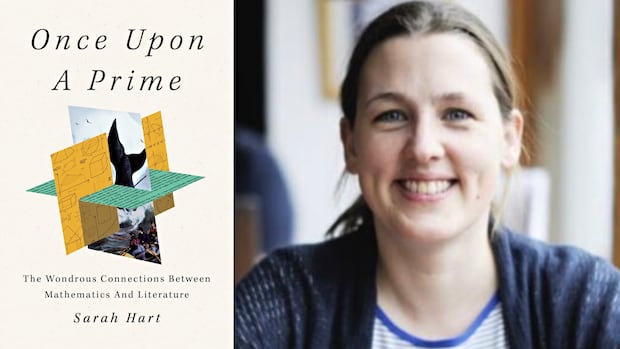
“The universe is full of underlying structure, pattern, and regularity, and mathematics is the best tool we have for understanding it,” writes Hart in her book, Once Upon a Prime: The Wondrous Connections Between Mathematics and Literature.
“That’s why mathematics is often called the language of the universe, and why it is so vital to science.”
In her book, Hart reveals a long list of literary greats who love mathematics such as James Joyce, Edgar Allan Poe and George Eliot. She also points to popular authors today who use math in their work like Chimamanda Ngozi Adichie and Michael Crichton who wrote Jurassic Park.
“Since we humans are part of the universe, it is only natural that our forms of creative expression, literature among them, will also manifest an inclination for pattern and structure,” Hart writes.
Hart is professor emerita of mathematics at Birkbeck College in London, England. She spoke to host Nahlah Ayed about how math is fundamentally creative and has always been deeply intertwined with literature.
Here is an excerpt from their conversation.
Why do so many of our most celebrated authors share these twin passions for writing and mathematics?
Well, for me, it’s because mathematics is really a key part of human creativity. Our minds, our brains delight in pattern and structure. And you see it everywhere in our forms of creative expression, whether that’s the rhythms and patterns of music with the beats that we sing along to and count along to unconsciously, or the symmetries and beautiful designs and patterns in art, or in literature those patterns and structures that authors use to give substance and delight to their work.
Literature and mathematics have these strong connections because mathematics is all about structure and pattern. It’s the language we use to describe those things. So it’s not surprising for me that the greatest literature and the greatest authors often enjoy mathematical patterns themselves.
Geometry has these idealized objects like straight lines that go on forever and circles that are absolutely perfect. Now those don’t exist in the real world. You can’t have straight lines. [They] do not go on to infinity. You can’t draw, physically, an absolutely perfect circle. They are abstract ideas, fictional things that allow you to get to a deeper truth.
And for me, literature, a great novel, It’s doing the same thing. It’s almost the same kind of process that mathematics and fiction are doing to explore and understand the world.
You describe math itself as a form of creative expression. What does creativity look like within mathematics?
Creativity within mathematics, I think, is about choosing the path that you are going to follow. Because in mathematics, you can’t do anything from nothing. You need to have some ground rules. So we call these axioms. They’re kind of the set up, the rules of the game. And then you can explore and play within those constraints. So to draw a literary analogy, if you’re gonna write a poem, you want to know, well, ‘What kind of poem shall I write — a sonnet?’ It gives you a constraint and that spurs your creativity on.
In mathematics, we have the same kind of playground that we can make. If there’s too many rules, then it becomes very boring and sterile. If there are no rules at all, we can’t get anywhere.
So mathematics is to some extent built upon constraints but it is also routinely moving beyond those constraints. You write that literature like maths allows you to ‘test the limits of imaginary worlds.’ What do those imaginary worlds look like to you?
In mathematics, it might be something like geometry where you find that you’re trying to prove things, you know, Pythagoras’ theorem, and you come up against a situation where you can’t prove the thing that you think might be true… And in mathematics, we want to take ideas to their logical conclusions and see what happens.
Actually, in literature, Lewis Carroll who was a mathematician as well as a writer, this is what he does in his stories. So in Alice in Wonderland, he has Alice go to this amazing world where she can grow and shrink by eating and drinking various different things.

If that were possible, what are the logical consequences of that? Lewis Carroll explores these ideas in a very playful way. You would be able to swim in a lake of your own tears, and that’s exactly what Alice does.
At the beginning of the story, she grows and shrinks, she grows, she cries, then she shrinks back down, and then she’s swimming around. This is a logical consequence of the axiom that you can grow and shrink, right? So it’s a kind of a mathematical way of thinking. ‘Surreal mathematics,’ I would call it.
Lewis Carroll, or Charles Dodson, was someone who absolutely throughout his life, was playful. For me, that’s the characteristic of good mathematicians as well as often good writers. So he’s playing in a kind of mathematical way, the ideas that he encounters in this invented world. That is part of mathematical thinking, you have to test ideas to their limits.
You can’t just say this seems to work, so I’m just going to assume it always works. You have to really stress-test it… and that’s what a mathematical proof ultimately is the result of doing.

In Orwell’s 1984, where two plus two equals five… this is perhaps when bad math kind of stands in for truth being stood up on its head. It actually tells a whole other story by being inaccurate. How often do you see that?
We all know that some things are universal truths. Mathematics does give you a truth, something that you can’t propagandize your way around. You can’t just decide that two plus two is five, because it isn’t. That’s a very powerful thing that we do see in writing – that mathematics is this symbol of truth and sometimes also a symbol of beauty.
In Moby Dick, Herman Melville’s novel, he includes a lot of mathematical ideas. But one of the things that Ishmael talks about as the narrator is about how wonderful and amazing the whale is as a creature, and he talks about the symmetry of it being almost like a virtue. He sees symmetry as being a proxy for goodness, and this is actually an idea that goes back thousands of years.
The ancient Greeks, philosophers like Plato, said that symmetry and very symmetrical objects must be at the heart of the universe because they’re beautiful, and because they are beautiful therefore they’re good, and them being good means the creator will use them.
They were really interested in things that were very symmetrical because they thought that’s what the universe must be made of.
*Q&A edited for clarity and length. This episode was produced by Annie Bender.
Download the IDEAS podcast to listen to the full conversation.
