Support CleanTechnica’s work through a Substack subscription or on Stripe.
By now, some of the initial buzz following Donut Lab’s CES announcement about its first production solid-state battery has subsided, and doubts it’s real have subsided. The company announced the “I Donut Believe” series, consisting of weekly third-party test results. The purpose and intention of the program was explained by CEO Marko Lehtimakki. He explained that announcing the world’s first solid-state battery in production vehicles at a price that competes with lithium-ion batteries comes with an “intense response.” The battery disrupts the entire industry.
Lehtimakki listed some of the industry responses. In particular, the “if we didn’t invent it, it doesn’t exist” argument. In the absence of information, speculation ran wild. Marko responded to some of the errant speculation. Repeated speculation spread on the internet and became fact. If you look at Wikipedia now, you can find some myths repeated there that have since been debunked by the provided tests. A Wikipedia Donut battery entry estimated cycle life of 50% to 70% capacity. It is erroneous for a variety of reasons.
Speculation has continued despite everything, and some have complained that Donut Lab should have released all the data. There are reasons why that is not happening. In short, it isn’t in Donut Lab’s best interests. Someone noted that research shows that no one reads links, so I am providing a select few comments from Marko’s series introduction along with explanation.
Why The “I Donut Believe” Series?
People said the battery is impossible and the research does not support Donut Lab’s battery claims. “That is why we are making this series,” Marko replied. “Not to argue online, and not to trade opinions, but to put measurable evidence in public view so people can separate what’s asserted, from what’s verified. So why didn’t we publish third party validation immediately?” …“If we had dropped complete third-party validation on day one, the controversy wouldn’t have ended. It would have simply moved.” He was right. He predicted that those who said the battery was not real would not admit they were wrong and that the argument would shift.
Marko revealed the core purpose in two parts. “The louder the doubts, the more difficult it is to fund scaling.” In other words, a FUD whisper campaign destroys startup competition. In essence, Donut Labs planned to set a trap, letting the biggest doubters go on record first, then showing the proof. By some measures, it succeeded in drawing the doubters into confident complacency. The plan is to counter this by showing how the rumor mill becomes “fact” once the experts have spoken. Once the facts come out, the fallacy of expert opinion becomes exposed.
He made it clear that there are powerful interests with their own agenda. Billions in energy and battery industry investment are threatened by disruptive technology. “We control the narrative.…” The purpose of the weekly test announcements is to regain control of the narrative. This does not fit the desires and agendas of everyone, not the least of which are legacy monied interests. Scientists, researchers, and curious onlookers wish they knew all the secrets, but the answers are not easy. It isn’t a binge watch that gets done in a few nights and leaves short attention spans satisfied. The truth will come when parties like Munro get their hands on a motorcycle and take it apart. That will explain what the battery ingredients are. This may not explain how the battery works or how it is made, though. Companies are reluctant to reveal proprietary information to competitors. That should require no explanation.
The Tests
The series started with fast charge, showing 11C charging and 0–80% charge in 4.5 minutes. The second test showed the device worked at 100 degrees C and still retained operation and normal charge at room temperature. During testing, the battery packaging failed, inadvertently showing that the battery was not a lithium battery with liquid electrolyte. In an indirect way, it proves the battery is solid state.
Next, a leak down test showed that it was not a supercapacitor, because discharge was slow. This was unnecessary, since the charging tests showed the charge characteristic did not match a capacitor charge curve. A capacitor charges linearly with a current source, with no bumps or dips in the profile, and the tested battery charge curve was typical of a battery with a bumpy curve. A “sneak peak” video showed the battery in a Verge motorcycle charged at 5C, faster than any production electric motorcycle and faster than any production car, while using only air cooling, a more difficult accomplishment than charging with liquid thermal management. This countered claims that it couldn’t work in a pack.
The fourth test used the battery with damaged packaging to show that further extended high temperature operation and fast charging did not result in unsafe operation or fire. After several cycles, battery capacity dropped. It is possible that the battery needs to be sealed, however, to prevent changes in performance caused by exposure to air and heat. Ricky from Two Bit DaVinci showed extensive analysis. If packaging is damaged and operation remains safe, that shows safety.
A Response to “Is Donut Lab’s Battery Lithium?”
When I wrote a story about a claim that Donut Lab’s battery was a lithium-ion battery, I expected no one would read it except for a small band of dedicated readers. I was wrong. I underestimated the response. Ryan Inis, known on the internet as Ziroth, replied. As I stated before, he is an intelligent, well educated person, and I admire his videos. I made similar comments about The Limiting Factor, Ricky from Two Bit Davinci, MissGoElectric, and Just Have a Think as well. It is reasonable to require proof in any engineering effort. I don’t blame anyone for being cautious and skeptical. I am. I spent decades designing products and have some idea of how difficult it can be. I separate cynicism and skepticism of success, because although anything that can go wrong will go wrong, engineers do make things work. A balance must be kept. Engineering design is not magic, but it is difficult. Every magic trick looks difficult when you don’t have the key. As soon as the key is available, it looks easy. Then the accomplishment tends to be forgotten. I am no less impressed after the accomplishment, because discovering how the solution was found and how it works interests me the most.
A Response to Ryan’s Video
First of all, Ryan, thank you for reading my story and for your response. I hope you don’t mind me referring to you as Ryan, and thank your for referring to me by name.
Thank you for adjusting curves to solve the battery mystery. Although we both understand that scientific and engineering inquiry must be about ideas, I do not mind being personal, cordial, and even jovial. I appreciate your courteous, friendly manner and sense of humor. Your videos are entertaining and instructive. From your tinfoil hat, I can tell that you enjoy not taking yourself too seriously. Your video has instructive explanations of the difference between cell energy density and component energy density, which I appreciate, enjoy, and recommend. I could cheerfully call my Donut Lab writing my “I do not know” series.
The Meat of The Matter
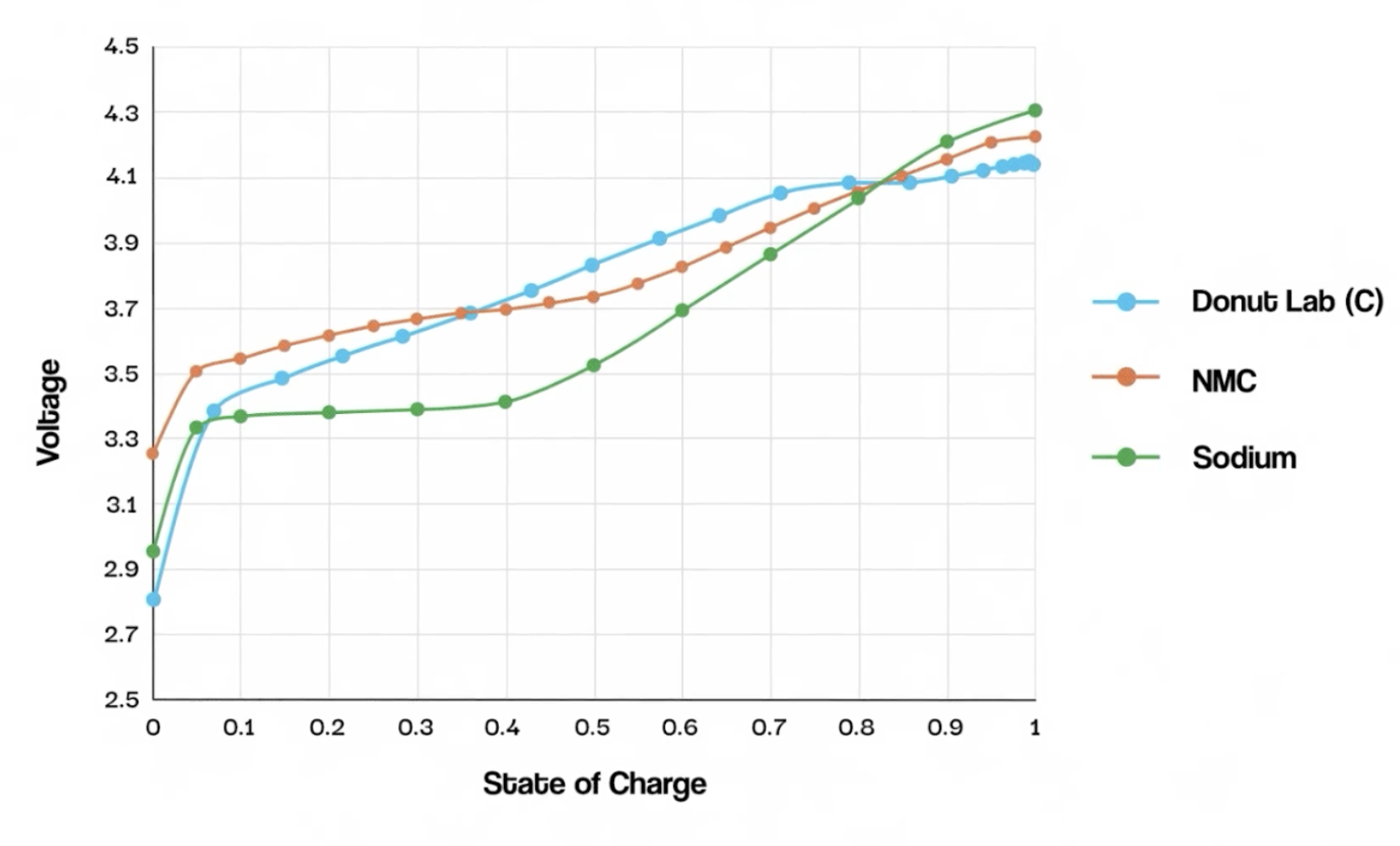
Ryan adjusted a graphic analysis comparing NMC, sodium-ion, and Donut Lab’s charge voltage versus state of charge (SOC). Correction was made to adjust Donut Lab’s parameter from time to SOC, and to account for battery series resistance to approximate battery open circuit voltage. The result shows three curves: for Donut Lab’s battery, the Naxtra sodium-ion battery, and an NMC lithium-ion battery, in Figure 1.
None of the charge voltage curves match exactly. That is the only direct conclusion I can draw from these curves. The upper voltages are set by the charger. Those voltage settings are determined in the laboratory. In a lab setting, researchers may try other upper voltages, and this may result in catastrophic cell failure, as over-voltage will destroy lithium cells. The upper voltage Donut Lab measured should have been 4.15V. One possible reason the measured voltage is not 4.15V is that full charging may not have been completed in the tests. The lower voltage inflection point is a direct indicator of internal cell physics, along with the curve’s general shape. Even among the same cell types, such as NMC, manufacturer curves vary, as do curves of same manufacturer cell types adjusted for different performance. To my eye, the Donut Lab battery curve is as close to the NMC curve as variations in NMC curves from different manufacturers for varied applications.
The CATL reinforced sodium-ion curve is not indicative of results for a sodium solid-state battery. It may be the Donut Lab battery shows the difference between a liquid electrolyte reinforced sodium-ion battery and a solid state sodium-ion battery. The upper charge voltage is determined by the well known electrochemistry rules relating to electronegativity. The cell voltage depends on pairs of substances used — for example, zinc and copper. By doing tests of each substance paired with hydrogen, each substance can have a known reference voltage versus hydrogen. If a new pair of substances is compared, the cell open circuit voltage can be obtained by adding the two reference voltages. This provides a convenient and easy way to obtain full charge cell voltages.
The explanation for discharged open circuit voltage comes from the Nernst equation:

where the funky a is activity and C is concentration. The ox and red suffixes refer to oxidation and reduction states.
The formula shows concentration changes voltage. When discharged, concentrations change within the cell resulting in altered open circuit voltage. A discussion of exact bumps and curves between full charge and discharge and other matters is beyond the scope of this venue. While Ryan believes the NMC curve more closely matches Donut Lab’s measured charge curve, the case for lithium-ion has already faded. It is no longer a case of which curve matches Donut Lab’s battery. After several tests affirmed Donut Lab’s statements, their word is a piece of the puzzle that cannot be arbitrarily dismissed. They did not ignore battery expertise when they bought Nordic Nano. There is evidence they have battery expertise in their domain.
Electrolyte Matters
Polymer is the only other common type of lithium cell electrolyte. As we know, lithium poly is in fact a solid or semi-solid battery, often using a compound such as PEG allowing ion flow. Generally, lithium poly has similar temperature and safety limitations compared to standard lithium-ion. Donut Lab states there is no lithium and it is not a lithium-ion battery. It could be a sodium-polymer battery. Lithium polymer batteries can have high energy density and are often used in drones and RC recreation devices. Cells can be flexible, and polymer allows varied shape. The sticking point with poly batteries up until recently has been low cell temperature operation. Poly batteries have displayed lower power, energy density, and cycle life at low temperatures, below 0 degrees C.
It is possible that a different electrolyte or modified polymer electrolyte changes the shape of a sodium-ion charge curve, and with a high-density, lightweight cathode increases cell energy density. Is there some other kind of solid-state electrolyte or an improved polymer electrolyte? What other cathodes beside TAQ have high energy capacity?
Thoughts, Clues
There are a few ways to address the mystery. One is by eliminating what it is not, and another is by listing what it could be. It is not any traditional cell. Performance is too high and the combination of claimed characteristics is beyond any other cell currently in practice or imagined so far. This is the cause for skepticism. Yet we know something exists and we know it has 11C charging, operates at 100 degrees C without safety risks, and returns to normal operation at full capacity. We can also look at Donut Lab’s statements and third party testing and draw a conclusion with those statements as part of the puzzle.
Test results give credence to Donut Lab’s word. We cannot merely eliminate Donut Lab’s statements like snipping off the edge of a puzzle piece to make it fit. The answer has to fit the statements, not just the available technical evidence. It is implausible that they are so technically incompetent that they do not know what the cell is made of. We cannot assume they had someone else build it and that party fooled Donut Lab. There is no reason to dismiss statements just because we cannot figure out how it works technically. After third party tests and demonstrations eliminated many critics’ claims, it is critics that need to prove themselves as much as Donut Lab.
I knew from the beginning it was not a capacitor. I knew making a pack from cells was unlikely to be insurmountable. I did have doubts regarding the most difficult battery design parameter.
Cycle Life
Some of the tests appear to show capacity recovery. This “stuck” charge phenomenon happens with solid-state electrolytes. Assessing cycle life via cycle tests and extrapolation via coulombic efficiency is a tricky business with solid state. In order to determine true cycle life in a solid-state battery, a deeper analysis of whether available ions are permanently removed or are not available due to temporary factors is necessary. Donut Lab data show efficiency consistent with high cycle life, as Ricky points out in his video and as is shown in VTT test data. High cycle life is not ruled out from the data.
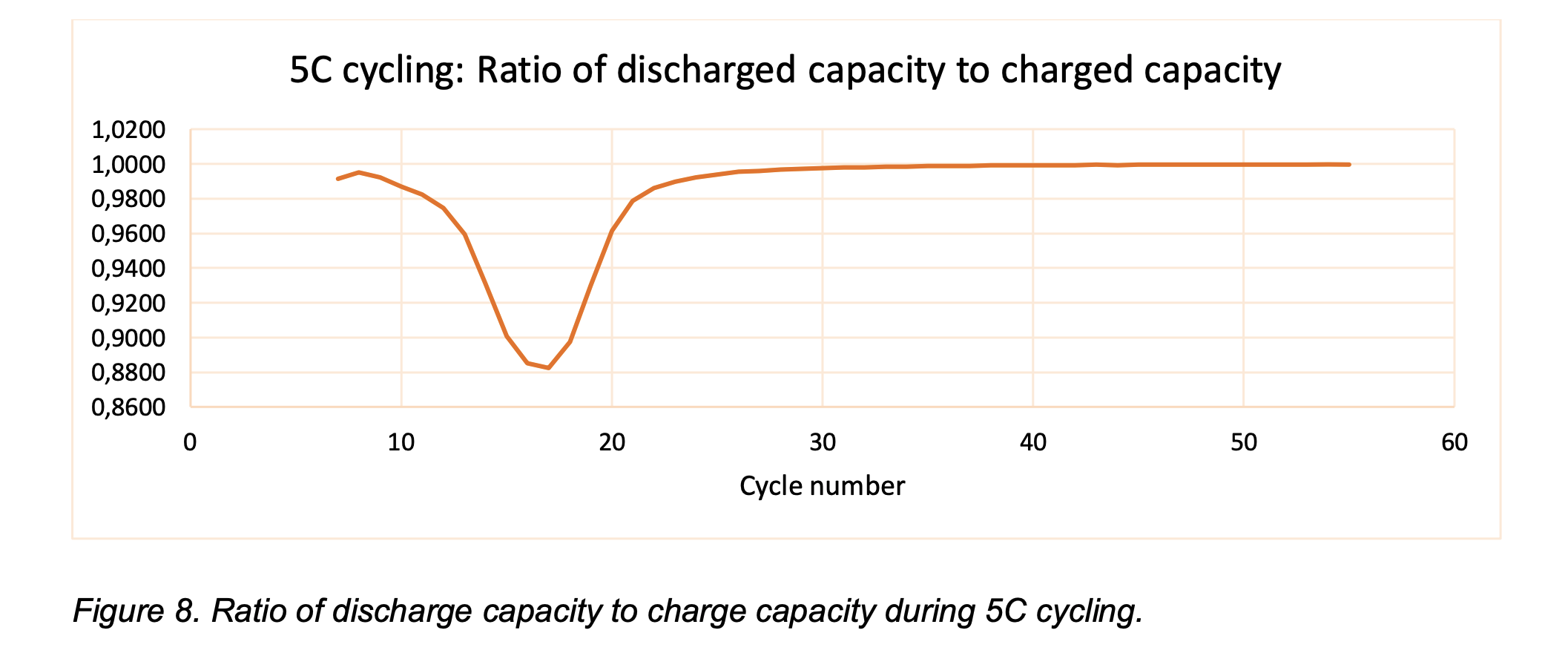
I wondered for some time how Donut Lab tested cycle life until I realized they did not need to use as much extrapolation as other chemistries might require. Attempting direct cycle life of 100,000 testing a 1C battery could take twenty years. Testing an 11C battery can be accomplished quickly. For a 10 minute charge and discharge cycle, there can be 6 x 24 = 144 cycles per day, 1,440 per ten days, and 14,440 cycles per 100 days — or 52,706 cycles in a year. By now, Donut Lab could be well along in cycle testing. This could explain its confidence in such high cycle lifetimes. So far, the company has claimed it did prior testing, but we do not know when it started. I was not certain about high cycle life, but since the team set a trap for overconfident critics, I am loathe to bet against them. I will wait and see what they did. The details do matter.
Other criticism concerned the prior lack of pack results. That critique is doused by the 5C motorcycle charging video. It is clear by now that Donut Lab is presenting the “I Donut Believe” series to damp out false speculation and trap overconfident skeptics with evidence while retaining early angel investor interest.
The remaining question Ryan presents regards how the cell achieves high energy density. I don’t know. The clues lie in how a solid-state electrolyte and advanced cathode material work. Ryan directly queried Donut Lab on this. The response reaffirmed that 400 Wh/kg is the actual energy density value including extras like packaging, and is not a laboratory result. Ryan’s video explains the performance hurdles that must be surmounted from lab to final product. The battery must have minimal swelling, high energy density, and high cycle life. A stable cathode and anode structure that matches the size of sodium ions creates less lattice strain, and allows the crystal structure to maintain integrity as ions are passed through it. Without an anode structure like carbon, there can be less weight. A lightweight cathode increases gravimetric energy density, and a high ionic conductivity electrolyte allows fast charge. The combination is a tall order. Even if tests showed proof of all the claims today, the mystery of cell operation could be an unknown for some time. The biggest mystery is the solid-state electrolyte.
What It Isn’t and What It Could Be
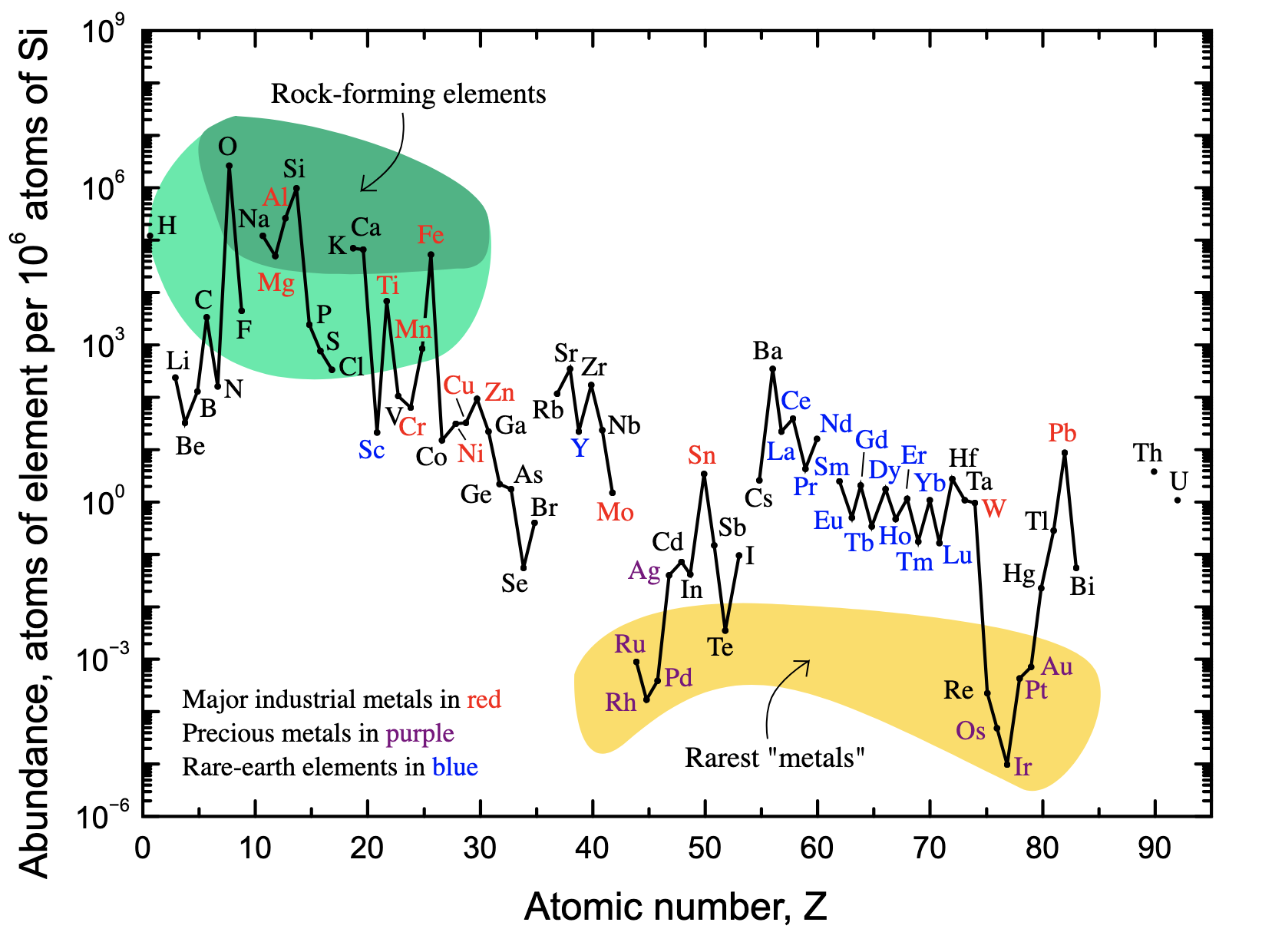
It isn’t a lithium-ion battery. It isn’t a capacitor. It isn’t any known cell chemistry and electrolyte combination. What could it be? It has to be made of abundant materials, no cobalt, no nickel, no lithium. It has to work at high temperatures safely. This practically eliminates all other possibilities except sodium and an advanced electrolyte. Alternatives like calcium in the same column of the periodic table of the elements do not as appear attractive.
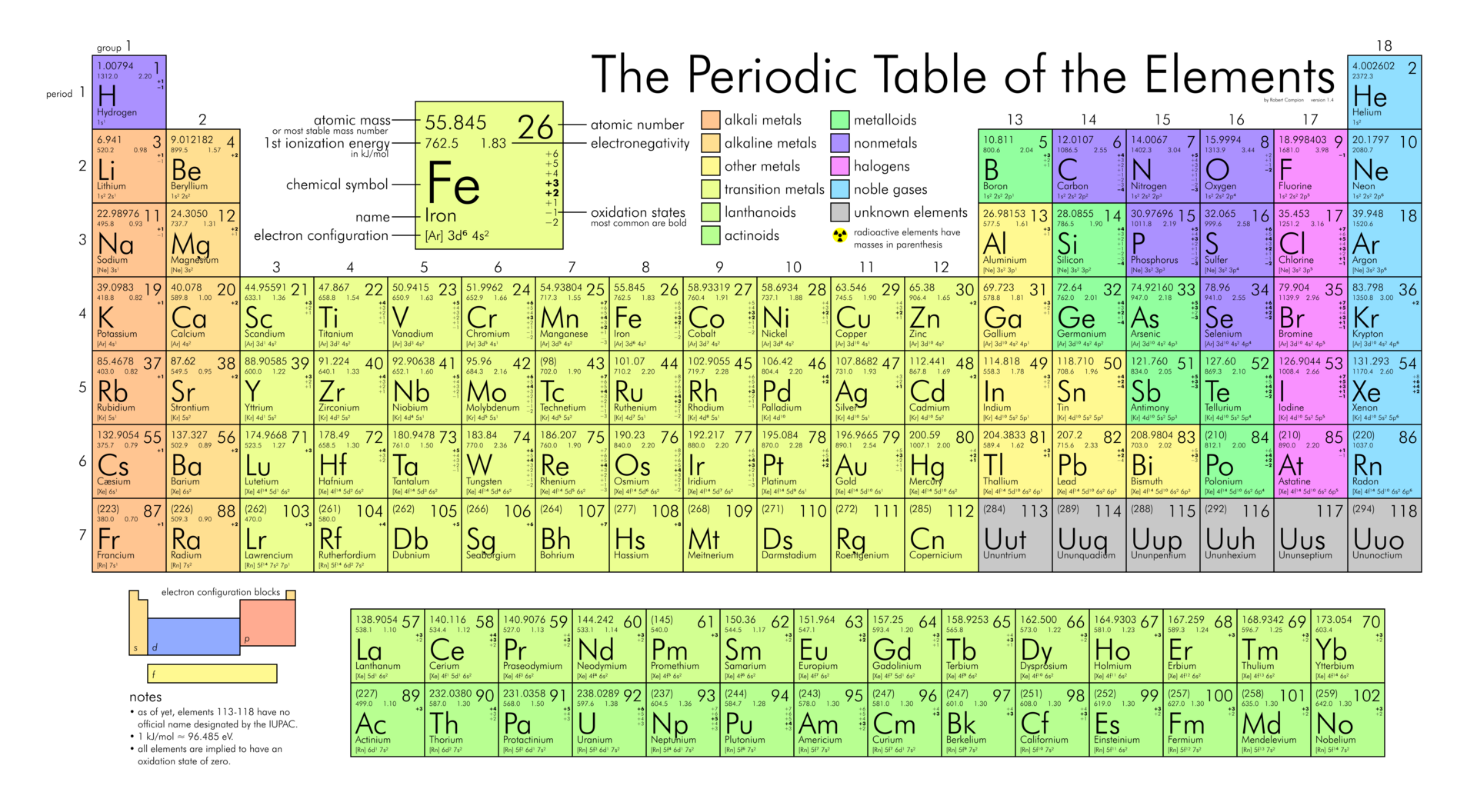
Sodium is more abundant and cheaper than alternatives.
The cell can be made in many shapes, which matches the characteristics of a polymer battery, but existing polymer electrolyte batteries do not work at low temperatures because polymer ionic conductivity decreases.
There are hints that indicate there may be reasons a battery could meet the Donut Lab specifications. There are clues that recently discovered solid- or semi-solid-state electrolytes have improved temperature operation and may be clay-like. Sodium-ion offers more safety and higher temperature range and cycle life than lithium. What we do not know is the effect of a new, unknown solid-state electrolyte combined with sodium-ion density. Up until now, high cycle life was achieved with roomy cathode and anode lattice structures that provided plenty of space for ions without straining the lattice. Cycle life, wide temperature operation, and fast charging are not mutually exclusive tradeoffs. We know this from lithium titanate. Lithium titanate produces a cycle life of 30,000, rapid charging, and wide temperature operation. It does not sacrifice charging speed for cycle life or temperature range.
Sodium-ion batteries like Naxtra now achieve 10,000 cycles using layered oxides. Other cycle life limits relate to electrolyte and binder breakdown. If a binder is not needed and the solid-state electrolyte is stable, then cycle life may be high. Brittle ceramic solid-state electrolytes have cracked. A polymer solid-state electrolyte could bend without failure and glue the parts together. The greatest unsolved riddle is dendrites. Dendrites are fingers of deposited metal that short anode and cathode. Dendrites have been the bane of all batteries thus far, solid state included. Could some new knowledge or technique have found the solution?
Solid-state and semi-solid-state lithium-ion batteries achieve double the energy density of standard lithium-ion batteries. Donut Lab’s battery achieves about double Naxtra’s sodium-ion battery energy density? Why wouldn’t we expect solid state to improve sodium-ion energy density as much as it improves lithium-ion energy density?
Could a combination of an advanced polymer solid-state electrolyte, sodium chemistry, anodeless construction, and cathode material provide a solution to the mystery?
Sign up for CleanTechnica’s Weekly Substack for Zach and Scott’s in-depth analyses and high level summaries, sign up for our daily newsletter, and follow us on Google News!
Have a tip for CleanTechnica? Want to advertise? Want to suggest a guest for our CleanTech Talk podcast? Contact us here.
Sign up for our daily newsletter for 15 new cleantech stories a day. Or sign up for our weekly one on top stories of the week if daily is too frequent.
CleanTechnica uses affiliate links. See our policy here.
CleanTechnica’s Comment Policy