


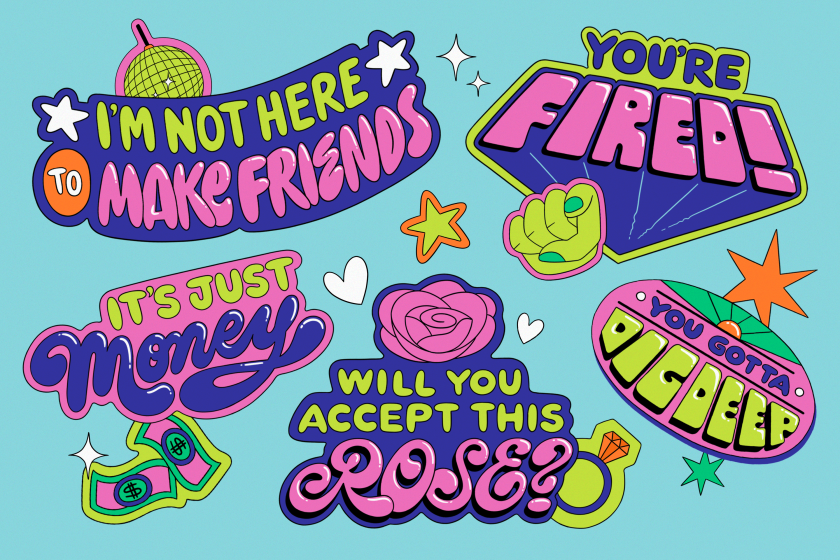
Illustration for Reality TV package
When you think of your earliest memory of reality television, what comes to mind? Is it “The Real World,” “Survivor” or “The Bachelor”? Perhaps it’s other fare like “Project Runway” or one of the “Real Housewives” franchises.
Growing up in the ‘90s and early aughts, my first exposure to reality programming was MTV’s slate of shows like “Real World” and “Road Rules” — thanks to being the youngest of four siblings, I was exposed to shows that were, in hindsight, too risque for me at too young an age. But they left an indelible mark. I saw Irene McGee of “Real World: Seattle” get slapped by her roommate Stephen Williams, a moment that at the time sent shock waves. Genesis Moss, of the Boston cast, was one of my earliest exposures to a gay person on TV. And Melissa Howard of the New Orleans season showed me how you can be 5-foot-2 and unapologetically feisty — as someone with a similar build and demeanor, I took that to heart.
Over the years, I’ve sometimes dismissed reality TV because it felt a little too personal or a little too competitive. I often wonder about the psychological effect on participants as their lives are laid bare for all to see. However, I can’t deny their appeal and why fans have continued to gravitate toward these shows season after season. They make for excellent watercooler talk; in recent weeks, my co-workers and I have spoken endlessly about “The Bachelorette” and Taylor Frankie Paul, and who did or didn’t stay married from Season 10 of “Love Is Blind.”
Few of us knew in the early days what effect reality television would have on the culture or how it would create a new type of star. Reality TV personalities have become influencers, pop culture icons and even political figures. One is the president.
And many shows have not only endured, they’ve spawned universes, international adaptations and spinoffs. Bravo, a TV channel that used to focus on the performing arts, is now an unscripted powerhouse that even has its own convention, BravoCon, where its various universes come together in service of fans.
What does that say about us as viewers? There’s always been a fascination with peering into the lives of others, seeing how they react to everyday problems under the glare of a camera. Perhaps it is a way to deflect from the reality of our own lives, which under the guise of normalcy is straining with the weight of political upheaval and economic turmoil, not to mention personal strife. Seeing someone else onscreen deal with their reality is sometimes the best escape.
So like it or not, reality television is here to stay.
Read more: ‘The Real Housewives of Orange County’: An oral history of how five unfiltered women changed TV
Read more: ‘Survivor 50’: How a social experiment turned competition show keeps the torch burning
Read more: From Trump to Dr. Oz: 10 personalities who went from reality TV to politics
Read more: We talked to ‘Bachelorette’ Taylor Frankie Paul. Then reality hit pause on her TV career
This story originally appeared in Los Angeles Times.
