


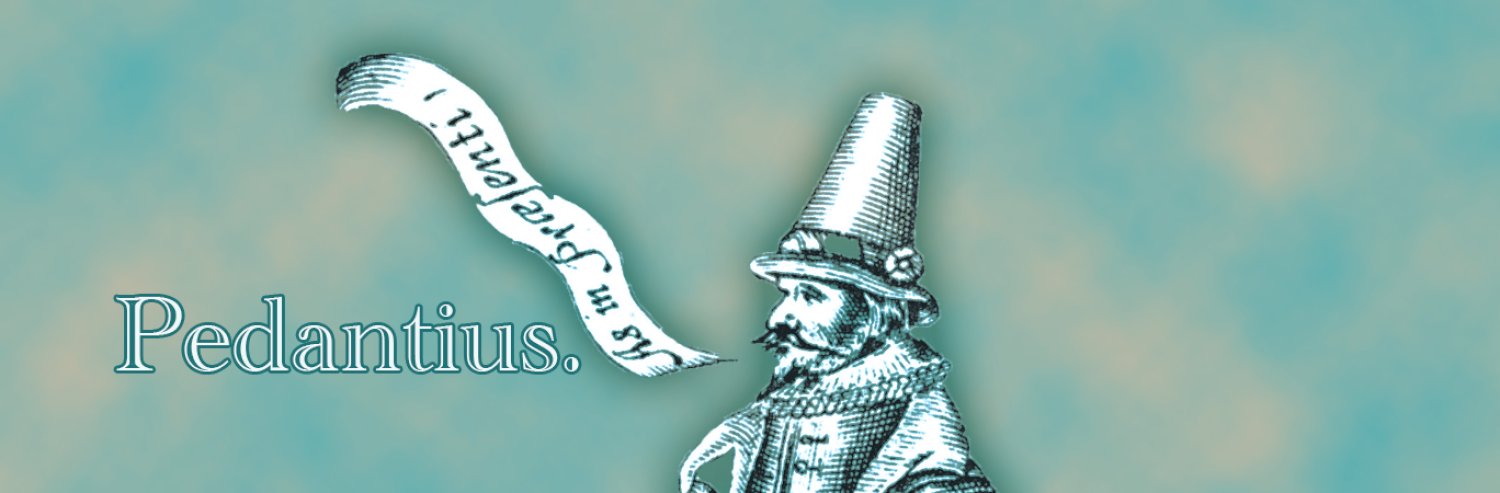
At the beginning of On the Nature of Things, a sort of textbook of Epicurean philosophy, the Roman poet Lucretius explains his choice to write in verse by comparing his poem to a cup of bitter medicine whose rim has been smeared with honey. Just as young patients will heal quicker if they enjoy taking their medicine, young students will benefit from encountering Epicurus’s difficult but edifying doctrine in a form they find pleasurable, even if that pleasure is only “lip-deep.” Arnoud S.Q. Visser’s On Pedantry: A Cultural History of the Know-It-All, a book about how intellectuals ranging from Socrates to Dr. Strangelove have made themselves disliked, takes a similar view of intellectual effort and enjoyment. The book is full of useful considerations for pedants hoping to be less irritating, but Visser ultimately considers that irritation the cost of doing business: Worthwhile intellectual work is unavoidably challenging, and sometimes even unpleasant.
Visser, an intellectual historian and scholar of Renaissance humanism at Utrecht University who has been as prolific writing for popular audiences as for academic ones, does a wonderful job of candy-coating this bitter pill. On Pedantry is relaxed and inviting; it is economical but judicious with historical detail, and discreet in its erudition. Like Lucretius, who rendered specialized Greek philosophical terminology into simple and non-technical Latin, Visser’s prose is totally free of jargon while still consistently engaging and precise. This accessibility does not come at the expense of sophistication and nuance. He follows a continuous tradition of criticizing pedantry, from fifth-century Athens to twentieth-century America, without compromising the extreme heterogeneity of the various historical moments he surveys. It would be fair to say that Visser is a bit pedantic—as any professional historian should be—but he is very gracious about it.
Under the rubric of pedantry, itself an early-modern term, Visser tracks a collection of negative tropes that have been continuously applied to intellectuals from classical antiquity to the present day. Many of these tropes have to do with compromised social skills: intellectuals may be boorish, pretentious, and oversexed (like a mansplainer), or undersexed, hapless, and awkward (like a nerd). But Visser gives the sense that these traits are, to some degree, epiphenomenal to a more fundamental social friction. Intellectual work can be opaque to non-specialists. Without training in an intellectual tradition, it can be quite difficult to judge the value, integrity, or wholesomeness of what that tradition produces, and that experience of incompetence can be frustrating, frightening, or upsetting—often with good reason. Thinkers from medieval scholastics to modern critical theorists have been accused of making themselves deliberately incomprehensible, and of using technical language to hide the triviality or meaninglessness of what they have to say. Most of us need to take it on faith that it matters whether Adam and Eve defecated in paradise, or that “the being of beings” means something. If there really is something behind the screen of jargon after all, there is still the danger that it might be socially corrosive, as the philosophies of Socrates and Voltaire allegedly were.
Visser does not dismiss any of these concerns out of hand. He avoids weighing in on whether any particular accusation of intellectual charlatanism is well-grounded; his interest is in the social problem indicated by these accusations: how intellectuals and non-intellectuals can live in peace with one another. Indeed, he seems to consider accusations of pedantry and defenses against them—at least ideally—as a sort of societal self-regulatory mechanism balancing intellectual and social values, keeping both in check. The pedant insists on enforcing intellectual norms at an interpersonal cost; the opponent of pedantry defends social norms at the expense of intellectual integrity or capacity.
The low-grade tension that comes out of this constant, productive negotiation between intellectual rigor and social harmony becomes more intense in times of conflict over what intellectual rigor should look like in the first place. In fact, On Pedantry is primarily a book about pedant-on-pedant rhetorical violence: Most of the accusations of pedantry it surveys are reciprocal, and surface in moments of particularly tight competition for social advancement or limited economic resources. In the sixteenth century, for example, humanists and scholastics accused each other of wasting time on pointless trivia, while humanists developed a courtly patronage system to rival traditional scholastic institutions like the monastery or university. In the seventeenth century, downwardly mobile courtiers and upwardly mobile men of letters mocked each other’s affectations in a scramble for royal favor.
The academic humanities today broadly maintain the same basic sense of what history is and of the value of studying it that Renaissance humanists developed in their polemics against medieval scholasticism. We share their sense that the past is alien and can only be approached as it truly was through extensive study and scrupulous attention to detail. Humanist historiography generally understood its task as collecting useful examples from the past to strategically guide its readers’ behavior in the present, which is more or less exactly how Visser frames the project of On Pedantry: “If this book has shown anything, it is surely that such anecdotes and examples…can help the pedants of this age to become more acutely aware of the history of which they are part. And awareness will enable them to make the benefits they offer more effective. The frictions of the past can encourage them to face today’s antagonism with greater empathy and a clearer sense of purpose.”
If we understand the past as a repository of anecdotes (as the New Historicists would have it) and examples (as the humanists would), that understanding determines which types of historical information and historiographical skills we consider valuable, which is to say worth the investment of intellectual effort and attention. One man’s pedantic trash is another man’s edifying treasure. Visser describes an episode in the career of his fellow Dutch humanist Erasmus of Rotterdam, on whom he has published extensively in a scholarly capacity, which illustrates (among other things) that what is at stake in this sort of conflict of intellectual values is ultimately the danger of cultural loss. The preservation of intellectual culture depends not only on the continued physical existence of the texts that make it up (even a digital edition exists physically on the server that hosts it) but also on the transmission of the interpretive tradition that makes those texts meaningful. Judaism, for example, could not exist without the Hebrew Bible, but it also could not exist without the Talmud. And the Talmud would not exist if Jews had not continued to see value in the same exegetical minutiae for thousands of years. But the substrate of any such interpretive tradition is linguistic competence: no one could study either without Hebrew.
Erasmus’s controversial Ciceronianus, a salvo in the early-modern culture war over Latin prose style, considers linguistic training specifically as a mechanism for this sort of cultural preservation. The Renaissance saw a movement to “reclassicize” Latin and erase the linguistic changes that had occurred over its centuries of continuous use since antiquity by returning to the language of golden-age Roman authors like Cicero or Vergil (whose name had been spelled with an i for centuries, until Renaissance humanists determined that an e would be more historically authentic). Erasmus criticizes an extreme version of this project as pointless, maladaptive, and pedantic; he advocates for imitating a less restrictive canon of classical writers, and for a more relaxed relationship with the linguistic minutiae of style. His primary concern is reading: People who only want to sound like Cicero will read only Cicero, at the expense of many otherwise important and edifying writers. Erasmus is worried that the next generation of humanists will shortchange foundational Christian moral texts, including the Vulgate itself. Although Erasmus characterizes the Ciceronians as pedants, pedantry is in the eye of the beholder. This is ultimately a question of cultural priorities: Which of classical Latinity and postclassical Latinity is worth prioritizing, pedagogically, at the expense of the other?
In the end, both sides of the Ciceronianism debate have lost—neither type of Latin is part of a liberal-arts education anymore, for better and worse—and texts like Erasmus’s Ciceronianus, itself written in Latin, have become historical trivia for pedants like Visser and myself to dredge up. If there is value in doing so, which he and I obviously both think there is, it is that the positions and arguments humanists staked out over Latin were directly recycled in later debates over vernacular prose style and how closely it should cleave to those same classical models. Our consensus today is an extreme version of the “naturalizing” Erasmian position, which seems anti-pedantic because we share its basic premises, as opposed to the “acculturated” Ciceronian one, which seems pedantic because we do not. What we now consider good writing does not—and, in fact, must not—too clearly show the linguistic influence of the past. On a purely rhetorical level, there is no reason to read anything written before the twentieth century to become a great prose stylist today.
But the danger in relaxing the cultural standards that make things such as a familiarity with Shakespeare, a reading knowledge of Latin, or an encyclopedic memory of Ciceronian clausulae obligatory for “educated” speakers and writers is that we do not know what we do not know. We can think about pedantry and English prose style in the light of early-modern Ciceronianism because of the tremendous amount of work, beginning with Erasmus’s own relentless self-promotion, that has gone into making the Ciceronianus available. Neither Visser nor anyone else would know about it, much less have read it, if it hadn’t been edited, published, translated, and written about for hundreds of years. Erasmus was one of the most famous and influential intellectuals of the age of the printing press, and even he is barely read compared to those who wrote in modern vernacular languages. Does that mean he is less valuable, either intrinsically or for our current moment, than they are? Or that he is more valuable than the countless medieval writers whose work—in solecistic, non-classical Latin or in medieval vernaculars—remains untranslated, unread, and even unedited? Erasmus certainly thought so.
Visser invites us to see pedantry as a valuable and necessary corrective to the various social forces, including faddishness, ideology, and simple laziness, that degrade skills and knowledge, and the institutions that preserve both. Although many intellectuals could certainly work to make themselves less abrasive and opaque, and more like Visser, the irritations and anxieties they provoke are fundamentally unavoidable as long as specialized intellectual work exists. And, indeed, Visser concludes his otherwise conciliatory book with a moment of abrasive insistence on pedantic authority: If his readers do not find the argument of the book convincing, he assures them that “[their] objections are absolutely understandable. But pedants will know better.”
And if this sort of abrasiveness is a feature rather than a bug, we should be skeptical of the most intense vitriol against the academy today. There is no getting away from pedantry, short of extreme obscurantism, and Visser shows us that many of the most vehement critics of pedantry have historically been those who wished to abrogate the status, authority, and economic stability of the establishment and install their own pedantries in the place of the received ones. Today’s online intellectual movements certainly do not shy away from deliberately obtuse language, like Bronze Age Pervert’s performatively elliptical and off-kilter prose (e.g., “When speak of whoremoans you might think I’m a materialist reductionist, or am saying you are like machine”). The Bay Area–centered “rationalist” community has certainly not shied away from sophistic justifications of antisocial action—most prominently, imprisoned crypto trader Sam Bankman-Fried’s many financial crimes, or, less prominently, successful blogger Scott Alexander’s alleged support for eugenics. And the effective altruist movement has been widely lambasted for what, to outsiders, seems like endless, frivolous quibbling about pointless questions, like the precise extent of our moral obligation to shrimp.
To me, these thinkers, texts, and issues seem pretty facile—easier and less productive to grapple with than, say, Nietzschean style, Thomistic ethics, or even Greek verb paradigms. Of course, I might be wrong, but I am at least well-positioned to make that comparative judgment, thanks to the education I have received from pedants, in an institutional tradition of scholarship maintained by pedantry. There is no limit to what could be sacrificed on the altar of pleasantness. The sort of cultural loss that happens when we forget how to read the books we have forgotten why we should read is nearly unimaginable until it happens. But once it does occur, no one can tell that it has.
Reprinted from The Hedgehog Review 28.1
(Spring 2026). This essay may not be resold, reprinted,
or redistributed for compensation of any kind without prior written permission. Please contact
The Hedgehog Review for further details.
