


Support CleanTechnica’s work through a Substack subscription or on Stripe.
The most useful way to think about the Strait of Hormuz in a decarbonized future is not as an oil story that fades away as the energy transition advances. It is a systems story about where risk sits in the architecture of the economy. In the fossil era, Hormuz matters because a narrow waterway carries a vast share of the fuels that power transport, industry, heating, petrochemicals and fertilizer. The International Energy Agency’s current assessment is that around 25% of the world’s seaborne oil trade moved through the Strait in 2025, that over 110 bcm of LNG also passed through it, and that the route remained the primary export path for Saudi Arabia, the UAE, Kuwait, Qatar, Iraq, Bahrain and Iran. Reuters’ reporting on the current Iran war makes the same point in more immediate terms. A closure of the Strait has not only choked fuel flows. It has disrupted fertilizer, shipping and food systems almost immediately.
A great deal of decarbonization commentary still treats the shift away from oil as if it automatically dissolves this kind of chokepoint risk. That is too simple. A world built around imported e-fuels, ammonia, methanol and other synthetic molecules would still be a world where energy security depended on ports, tankers, shipping lanes and strategically exposed coastal industrial hubs. If the molecule changes but the map does not, much of the vulnerability remains. This is especially true because the Gulf states have every incentive to preserve the export logic of their economies. They already have capital, industrial land, energy infrastructure, engineering capacity, shipping access and long experience in commodity export markets. It would be surprising if they did not try to replace a share of oil and gas rents with ammonia, synthetic fuels and hydrogen derivatives. The question is not whether that strategy is rational. It is. The question is whether a world that leans heavily on those exports would be much safer than the one we live in now.
The answer is that it would be somewhat different, but not different enough to justify complacency. The International Renewable Energy Agency’s work on global hydrogen trade is useful here because it shows both change and continuity. In its 1.5°C scenario, about one-quarter of global hydrogen demand would be internationally traded by 2050, compared with about 74% for oil today. That suggests a lower level of cross-border dependence than the oil system created. But it does not eliminate maritime vulnerability. IRENA expects around 55% of internationally traded hydrogen to move by pipeline, concentrated in regional markets, while the remaining 45% would move by ship, predominantly as ammonia. It also projects global ammonia demand rising to around 690 million tons per year, with almost 80% used as chemical feedstock and as fuel for shipping and power, and only 20% used as a hydrogen carrier. Those numbers point to a future where some energy trade regionalizes, but where ammonia and related liquids still become strategic seaborne commodities on a very large scale.
That matters because shipping geography is often more important than production technology. A synthetic fuel made with electrolysis and captured carbon is cleaner than bunker fuel. It is not less vulnerable if it is produced in the same Gulf-side complexes and loaded onto tankers that still have to pass through Hormuz. The International Energy Agency’s current Strait assessment shows how little bypass capacity still exists. Only Saudi Arabia and the UAE have crude pipelines that can partially reroute some exports around the Strait, with an estimated 3.5 mb/d to 5.5 mb/d of available capacity. Other exporters remain reliant on the passage for the vast majority of their oil exports. On the gas side there are no alternative routes for Qatar’s and the UAE’s LNG exports of the scale currently involved. If future ammonia, methanol and synthetic liquid fuels are concentrated in the same places, the same basic geometry applies. The molecule is low-carbon. The route remains brittle.
Fertilizer deserves special attention because it becomes more visible as a strategic molecule in a decarbonized world. The International Energy Agency’s ammonia roadmap states that around 70% of ammonia is used to make fertilizers. Ammonia is the bridge between atmospheric nitrogen and much of the food consumed by humanity. When the Strait is disrupted, that food linkage shows up very quickly. The IEA now estimates that more than 30% of global urea trade, about 20% of ammonia and phosphate trade, and around half of global seaborne sulphur trade move through Hormuz. Reuters reported that the war had shut down fertilizer plants, driven up urea prices, and left farmers in regions from Ontario to Kashmir struggling with input costs before planting. In a world where buildings, most ground transport and much of industry are electrified, fertilizer does not become less important. It becomes more clearly one of the remaining molecules whose interruption can destabilize societies.
Once again, the same states that are blocked from exporting fossil fuels and fossil ammonia today have major expansion plans to be providers of green ammonia fertilizer.
That leads directly to the reserve question. The twentieth-century oil system built deep buffers because oil was universal, fungible, storable and mission critical. IEA member countries still have to maintain stocks equal to at least 90 days of net imports, and the agency reported in March that members hold over 1.2 billion barrels of emergency stockpiles plus another 600 million barrels of industry stocks under government obligation. That is an extraordinary institutional achievement built over decades of crisis learning. There is little reason to assume that a future system of multiple green molecules would replicate it across the board. E-kerosene, synthetic diesel and methanol could be buffered more easily because they fit into many familiar liquid-fuel logistics systems. Ammonia can also be stored and traded at scale, and it already is. But a world of multiple strategic molecules is more fragmented than the oil world. It is harder to imagine every country maintaining oil-style 90 day reserves of every critical low-carbon liquid and gas. The likely result is a patchier, more selective system of strategic buffers.
Current policy already hints at what that future would look like. Governments are not waiting for a full green-molecule economy to start treating some non-oil inputs as strategic. Australia created a 7,500 ton stockpile of technical grade urea to protect diesel exhaust fluid supply. Switzerland released 20% of its strategic reserve of nitrogen fertilizers during earlier supply difficulties, equivalent to about 8% of annual national need according to OECD reporting. Japan has been building fertilizer reserves targeted at months of demand for key imported nutrient inputs. Those are not universal reserves on the oil model. They are targeted interventions around critical services and exposed molecules. That is probably the more realistic shape of resilience in a decarbonized future. Strategic stockpiles will exist where storage is practical and the service is essential. Elsewhere, governments will rely on redundancy, local production, route diversity and substitution.
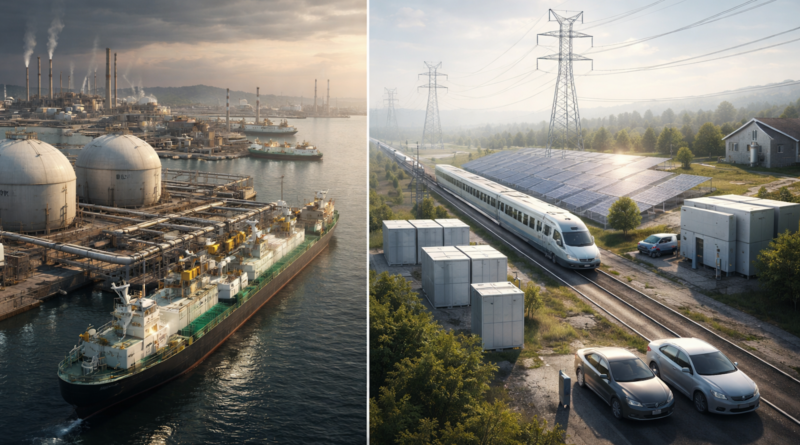
A maximally electrified economy is different in a more fundamental way. It does not remove geopolitical exposure, but it changes the dominant security model from fuel inventory to infrastructure adequacy. The International Energy Agency expects electricity’s share of final energy consumption to rise from about 20% today to over 50% by 2050 in the Net Zero Emissions by 2050 scenario. That means the center of gravity of resilience shifts away from tank farms and fuel cargoes toward transmission lines, transformers, storage, flexible demand, dispatchable clean capacity and interconnection. Oil and LNG tankers become less central to the daily functioning of households, offices, urban transport and a growing share of industry. In a fully or near fully electrified economy, most cars do not care whether a tanker has cleared Hormuz. Most heat pumps do not care. Many factories do not care. The problem becomes whether the grid has enough capacity, flexibility and spare equipment to keep power flowing through stress events.
That is a major reduction in macroeconomic vulnerability, but it is not a free pass. Electricity systems have their own failure modes. They depend on capital stock that can be slow to replace. The IEA’s transmission report says it now takes two to three years to procure cables and up to four years to secure large power transformers, with some direct current cable lead times beyond five years. Prices for cables have nearly doubled since 2019 and transformer prices have risen by around 75%. In other words, the electrified world is less vulnerable to continuous fuel-flow disruption, but it can be more vulnerable to delayed buildout, repair bottlenecks and underinvestment in resilience. The exposure changes from a maritime commodity problem to a network adequacy and industrial supply chain problem. Countries that electrify deeply but fail to build robust grids and maintain strategic equipment spares may discover that they have traded one form of fragility for another.
The comparison between the two futures is therefore not simply one of lower emissions versus higher emissions. It is a comparison of failure modes. In the molecule-heavy future, the main risks are chokepoints, inventories, shipping routes, fuel conversion hubs and commodity price spikes. In the maximally electrified future, the main risks are adequacy shortfalls, equipment lead times, cyber and physical grid threats, and the still narrow but important molecule dependencies in aviation, ocean shipping, fertilizer and some emergency backup. This makes the macro picture meaningfully different. A blockade of Hormuz in an e-fuels-heavy world still transmits shock through a large share of trade, freight and food systems. A blockade in a maximally electrified world is less likely to trigger an economy-wide energy crisis. It is more likely to trigger a severe but more sector-specific bunker fuel and fertilizer crisis. That is a real improvement in resilience, even if it does not eliminate pain.
Another reason a maximally decarbonized, highly electrified world is more resilient than a molecule-heavy one is that many of the remaining critical materials can be manufactured from inputs that exist in far more places than oil and gas fields clustered around the Gulf. Ammonia starts with nitrogen from the air and hydrogen from water and electricity. The International Energy Agency notes that ammonia is the basis of all mineral nitrogen fertilizers and that about 70% of ammonia goes into fertilizer production. Renewable ammonia pathways replace fossil hydrogen with electrolysis, which means countries with wind, solar, hydro and water can produce it close to farms or at ports well outside Hormuz. Methanol and other synthetic fuels are similar. IRENA notes that renewable methanol can be made from renewable hydrogen combined with CO2 from biomass, biogenic streams or direct air capture, while renewable ammonia is produced from renewable electricity, hydrogen and separated nitrogen. More broadly, the IEA and World Bank both point to low-emissions hydrogen and related commodities being produced in regions with abundant renewable resources, and in some cases supporting local fertilizer industries that reduce dependence on volatile imports. That does not make the world immune to concentration risk, because markets can still cluster around the cheapest producers, but it does mean the chemistry of a decarbonized economy allows strategic production to be distributed across many more geographies than the fossil system ever did, including agricultural regions and open-ocean states that sit entirely outside the Strait’s chokehold.
The broad lesson is that decarbonization does not by itself determine security. Architecture does. A future centered on imported green molecules from Gulf-side export hubs preserves much of the logic of the fossil era, even if emissions are lower. A future centered on direct electrification for most end uses, with molecules reserved for aircraft, ships, fertilizer and a few difficult edge cases, weakens the role of maritime chokepoints in the everyday economy. It does not abolish them. It demotes them. That is the right way to understand the significance of the Strait of Hormuz in a decarbonized world. The question is not whether low-carbon molecules can be made and shipped. They can. The question is whether we want to build a future where a narrow waterway can still disrupt freight, food and strategic energy services for much of the planet. A maximally electrified economy does not solve every resilience problem. It changes them into problems that are more domestic, more buildable and, in many cases, more governable than reliance on globally traded fuel molecules passing through a single maritime chokepoint.
Sign up for CleanTechnica’s Weekly Substack for Zach and Scott’s in-depth analyses and high level summaries, sign up for our daily newsletter, and follow us on Google News!
Have a tip for CleanTechnica? Want to advertise? Want to suggest a guest for our CleanTech Talk podcast? Contact us here.
Sign up for our daily newsletter for 15 new cleantech stories a day. Or sign up for our weekly one on top stories of the week if daily is too frequent.
CleanTechnica uses affiliate links. See our policy here.
CleanTechnica’s Comment Policy
