



The Mormons were done evangelizing. Curtain call bows had been taken. I turned on my phone after “The Book of Mormon” to take note of the show’s runtime, as part of my job as theater critic, and had a moment of cognitive dissonance.
Only 9:30 p.m.?
It was true, even though I’d just seen a full Broadway musical.
This season, ATG San Francisco – which presents touring shows at the Orpheum, Golden Gate and Curran Theatres – moved three of its curtain times earlier. With occasional exceptions, Tuesday throughThursday evening showtimes are now 7 p.m instead of 7:30 p.m.
American Conservatory Theater and Berkeley Repertory Theatre have become earlier birds, too. Three years ago, Berkeley Rep reset its Tuesday showtimes from 8 to 7 p.m., and next season, Managing Director Tom Parrish told the Chronicle, it’s rescheduling Saturday evening showtimes from 8 to 7:30 p.m. ACT, meanwhile, made two changes for its 2024-25 season, moving Sunday from 7 to 6:30 p.m. and Tuesday from 7:30 to 6:30 p.m.
Berkeley Rep made its Tuesday change years ago after seeing increased demand for Wednesday performances, which have long been at 7 p.m., Parrish noted. Now, after seeing lower demand for Saturday evenings in more recent years, he had a hypothesis: “Maybe the performance time was the issue.”
The company surveyed 1,519 audiences, and sure enough, 90% said they’d be as or more likely to attend Saturday shows if they were moved earlier. Its 2026-27 season’s change is in response to those results.
At ATG San Francisco, reaction to the new, three-day-a-week 7 p.m. showtime, which began in the fall with “Shucked,” suggests the change is working.
“We’ve had zero complaints,” said General Manager Jamie Budgett, who acknowledged his strategy is capitalizing on post-pandemic work schedule flexibility.
But for patrons who live further away, an early showtime can be prohibitive. For instance, San Jose resident Karen Altree Piemme said that if she has to travel the roughly 50 miles by earlier than 8 p.m., she can’t eat dinner first, “so by the time I get there I’m stressed and hangry.”
Even as Santa Clara resident Mike Rhone allots two hours to drive to ATG San Francisco or San Francisco Playhouse performances, it is never a guarantee he will make a show on time. Once, when he and his husband tried to make a 7:30 p.m. curtain for “Six” at the Orpheum on 90 minutes of drive time, they had to run from their parking garage to the venue, taking their seats just as the music started.
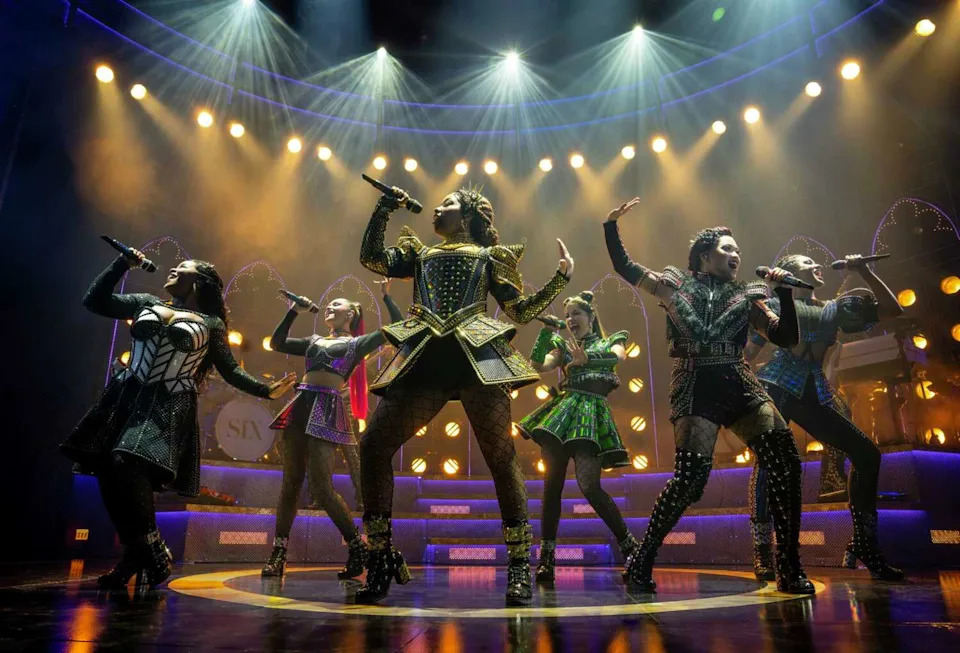
The cast of “Six,” which tours to ATG San Francisco and Broadway San Jose venues. (Joan Marcus/BroadwaySF and Broadway San Jose)
“Still can’t believe we made it on time,” he said, “but the stress of that drive was nothing I want to experience again.”
Leaving work isn’t always an option, and Rhone said he feels guilty when he does. While weekend shows alleviate that burden, he points out that they’re also often more expensive – a trade-off that doesn’t make sense for everyone.
Others point out there’s such a thing as too much time before a show. Audiences can “lose steam,” as San Francisco resident and performer J.A. Valentine put it, and actors can spot “Friday night fatigue in the seats.”
If earlier showtimes strain farthest-flung audiences, ACT Marketing Director Adam Thurman pointed out they can reduce other patrons’ late-night anxieties.
“You know when the show lets out, the odds that Muni and BART will still be running as you anticipated would be pretty good,” he said.
In any case, more of his single-ticket buyers are coming from the city as opposed to surrounding counties – 40% now versus 25% before the pandemic.
It’s not just public transit, patron Debi Durst pointed out. “Sometimes it’s more difficult to find a WAV (wheelchair accessible vehicle) taxi later in the evenings,” she said.

The cast of “Shucked,” which toured to ATG San Francisco’s Curran Theatre. (Matthew Murphy and Evan Zimmerman/BroadwaySF)
Some survey data backs up all these trends. Californians spend seven more minutes sleeping per day and 19 minutes less working per day than the rest of the country does, according to the U.S. Bureau of Labor Statistics’ American Time Use Survey.
The same data also shows we also spend more time preparing and eating food per day, which would seem to be a strike against earlier show times.
Yet at Italian eatery Tratto – a block away from the Toni Rembe and the Curran, and a frequent partner with ACT on special events – the leadership team is in favor of earlier curtain times. General Manager Ricardo Bosco and Brian Fenwick, who is managing director of the Marker Union Square, where Tratto is housed, hope to persuade theater patrons to come by post-show for a drink, dessert or full meal. Such demand is nonexistent now, they said, though Tratto is reliably packed before curtain times.
“I won’t be opposed to extending (restaurant) hours if I know that the show is going to bring in people after,” Bosco said. “We can be pretty flexible when it comes to that.”
For now, though, post-show dining options are limited. A 2024 report pegged San Francisco as the worst major American city for late-night dining.
Fenwick said Tratto’s success is so tied to neighboring plays and musicals that now its Fridays are the lightest days of the week if the theaters are dark. This reflects the popularity of work-from-home that day and a decline of after-work nights out.

Sullivan Jones as Big in Berkeley Repertory Theatre’s “The Monsters.” (Kevin Berne/Berkeley Repertory Theatre)
Still other structural factors might push Bay Area patrons and theaters toward earlier evenings. One is a graying Bay Area.
San Francisco bars’ last call is at 2 a.m. in contrast to New York’s 4 a.m. BART stops running at midnight, which is also when Muni switches to Owl service, halting many routes and shortening others and/or running them less frequently. In New York, subways run 24 hours a day.
But Broadway’s been moving curtain times earlier since the beginning of the millennium as well. Among evening performances listed on Broadway.com on Thursday, April 9, 30 shows had 7 p.m. curtain times; 10 at 7:30 p.m.; 11 at 8 p.m. and another had multiple entrance times starting at 7:15 p.m.
Then there’s always the 4 p.m. option, which Peninsula patron Vicki Reeder appreciates at Stanford Live.
“I did love being on my own comfy couch by 7 p.m.,” she told the Chronicle.
This article originally published at Why Bay Area theaters are embracing earlier curtain times.
