


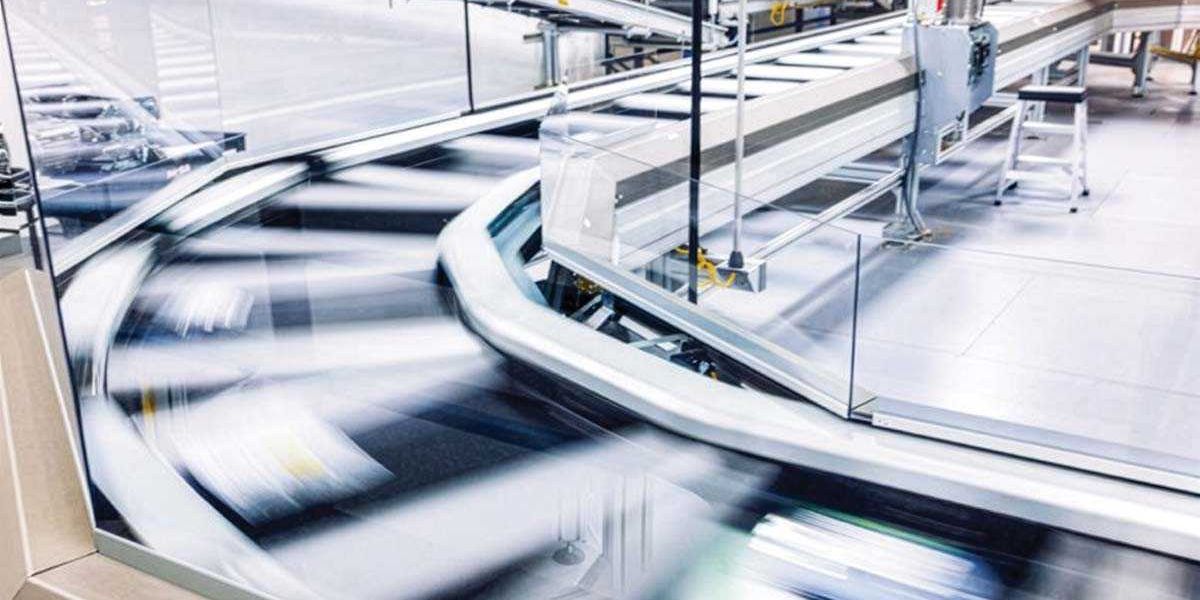
Today’s warehouses are dealing with an increasing array of items that must be conveyed and sorted, thanks to the acceleration in e-commerce activity over the past several years. The complexity comes from dealing with packages of different sizes and types, from polybags to padded envelopes to boxes of varying dimensions—all of which wend their way through the warehouse at the same time, bound for multiple destinations.
It’s a far cry from the days when facilities managed a more uniform flow of cases and boxes that would be delivered in bulk to a handful of outlets. As a result, today’s conveying and sortation equipment must be flexible enough to handle that ever-growing array of items—and do so quickly and efficiently. The trend is driving the adoption of advanced automated sortation systems that can help warehouses keep up with demand.
“The growth of the conveyor sortation system market is primarily driven by the booming e-commerce industry, which has necessitated faster and more efficient logistics operations,” according to a March 2026 report on sortation systems from Core Market Research. “Retailers are focusing on enhancing their supply chain management to meet the growing customer demand for quick delivery, thus propelling the adoption of automated solutions like sortation systems.”
DEMAND ACCELERATES
Ron Roth, business development manager at industrial automation solutions provider Regal Rexnord, is witnessing the trend up close. Roth says demand for flexible automated sortation solutions is translating to more projects and that he expects strong growth to continue.
“I think in general terms we’re seeing a lot of activity,” he explains. “[It] seems like it’s picking up every year. The amount of interest and the [number of] people looking to automate is really expanding … I’ve quoted more projects, and we’ve won more projects, in the past few months than I would say has been the norm in the past couple of years.”
That outlook is in line with the Core Market Research report, which predicts compound annual growth of 4.5% in conveyor sortation systems globally between 2025 and 2035, reaching a market size of $7.5 billion.
After a pullback in automation investing following the Covid-19 years, Roth says companies are now experiencing “a very robust economy, and people are looking to automate and expand in anticipation of a lot of growth in their businesses.”
Roth notes that he’s seeing strong demand for new technologies in the parcel, apparel, home goods, and health-care industries in particular. Regal Rexnord provides power transmission and motion control products, particularly for conveyor systems, and Roth points to the company’s ModSort divert and transfer module as an example of the kind of flexible solutions warehouses and distribution centers are seeking.
ModSort is a divert and transfer station that can be added to an existing or new conveyor system to address the growing complexity of handling multiple-sized items. The flexible sorter, which provides all-electric, omnidirectional sortation for a wide range of package types, is essentially a transfer belt that is used to receive and pass product from one conveyor to another—either straight through or by diverting packages left or right. Roth explains that the system uses small rolling spheres built into the conveyor surface to move parcels in the direction to be sorted: They can roll forward, powered by a belt that’s in line with the conveyor, or they can be diverted left or right, powered by a separate belt that moves items onto a divert lane. The system can handle packages measuring up to 30 by 30 inches and weighing 50 pounds or less—at rates of 35 to 50 packages per minute. And it uses standard 24-volt connections, making it quiet, safe, and low maintenance, according to Roth.
The safety of the equipment itself is a key selling point. As Roth explains, ModSort’s rolling spheres eliminate the need for any mechanisms to lift and transfer packages during the divert process. This creates a smooth transfer of items, eliminating work-stopping incidents like parcel jams—which are common with traditional pneumatic or mechanical transfer and pusher stations. Parcel jams halt the conveying process and require workers to step in and clear the system. That task takes time and can pose safety risks if there are “pinch points” in the system—areas in which moving parts of the conveyor can trap, squeeze, or even crush workers’ fingers or hands as they try to clear the jam. There are no pinch points in the ModSort solution, which means that working with and near the conveyor is safer and easier—a boon to warehouses that are trying to reduce the amount of manual intervention in the conveying and sorting process.
And because it’s quiet—operating at less than 72 decibels—no personal protective equipment (PPE) is required. On top of that, the system is expandable, allowing warehouses to add divert and transfer stations as needed to accommodate growth.
“And it’s not intimidating,” Roth adds. “[People are] working alongside it. It’s approachable.”
Such solutions can also contribute to freight savings, which is a key measure of return on investment (ROI) from conveyor and sortation projects, according to Roth. Reducing the size and weight of packages can help companies get more product into a shipment or reduce the amount of space taken up on a delivery truck—all of which adds up in freight savings. Sortation solutions that allow companies to handle a broader array of smaller and lighter items can contribute to those savings.
“[When you ship] smaller packages … you’ve lowered your expense to deliver,” Roth adds.
HIGH-SPEED SORTATION TAKES OFF
A recent sortation project at Mouser Electronics’ global distribution hub also illustrates the creativity and flexibility behind today’s conveyor and sorter designs. The distributor of electronic components worked with automated sortation systems manufacturer EuroSort to develop a solution that is “really pushing the boundaries of high-speed sortation,” according to Scott Eisenberg, EuroSort’s regional sales manager. The project highlights how next-generation sortation and control technologies can overcome the limits of traditional sortation systems when SKU (stock-keeping unit) counts explode and order profiles grow more complex.
EuroSort worked with industrial automation and controls manufacturer Beckhoff Automation to develop a high-speed sorter that could accommodate the extremely high volume of components Mouser handles at its distribution hub. The distributor needed to be able to process more than 1.2 million SKUs that are stored in the DC—many of them extremely small—while maintaining greater than 99% accuracy and meeting late same-day shipping cutoffs. Legacy systems had reached capacity and lacked the precision needed for the job.
Working with EuroSort, Mouser deployed a customized sortation system spanning more than half a mile—EuroSort’s longest sorter built to date, according to Eisenberg—and with multiple sorter types, achieving up to 30,000 items per hour per sorter. All told, the project incorporates four types of EuroSort sorters: the Single Split Tray, Dual Split Tray, Cross Tray XL, and E-Sort, a multi-destination chute system. A unified control platform from Beckhoff, built on PC-based control and EtherCAT technology, allows real-time coordination across tens of thousands of input and output (I/O) points.
Matt Bell, Mouser’s vice president of outbound operations, says the project has solved a host of labor and fulfillment challenges, most notably by reducing the number of workers required to consolidate orders at the facility. Now the distributor can reallocate those labor resources to other tasks in the building.
All told, the project has doubled goods-to-person performance and increased throughput, among other benefits.
The high-speed sorter “will absolutely transform the way we fulfill orders,” Bell said in a video case study on the project.
And transformation is very much the goal in today’s complex warehouse environment.
“Conveyor sortation systems enable these businesses to streamline their operations, reduce errors, and enhance customer satisfaction by ensuring timely deliveries,” according to the Core Market research. “As companies aim to improve their competitive edge, integrating advanced sorting technologies has become paramount for optimizing warehouse processes and meeting the high expectations of consumers.”
