


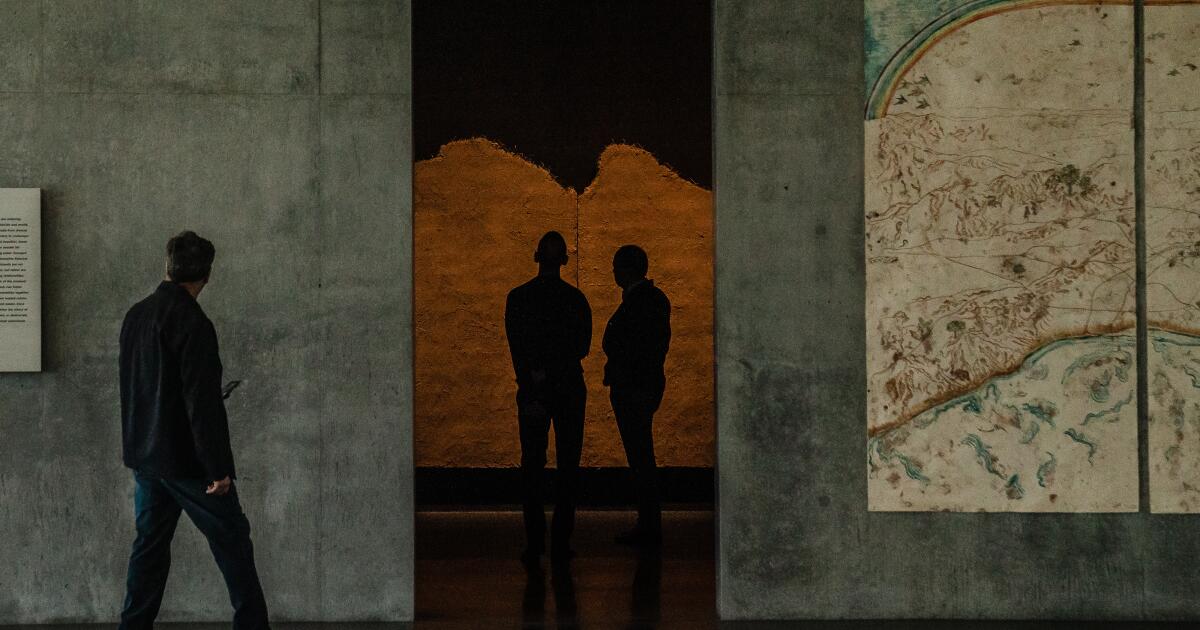
It’s not only easy to get lost in the Los Angeles County Museum of Art’s new David Geffen Galleries, it’s inevitable, intentional — and one of the best things about the place.
The museum has deconstructed the traditional, boxy narrative of art history and rendered the story itself a matter of curves and continuities. Art in the collection is freed from its departmental silos and put into conversation across genre lines, place and time.
The museum has physically invalidated the binaries of center and periphery, major and minor arts. In a startling and largely gratifying way, LACMA has done what the poet Audre Lorde, alluding to a different but not unrelated aspect of patriarchal dominance, deemed impossible: used the master’s tools to dismantle the master’s house.
The change goes far beyond a remodel. It’s a reinvention, a recalibration, a revisionist fever dream.
The vision conceived by museum director and Chief Executive Michael Govan and architect Peter Zumthor is not perfect, and brings with it a modest set of frustrations, but as a whole, the installation registers as ravishing and bracingly fresh. It thrusts us midstream into the ageless, ceaseless flow of makers worldwide reckoning with life, earth and being.
It prompts us, as we bob about, to reflect on our own proclivities and preconceptions, our patterns of reception and perception.
It compels us to recognize that what matters is not just what we see in the museum but how we see, what pulls us close and why, what private histories we bring to the occasion, what expectations, what tools.
Over two visits to the new building, getting my physical bearings mattered less and less as I surrendered to the generative sensations of not knowing. The museum has produced a dense guidebook to the new galleries, whose title, “Wander,” doubles as invitation and imperative. Even at 430 pages, the book is only minimally useful as an orientation device. For help with that internal navigation, Rebecca Solnit’s moving 2005 book, “A Field Guide to Getting Lost,” proved a better compass.
LACMA’s guidebook to the David Geffen Galleries, called “Wander,” doubles as invitation and imperative.
(Museum Associates / LACMA)
Solnit, citing the cultural critic Walter Benjamin, writes, “to be lost is to be fully present, and to be fully present is to be capable of being in uncertainty and mystery.” She goes on to recall how roaming freely as a child was key to developing self-reliance, which feels apt to the LACMA strategy. We are put in charge of making our own way, through tapestries and tea sets, past ancient jug and contemporary sphinx, without heavy-handed authoritative direction.
The history of art reads here as one long, free verse poem-in-progress, gorgeous and absorbing. Even so, many of the most memorable moments come in the form of cogent micro-essays, smartly curated ensembles of work bearing a legible, lucid premise. Some of these are contained within four (rectilinear) walls; some occupy less demarcated spaces. “Tonal Variations: Photography and Music,” for instance, gathers images by Paul Caponigro, William Eggleston, Lisette Model and others. These artists were also serious pianists, attuned, no matter which instrument they were using, to the qualities of rhythm, pattern and progression.

Lisette Model, “Window at 5th Avenue,” 1940, Los Angeles County Museum of Art
(Museum Associates / LACMA)
In a section headed “The Global Appeal of Blue-and-White Ceramics,” a long display case houses a timeline articulated sculpturally. The sequence advances from a 9th century bowl made in Iraq to a 13th century vessel from China, a 14th century example from Thailand, another from 15th century Syria, up to work by a 20th century German artist who transformed a functional vessel into personal adornment by cutting a string of beads out of the planar surface of the bowl.

Dish, Turkey, Iznik, c. 1530-35, Los Angeles County Museum of Art
(Museum Associates / LACMA)
On the wall facing this display is a huge vitrine containing an 18th century Talavera jar from Mexico, paired with a 2025/26 color photograph by Brooklyn-based Stephanie H. Shih. In the still-life composition, a cheeky visual lesson on the collision and convergence of cultures, the jar holds flowers, cactus and edible Mexican treats influenced by Chinese and Filipino flavors.

Top, Stephanie H. Shih, 梅國 “(Still life with chamoy and Dirty T Tamarindo),” (2025- 26); bottom, Jar (c. 1700-50)
(Museum Associates / LACMA)
Shih is one of a handful of artists commissioned to create new work using the museum’s collection as muse. L.A.-based Lauren Halsey is another. Her formidable, untitled 2026 sphinx regally commands its space among ancient Egyptian and Roman sculpture, a marvel of the cross-temporal and cross-spatial, spiked with specific references to Black self-determination.
Setting recent works among older ones is an effective element of LACMA’s overall plan to shed outworn hierarchies. It recasts every piece of art by every artist throughout the single-story space as equally relevant. The seamless integration of old and new feels stealthy, and a touch subversive, a doubling-down on the museum’s approach to time as nonlinear, sinuous and delightfully slippery.

Lauren Halsey’s untitled 2026 sphinx.
(Museum Associates / LACMA)
That said, a few words readily available would help connect the dots without undermining the provocation. Text — where and how it appears, or doesn’t — is my only major complaint about the installation of the new galleries.
Text panels announce, in one or two paragraphs, the themes of each given section: “Images of the Divine in South Asia”; “The Evolution of Abstract Painting in Modern Korea”; “Textile Conversations: Africa and Black America.” Individual object labels are kept minimal, containing only basic identification about each work, no commentary. When asked about this decision during my first walkthrough, Govan replied that more time reading means less time looking — “and we have the internet.” Every thematic text panel has a QR code that links to the Bloomberg Connects app, an aggregate guide to museums and other cultural sites that offers selected, augmented entries.
Determining how much didactic information is insightful and sufficient, and how much constitutes excessive artsplaining, is a delicate, ongoing challenge for museums. Where LACMA landed on this contested plain strikes me as unfortunate and counterproductive.
A few lines of explanation or context on a wall label can add perspective for even the most informed visitor, and provides crucial support to those with less foundational exposure and access to art.
You can take or leave text on a wall without breaking your stride, but text accessed via QR code is another matter. (Never mind that connectivity is spotty inside a sprawling concrete shell, and several times when I tried to get information from the app, I couldn’t.) Encouraging us to shift our gaze from the wall to our devices — to assume that accursed downward tilt of the neck when splendors abound before our eyes — is simply detrimental. It breaks the spell of being fruitfully lost in the present, and retethers us to the digital distractions that dominate our days.

Wall text beside Francis Bacon’s “Three Studies of Lucian Freud” (1969), at Los Angeles County Museum of Art.
(Museum Associates / LACMA)
Shouldn’t the imaginative minds that created this space, this opportunity to revel in direct sensual experience, want us to keep our attention where our bodies are? Why this fallback to current convention, when the rest of the experience is about radical reinvention? This feels like a missed opportunity. I’m hoping a more experimental, exploratory approach to providing information, context and interpretation, in keeping with the rest of the enterprise, might yet come.
Does the new structure serve the art? Mostly, very well.
The lighting is varied, treated as another texture in the space, palpable and rich. There’s a generous amount of natural sunlight, but some spots are noticeably dim. Some gallery walls are glazed in deep hues (reddish and eggplant), and the intensity of the color is jarring at first. But neutral, white-box viewing spaces (with even, predictable lighting) can be found elsewhere on LACMA’s campus and pretty much anywhere art is shown. Here, the very irregularity of the interior environment, including the concrete surfaces — richer and more textured than I expected — heightened my alertness. And keener senses tend to make for more consequential experiences.
In deciding how to organize roughly 2,000 works of art across 110,000 square feet of exhibition space, LACMA devised a conceptual schema that isn’t apparent in the galleries themselves. The “Wander” guide maps out the division of the space into four regions correlating to bodies of water: the Indian, Atlantic and Pacific oceans, and the Mediterranean Sea. While the zones and their boundaries aren’t indicated by obvious signage, and I caught one laughable categorization (Ansel Adams’ photographs of the Pacific shoreline landing in the Atlantic section), this schema at least doesn’t get in the way.
And what does work about the propositional structure is its comprehensive realignment. It moves to retire art historical frameworks of the past, dependent on borders between places and times.
Throughout this installation, we are repeatedly reminded of the impact of trade and migration, the fluid movement of resources and belief systems. We’re reminded of porousness and simultaneity, and that all art histories are, in the end, propositional structures.
Here’s a new one, the Geffen Galleries say. Try it out. You might get lost. Indeed, you will get lost. And what wonders await you in the uncertainty and mystery.
