


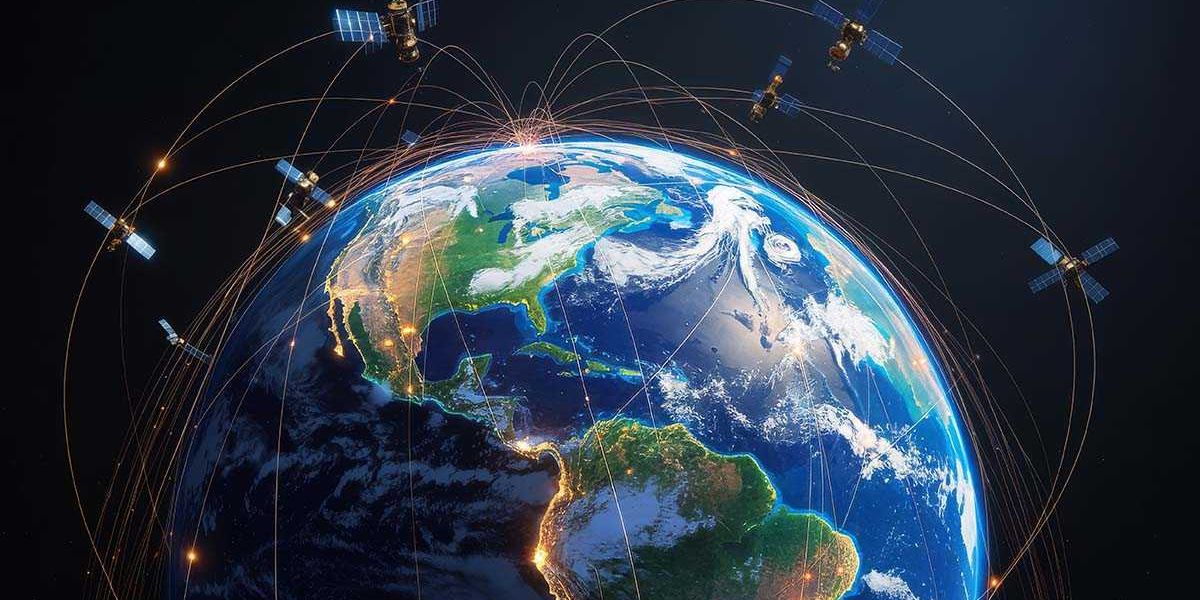
Many of us rely on GPS (global positioning system) technology every day. But what we may not realize is that the system is vulnerable to criminals, hackers, and a range of other bad actors. Between jamming GPS signals and mimicking real signals, the potential for harm is real, and it may be just a matter of time before disaster occurs—unless we do something about it.
That is where the GPS Innovation Alliance (GPSIA) comes in. Founded in 2013 to promote commercial applications of GPS technology, the industry association has made it its mission to protect GPS, global navigation satellite systems (GNSS), and other space-based positioning, navigation, and timing (PNT) systems from “harmful and illegal interference.” Member companies include industry icons like Apple, Deere & Co., Garmin, Lockheed Martin, NovAtel, Trimble, and TrustPoint.
The impact of GPS on our daily lives is hard to overstate. In addition to the millions of drivers who rely on it for navigation, GPS is used by the military, freight carriers, and other commercial entities that depend on proper locating and timing to guide their activities. These technologies also synchronize communication, electrical, and financial networks to within three nanoseconds of accuracy, and they impact more than 6 billion users in nearly every industry around the world.
Lisa Dyer is executive director of the GPS Innovation Alliance. She has over 25 years of experience as a leader in public policy, national security, business, and technology. She spoke recently with DC Velocity Group Editorial Director David Maloney about the threats to our GPS systems and what it will take to protect this critical technology.
Lisa Dyer, executive director of the GPS Innovation Alliance
Q: I’m someone who thinks that GPS is one of the greatest inventions of the last few decades. I’m old enough to have gotten lost while fumbling with maps, so I see GPS as a big improvement. Most of us now take it for granted: We simply get in our car and navigate with GPS. We know the system uses signals from satellites, but for us non-engineers, can you briefly describe how GPS actually works?
A: Absolutely, and I agree with you 100%. I put GPS up there with the internet as one of those amazing inventions. And a thank you to the U.S. government for investing in both and making GPS and the internet available to us all.
It’s really an exciting and very simple technology, with one-way transmission from space. The receiver and device are listening for it, turning it into information that you and I can use. The commercial spinoffs of GPS are also just phenomenal. You and I depend on it every day, often in ways we don’t think about.
How it actually works is that the satellite sends three different signals in one direction, from space to Earth. One tells you where you are located on the planet. The second signal sent tells you how to get from where you are now to where you want to go.
And then a third signal that most people don’t really recognize or understand, but is vitally important, is a very precise timing signal that’s accurate within a hundredth of a billionth of a second. Those timing signals are also what make our electrical grid work. It’s what makes Wi-Fi work. It synchronizes the transmissions of those signals so that you and I can flip on a light switch and immediately get electricity. And then we can connect our phone or a computer to Wi-Fi and be connected with people around the world.
So those three signals are coming from space in one direction. The signals are received by devices embedded in our iPhones and also by those that are embedded in aircraft, trains, and trucks transporting goods across the country. Those are giant ears on the ground listening for those signals, and once they get signals from at least four different satellites, the chip in the receiver and device works with the software to turn that into information you and I use to make decisions.
Q: You mentioned that it uses four satellites. Is that how it determines accurate positioning—by triangulating the signals from those satellites?
A: That is correct. It’s something called transliteration. And the irony is that the most important signal is the timing signal. That’s how they determine where you are located and how you get from Point A to Point B. The receiver is taking those timing signals and measuring from the distance of the satellite to the receiver to really pull that into information.
Q: And I find it to be highly accurate. I know when I drive, I usually get to my destination at almost the exact time the mapping system said I would arrive. But we are here to talk today about the vulnerability of GPS technology and how GPS systems can potentially be spoofed and jammed, and otherwise interrupted by bad actors. So how vulnerable is this technology we rely on so heavily?
A: In some parts of the world, we are seeing an increased incidence of jamming and spoofing. Now let me just say that any system on this Earth can be interrupted. We have invested a lot of money into protecting our cyber capabilities so that the bad actors who want to mess with our computers and other systems can’t get to them. All kinds of systems, including radar, are vulnerable. But GPS is vulnerable in somewhat of a unique way.
There are currently 32 satellites in what’s called medium-Earth orbit that provide our GPS signals. They are about 12,000 to 15,00 kilometers (7,456 to 9,320 miles) apart in space and 20,000 kilometers (12,427 miles) up. And because they are so far out in space, it is a very, very quiet signal—so quiet that if it were the type of signal that our ears could detect, it would be below the noise floor. That signal can be interrupted, both intentionally and, in some cases, unintentionally. So someone could interrupt the signal before it gets to the receiver or the device that’s listening for it.
Q: Are most of these threats coming from foreign nations or simply someone wanting to destabilize our systems?
A: We do have foreign governments who interrupt the signals, and we do have other people as well. There was a famous case in New Jersey where they discovered someone didn’t want his employer to know where he was traveling. He was intentionally interrupting the signal so that they couldn’t figure out where he was when he took breaks while transporting goods on the East Coast.
Then in March of 2024, there was someone who had turned on a device that accidently acted as a jammer and interrupted flights at Denver International Airport. In this case, the person didn’t realize they were doing it, and once the device was discovered, they were like, “Oh my gosh, I’m so sorry. I didn’t realize that that was what was happening.”
So you have a range of different actors that are intentionally and unintentionally interrupting the signals.
Q: We just talked about jamming and interrupting the signals, but there’s also spoofing. What are the differences between those, and how easy is it for someone to actually manipulate these signals?
A: Jamming is interrupting the signal, and it’s usually done for a specific period—a limited burst of time. Jammers can “broad” broadcast their interrupting signal over a wide swath of spectrum, or they can narrowly direct it at a particular part of the spectrum.
Spoofers, on the other hand, are somewhat more challenging [to deal with]. They’re essentially scammers, people who are [broadcasting counterfeit signals that trick a receiver into calculating a false position or time]. In the physical world of GPS, there have been impacts to a number of transportation nodes, particularly in Europe and in the disputed waters between China and the Philippines. What they’re doing is, they’re sending a signal out into the air that mimics what’s coming from the GPS satellite, and the person using the signal thinks they’re heading in a different direction from where they’re actually going. So they don’t realize that they’re getting incorrect information until something else tips them off that they aren’t where they thought they were.
Spoofing is actually a recent phenomenon. Until September of 2024, most of the aviation and maritime industry really didn’t report seeing too much of it. It was very theoretical, but in Europe, it started showing up in a very big way.
Q: When we use GPS in our cars, probably the worst thing that can happen is we make a wrong turn and have to backtrack. But there are systems that use GPS where the consequences of a disruption are far more serious. Could you talk a bit about the vulnerability of airplanes and defense systems that rely on GPS?
A: Let me start with the defense systems. The GPS satellites send out two different types of signals. They’re roughly divided into military signals and civil signals. The defense and the weapons systems that are going into combat or might be delivering weapons to a particular location are receiving encrypted signals, which are much more difficult for bad actors to jam and spoof than unencrypted signals.
However, what most people don’t realize is that the defense enterprise, particularly the U.S. Transportation Command, relies on the commercial transportation industry for 80% of their work moving people, goods, weapons, and all kinds of things to forward-deployed bases. And much like our cars, the commercial transportation industry largely relies on those civil signals that are unencrypted.
Ironically, that wide unencrypted availability is the magic of GPS, and it is what helped to create multibillion dollar companies using these free, unencrypted signals from the satellites and turning it into this amazing information you and I can use.
Q: So, then, how vulnerable are our air traffic networks?
A: Airplanes use those unencrypted civil signals in their receivers and devices, and those are integrated into the aircraft. These are highly regulated receivers that go into aircraft, whether they’re general aviation aircraft or cargo aircraft. So this is an area where we are very keen on seeing the government take action to stop the jamming and spoofing of the GPS system.
There are so many public safety and economic applications for GPS. It sounds scary if we have a world where we can’t rely on the GPS or we’re concerned that we might not be navigating where we actually thought we were going to go.
Q: So bottom line, what can be done? Is it a matter of encrypting every kind of GPS signal, or are there other, simpler ways of preventing jamming and spoofing?
A: There are a number of different fixes. First of all, the United States has not yet actually made a statement acknowledging that this is a problem. Many European nations face it every day even while operating in areas that are outside of conflict zones, such as the Baltic Sea and the Arctic, and they have spoken out about it.
I would love to see the U.S. government make a statement [acknowledging that GPS interference is a serious problem]. It’s impacting public safety and impacting commerce.
In the meantime, I know that a number of aircraft manufacturers are working hard to integrate some specialized technology to make their receivers and their entire systems more resistant to jamming and spoofing.
Q: While the U.S. has not yet acknowledged the problem, is there a way to address these vulnerabilities in our GPS systems at the international level?
A: Yes, some great work can be done through international organizations, such as the International Civil Aviation Organization, to try to address these issues diplomatically. Within the GPS system itself, there are some items that we think would be really important for the U.S. government to integrate, and one of those is an authenticated signal that comes from the satellite or a ground station to the receivers and devices. The signal from the satellite would basically say, “Hey, you can depend on this signal. I’m the genuine thing. This is not being spoofed.” This would allow the receivers and devices to marry that authentication signal with the actual signal and have confidence that what they’re getting is real.
Q: So it sounds like there are some good proactive measures that can be taken.
A: Absolutely. And you know, one of the really exciting parts of GPS is how many different use cases there are—how many people rely on these signals. There are people working in digital construction as well as farmers who use precision agriculture equipment. They need signals that can get them down to one to two centimeters in accuracy. This compares to the accuracy for driving. Those regular signals for driving come with an accuracy of about two meters, which works well enough for you and me.
We have to understand all of those use cases and what each one needs from GPS to make sure that users can get what they need and that it is available to them continuously and with integrity. And then we have to look at some of the new commercial industry applications that can be integrated into GPS systems to create the redundancy and resiliency that is needed.
