


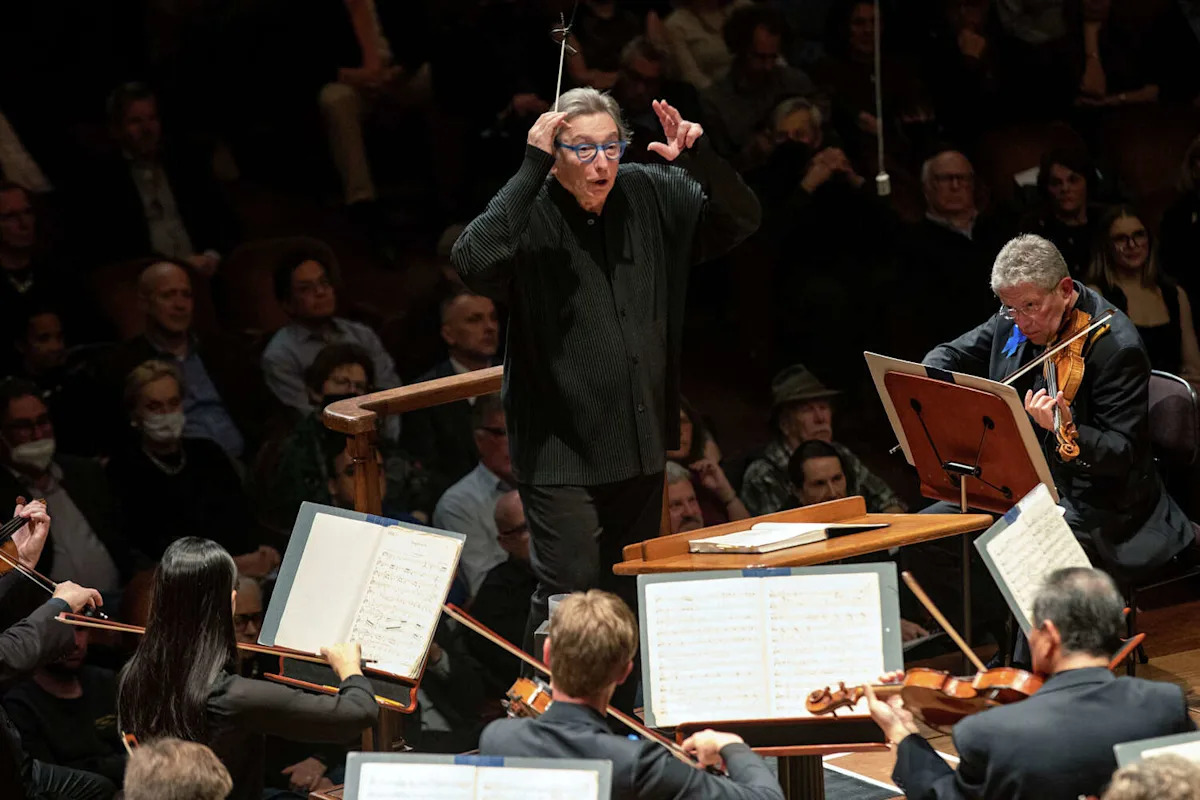
To understand what Michael Tilson Thomas meant to the musical world, and to the Bay Area in particular, you really had to be here.
In the wake of Thomas’ death on Wednesday, April 22, the press and social media around the world have been inundated with tributes, celebrations and fond memories of the conductor and his legacy. His recordings, his live performances and a wide array of other projects over more than half a century- including the “Keeping Score” series and the creation of the New World Symphony in Florida, to name just two – left an indelible imprint on music.
But for all his international stature, I don’t think anyone ever quite got the full benefit of Thomas’ artistry the way you and I and other music lovers in San Francisco and the greater Bay Area did.
Yes, he had long and fruitful relationships with other orchestras, particularly the London Symphony Orchestra, and those patrons got to hear him perform plenty of times. And yes, his high visibility over many decades meant that he was known, either by reputation or through first-hand encounters, to just about anyone with an interest in classical music.
Michael Tilson Thomas named the new director of the San Francisco Symphony, succeeding Herbert Blomstedt in 1995, at Davies Symphony Hall in San Francisco on June 22, 1993. (Brant Ward/S.F. Chronicle)
None of that, though, was quite the same as having the privilege of hearing him and the San Francisco Symphony work their collective magic week after week, month after month, year after year. That one was a special bounty reserved for us alone.
I say this not to gloat (OK, maybe just a tiny bit). Rather, it’s because full-on, steady exposure to Thomas’ artistic sensibility was a unique way – perhaps the only true way – to grasp his genius. You had to hear him in action often, over long spans of time, to get the full MTT Experience.
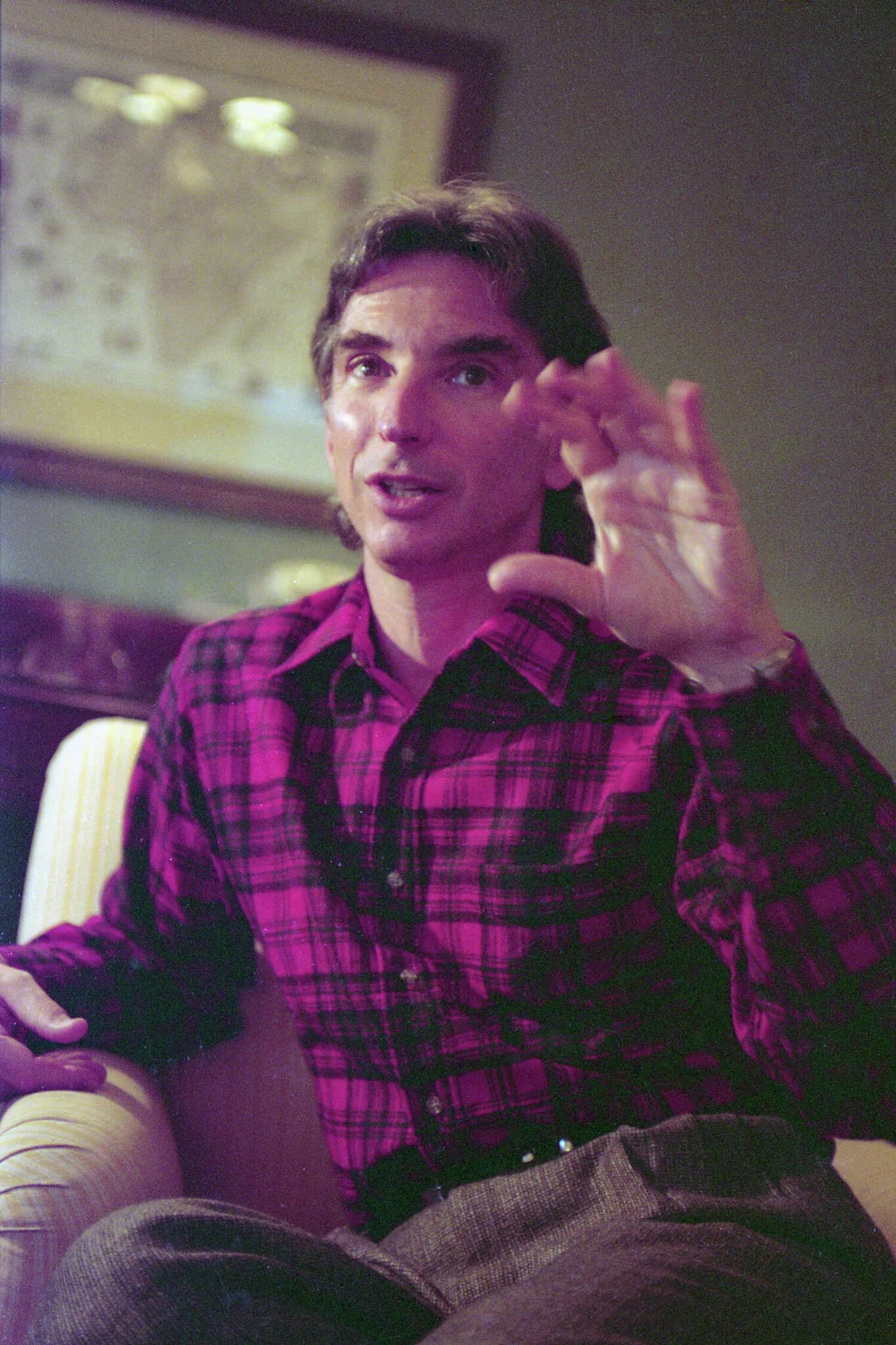
Michael Tilson Thomas at Davies Symphony Hall in San Francisco on Nov. 29, 1993, after being hired as the new San Francisco Symphony music director. (John O’Hara/S.F. Chronicle)
“He really became part of the fabric of the city and of the arts community,” said San Francisco resident Susan Toland, a Symphony subscriber since the mid-1980s.
Toland and her husband, Scott Lefevre, who began attending Symphony concerts in 1975, were part of the MTT fandom that grew over generations.
“Compared to many other conductors, Michael was unique in how he reached out to the audience,” Toland said. “He wanted us to enjoy it as much as he did.
“You know the saying, ‘It takes time to grow an old friend’? He became an old friend over time.”
Thomas was also an example of an artistic leader serving as a guiding star for an entire geographic area – emphasizing the importance of audiences being, as it were, cultural locavores.
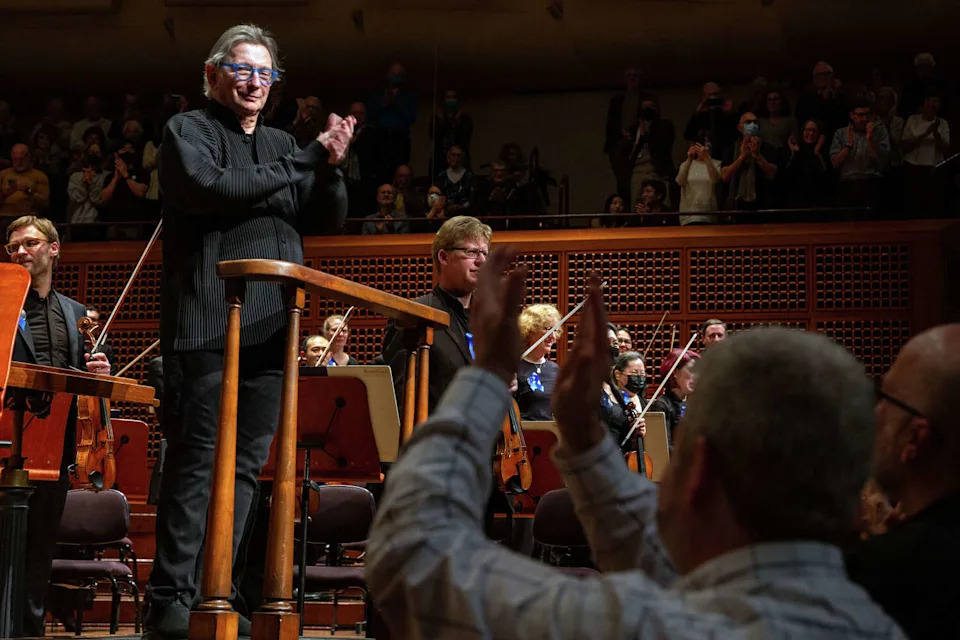
Michael Tilson Thomas, former music director of the San Francisco Symphony, engages with the audience after he conducted one of his final concerts with the orchestra, Gustav Mahler – Symphony No. 5 in C-sharp minor (1902), at Davies Symphony Hall on Jan. 25, 2024. (Jana Asenbrennerova/For the S.F. Chronicle)
“Thomas elevated what classical music could mean to a region, and what a region could mean to classical music,” Opera San José’s general director, Shawna Lucey, said in a statement to the Chronicle. “He insisted that Northern California be a place where great art was not merely presented but made.”
Just as relevant was the fact that Thomas’ artistic approach was built on a commitment to spontaneity, variety and unpredictability. He believed that any sufficiently worthwhile piece of music could be performed in an infinite number of ways, and that the interpreter’s task was not to choose the one true path among them, but to explore all of them with as much passion and commitment as the performers could muster.
During a recent conversation, San Francisco Symphony concertmaster Alexander Barantschik recalled how Thomas would sit at the piano in his dressing room before concerts, playing snippets from the upcoming program. “Every time he’d play a passage it would be a little different – a little change in tempo, or an emphasis on a different part of a musical phrase.”
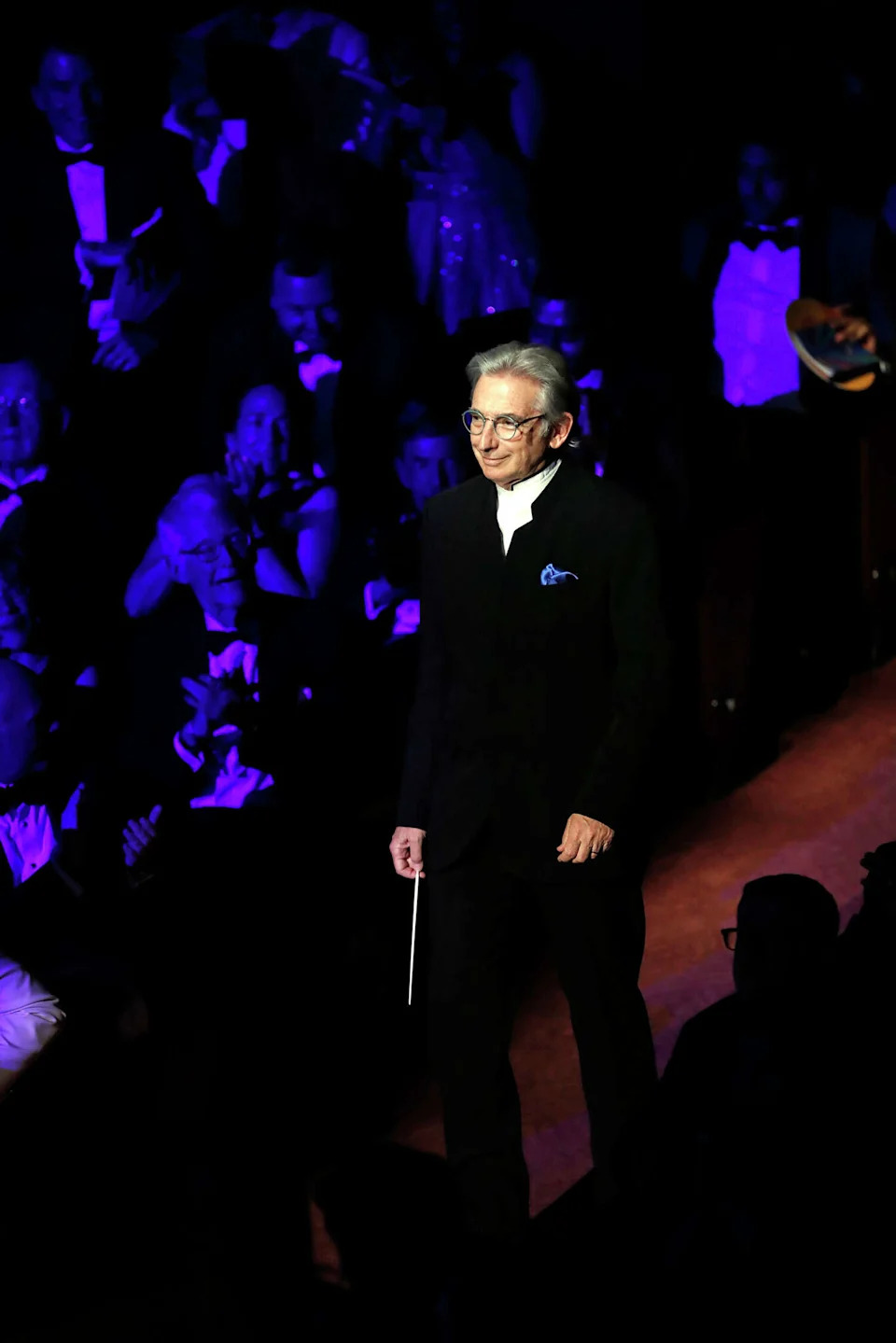
Michael Tilson Thomas is introduced at 2019 San Francisco Symphony Opening Night Gala at Davies Symphony Hall on Sept. 4, 2019. (Scott Strazzante/S.F. Chronicle)
Those variations, in turn, played out on larger and larger scales. If Thomas conducted four performances of a Mahler symphony over the course of a week, those performances would be shot through with interpretive twists – small ones, to be sure, but enough to make each night’s rendition present a new aspect compared to the one before.
Inevitably, when he returned to the same symphony four or five years later, the rethinking had become even more thorough, to the point where the entire meaning of the piece had shifted or been recalibrated. It was like watching an accumulation of genetic mutations lead to a whole new species.
The only flaw in that evolutionary metaphor is that, in Thomas’ world, mutations never became fixed. Everything was up for reappraisal. “What if we tried it this way instead?” was always a legitimate position in his mind, while “Nope, we’ve found the right tempo for that passage” was not.
As a listener, how do you track that kind of evolution without being there as a witness throughout the process? Every performance Thomas led represented that night’s particular combination of interpretive choices, a combination that would be subtly rethought 24 hours later to produce a different but equally valid reading. Nothing was ever set in stone.
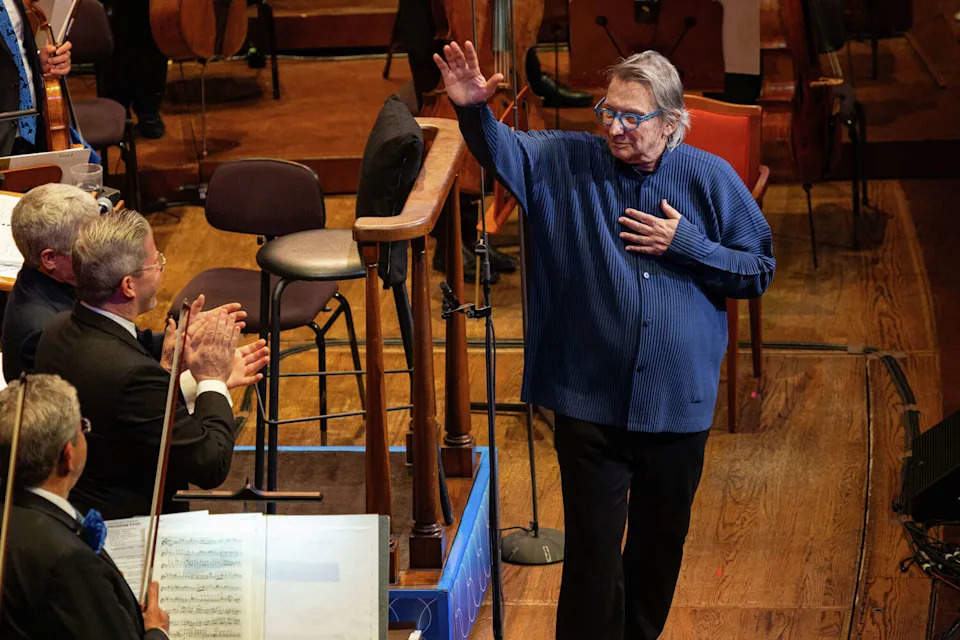
San Francisco Music Director Laureate Michael Tilson Thomas greets audience after his final concert with the orchestra during the “MTT 80th Birthday Concert” at Davies Symphony Hall on April 26, 2025. (Jana Ašenbrennerová/For the S.F. Chronicle)
Obviously, this isn’t to suggest that anyone was realistically going back to hear the same program night after night, although I suppose you could if you’d had the money, time and inclination (I never did it myself).
But every concert took place within a thrumming network of possibility and choice which you could make out if you listened for it carefully. It was as though each performance of Beethoven’s Fifth existed against a backdrop of all the Beethoven Fifths that hadn’t been chosen, and they were in the room there as well.
The one that didn’t materialize the night you came to Davies Symphony Hall could easily find its way the next time. Anything was possible. You just had to be there.
Joshua Kosman is the Chronicle’s former classical music critic.
This article originally published at To understand Michael Tilson Thomas’ genius, you had to be in San Francisco.
