


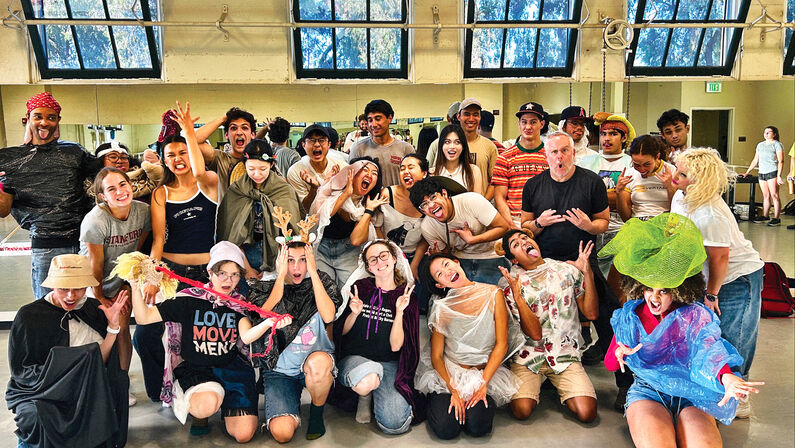
“Welcome to bad dancing,” says Alex Ketley, a professional choreographer and former member of the San Francisco Ballet who teaches Dance 123: Hot Mess & Deliberate Failure as Practice. Ketley, an advanced lecturer in the department of theater and performance studies and a former Guggenheim Fellow, says it’s his most popular course.
About 20 undergraduates and graduate students have signed up for what the course catalog describes as “a dance class in how we become the worst dancer possible.”
“That’s something I’ve never been told to do,” says Annika Younge, ’27.
“Run with absolute abandon,” Ketley says. And, like kids at recess, the students swarm onto the floor at Roble Gym, prancing, leaping, and stumbling into one another. Next, “make crazy monster faces,” Ketley instructs. Now, he says, “Repeat the phrase: ‘I’m alive and filled with watermelon.’ ”
‘So much of our dance training is claustrophobically serious. Happiness, in a repressive culture, is transgressive.’
After class, Ketley says that his objective is for students to challenge and expand their perception of what is beautiful by performing silly pantomimes and reacting to movement prompts that are virtually impossible to do well. “What happens,” he asks, “if we accept failure as a creative virtue?” By letting go of perfection, students might discover something unexpected and quite beautiful, he says. From dancing at an elite level to rock-climbing for 30 years, Ketley has “obsessively” explored movement. He designed the course after using chaos in his own process and watching thousands of other performers: “I noticed a type of brilliance when people relinquish control.”
Why is dance the right medium? “It’s fun,” he says. “So much of our dance training is claustrophobically serious. Happiness, in a repressive culture, is transgressive.”
The class culminates in a group performance when, Ketley says, students discover how far they’ve come from feeling fearful and embarrassed to dancing in front of complete strangers. “It’s a very telling and liberating moment for them.”
Elijah Williams, ’26, took the course hoping it would be a confidence booster. Several weeks in, it’s become one of his favorite classes—a helpful lesson in how to break out of your shell. Plus, he says, “I feel more able to express myself through failure.”
“Artistic expression is quite limitless if we jettison the need to be correct,” says Ketley.
Tracie White is a senior writer at Stanford. Email her at traciew@stanford.edu.
