


Literary credibility in the age of AI.
Did you know LARB is a reader-supported nonprofit?
LARB publishes daily without a paywall as part of our mission to make rigorous, incisive, and engaging writing on every aspect of literature, culture, and the arts freely accessible to the public. Help us continue this work with your tax-deductible donation today!
This essay is a preview of the summer issue of our print journal, the LARB Quarterly, no. 49: Traffic, out now. Become a member for more essays, criticism, poetry, fiction, and art—plus the next four issues of the Quarterly in print.
¤
NAPOLEON’S FAVORITE BOOK of poetry was a fraud. He carried it through the Italian campaigns and still had it with him, years later, in his exile on Saint Helena. Attributed to an ancient Celtic bard named Ossian, the poems were presented as translations of a recently “discovered” third-century epic cycle. Raw, melancholic, and untouched by Christian pieties, Ossian’s poetry swept across Europe, fueled nationalist sentiment, shaped early Romantic taste—Goethe was a fan—and, improbably, became Napoleon’s bedside read, even as many of Europe’s literary scholars suspected it of being a forgery. Today, Ossian is a curiosity with which hardly anyone bothers.
As odd as the episode now seems, it was less an anomaly than a recurrent symptom of a certain kind of malaise. Late 18th-century Europe was gripped by nostalgia for imagined pasts unspoiled by the perceived corruptions of modern life. Writers and readers alike yearned for the sublime, for sentiment, for a “natural” folk genius unburdened by learning. Ossian’s songs—primitive, elemental, unmediated—offered what the existing canon could not: the promise of uncontaminated origins.
We have, I believe, crossed a new threshold, and all authored writing—novels, poems, screenplays, newspaper columns, not to mention love letters—will be judged according to which side of that divide it falls on. On one side are texts produced before the arrival of generative large language models (LLMs). On the other, everything that has followed—texts that might still be useful, even compelling, but that will always face a lingering suspicion of not being entirely human, of having been smoothed by systems trained to predict the word that comes next. We will come to prefer the former over the latter, not because it will be better, but because we will be more certain of its origins.
Tastes Catch Up
A recurrent blind spot when imagining the effects of any large-scale technological change is to assume that the world will change but that what we value in it will not. In practice, our tastes swiftly adjust—and in ways that often blunt the most alarmist forecasts. Mass industrial production didn’t wipe out handmade crafts; it turned them into a marker of distinction and raised their price. Photography didn’t kill painting; it updated its ambitions. Wikipedia didn’t abolish expertise; it changed what we demand of experts. In the same way, AI won’t downgrade writing, but it may permanently change what counts as good writing.
Perhaps you’ve already adjusted. Perhaps you’ve started treating books, articles, essays, and emails written today differently from anything before, say, 2022. On hearing a polished sonnet in effortless iambic pentameter at a wedding toast, you may now smell a rat. If that reflex hasn’t set in yet, my bet is that it will soon. In fact, I suspect the distinction will be drawn first by those of us who rely most on LLMs in our own writing, who know how hard it is to resist their knack for finishing a thought before it has fully formed—sometimes directing it in an unanticipated direction. The better and more omnipresent these systems become, the more we will come to prize the culture that preceded them. We have ejected ourselves from our all-human paradise, and we will look back on its artifacts with a trust that can never be recovered.
Some of the unease around LLMs centers on hallucinations: invented facts, spurious citations, confident nonsense. Those are conspicuous and easy to ridicule, but they’re also tractable. The model designers will develop safeguards, and we will develop habits. We’ll learn to double-check things that seem too good to be true. No, the real threat is not the flamboyant hallucination. It’s the impossibility of knowing whether any text we now come across represents an individual sensibility or a synthetic hybrid—the result of a human prompt and a system trained to complete patterns drawn from vast archives of prior writing.
The Threat of Recursion
If a key ambition of cultural production has long been innovation, its opposite is recursion: the slow, imperceptible drift that happens when a body of work increasingly reflects what preceded it. Generative models are trained to reproduce what is most statistically probable. When their own outputs are fed back into the training pool, that bias compounds. Over time, the informational commons is quietly reshaped—not by the introduction of obvious errors but by the systematic reinforcement of the already likely and the gradual disappearance of the rare, eccentric, and hard to predict.
Recent studies show that recursion is not just a metaphor: researchers have documented a form of “model collapse” when systems are trained on their own output. As this research shows, low-probability events—idiosyncratic turns of phrase, unusual associations, minority styles, marginal voices—are the first to vanish. What results is not falsehood but the flattening of language and experience.
From the standpoint of writers, this is the 21st-century version of the old “anxiety of influence”: the fear of parroting predecessors rather than speaking in one’s own voice. The current situation is comparatively worse because the anxiety plays out between reader and writer: the latter is always under suspicion of ceding to the obvious temptation of expedient completion. As such writing circulates, is absorbed, and gets fed back into training data, the signal of human authorship degrades. Those choices don’t just shape individual texts—they may eventually thin the culture itself.
It should surprise no one that AI companies themselves are alert to this problem. Their solution has been to forage any remaining scrap of certifiably human text. Google has paid $60 million to Reddit for access to what it has praised as “authentic, human conversations and experiences”—material that most of us might have dismissed as the exhaust fumes of online life. Other gold mines lie in the past. OpenAI has struck a licensing deal with Time; Amazon has licensed all New York Times content. Each archive is over a century old, offering something no contemporary text can match: the guarantee of all-human content.
Our own tastes will likely go the way of the AI companies, and for similar reasons. It is becoming impossible for contemporary writers to convincingly signal their all-human bona fides, so why should readers risk it? Institutions are making a valiant attempt to ensure reliability. In March, Hachette pulled the forthcoming US edition of the 2025 UK horror novel Shy Girl over suspicions that it had been largely AI-generated. Last month, a controversy erupted when the Commonwealth Short Story Prize for the Caribbean region was awarded to a work that readers identified as bearing the hallmarks of LLM writing, a suspicion apparently confirmed when certain AI-detection platforms determined the story was significantly or entirely produced by machine. Academic journals and popular magazines alike now require solemn declarations from their contributors that no AI tool was used in the writing of a submission. It’s an unenforceable demand, and likely to be flouted in the supermajority of cases. And as unenforceable rules tend to do, it will progressively reduce any social obligation to comply. As writers blithely check the box, they will grow suspicious that others are doing the same. The result will likely be a generalized wariness of the human portion of any contemporary published content. Trust will come down to chronology.
If so, then the fears gripping writers today are misplaced. The 2023 Writers Guild of America settlement was widely hailed as a win for humans. After a strike that ran from May to late September, the studios agreed that AI could not write scripts or receive writing credits, and that writers could not be made to use generative tools. The real danger, though, isn’t that audiences will want stories generated by machines—my bet is they won’t—but exactly the opposite. Audiences will increasingly demand stories written by humans, while perennially suspecting any given story of AI-doping. From now till yonder, every screenwriter will face the same mistrust. Solving that credibility problem would require more than constraints on studios; it would require constraints on writers themselves.
Faced with that kind of permanent suspicion, there will, no doubt, be heroic attempts to secure trust by drastic means. Writing may gradually edge toward performance. Maybe poets will resort to composing their verse in glass boxes in the public square, the way chess players are now forced to play in controlled environments. In my own world of teaching, such measures have been shown to work, up to a point. Oral examinations, which were falling out of fashion in universities, are back, because they are the one sure way of testing students’ actual knowledge. But culture is not a sit-down exam; the point is not verification but creation. There are no easy fixes to our credibility problem.
The Fallback: Plumbing the Past
Short of forcing the genie back in the bottle or erecting a reliable cordon sanitaire around the use of LLMs—both of which seem unlikely, perhaps undesirable—we will adapt in the way cultures invariably do. Our tastes will change. We will recalibrate what we find beautiful, vulgar, and merely banal.
Reliably human authorship may come down to a date. OpenAI opened access to GPT-3 in late 2021; by 2022, it was within everyone’s reach. Everything written before that point earns the all-human certification. Everything after does not. I can already hear the literary snobs of the future loudly declaring that they only read pre-GPT fiction and wouldn’t dream of touching anything more recent. They’ll talk about purity and authenticity, with the earnestness people reserve for heritage chickens and artisanal salt. Expect publishers to get in on the action, and ever more “lost gems” to be discovered on backlists and reissued with fresh covers. I can almost see the “Verified Human Content” ribbons stamped on those covers, like non-GMO labels on European beef—less a guarantee of quality than a reassurance of provenance.
The New Humanism
This is not the first time culture has had to claw its way out of a recursive spiral of its own making. Last time around, we also became the victims of our own ingenuity. The tools designed to preserve and refine knowledge ended up enclosing it, producing a kind of intellectual inbreeding.
The first humanist turn—the one we associate with the Renaissance—was a response to the dominant intellectual tradition of its day. In the 15th century, learned culture in Western Europe was still dominated by the centuries-old scholastic tradition, concerned primarily with reconciling classical logic, especially Aristotelian philosophy, with Christian theology. Yet most scholastics knew neither Greek nor Hebrew. They worked from translations of translations, mediated through generations of commentary. The result was a set of increasingly insular arguments, interpretations of interpretations. The result can literally be seen on the page: medieval manuscripts often feature a snippet of authoritative text as a small island at the center, surrounded by a sea of gloss, dense commentary filling the margins. Over time, the map became the territory. The actual goal—perfecting moral reasoning—got eaten up by the method.
This is the culture the first humanists—figures like Petrarch and Erasmus—set themselves against. Their rallying cry, “ad fontes” (“to the sources”), was a call for a reset. They sought texts free from the accumulation of layers of commentary and syllogism. Ancient works were valued not because they were presumed wiser but because they were thought more trustworthy, closer to the moment of thought itself. Petrarch and Poggio Bracciolini hunted down forgotten manuscripts by Cicero, Vitruvius, Quintilian, and Lucretius. Erasmus produced new editions of the New Testament, in which the Greek original sat side by side with his corrected translation of the Vulgate Latin because, as he put it in the dedication to Pope Leo X, “our salvation was to be had in a much purer and more lively form if sought at the fountain-head and drawn from the actual sources than from pools and runnels.”
In today’s terms, Renaissance humanists were trying to bypass corrupted training data. They were searching for a cleaner signal—texts not yet saturated by the interpretive habits of the system that transmitted them. They were trying to break a cycle of recursion. Over time, however, what had initially been a reset in scholarly practice hardened into a cultural heuristic. If earlier sources were purer, then the connection to antiquity took on an aura of authority. What began as a guiding principle gradually slid into something closer to antiquarian fetishism.
The Demand for Fakes
Much of the humanists’ work was devoted to uncovering the errors that had crept into the canon. Some were mistakes of translation that got compounded across generations. They were the hallucinations of the Middle Ages: just as today’s LLMs supply citations to texts the user might wish existed, those earlier mistranslations often produced the interpretation that Christian theology was hoping to find.
Other errors were more willful forgeries in the service of Christian interests. The most famous of these was the Donation of Constantine, an eighth-century imperial decree that conveniently granted the papacy sweeping earthly powers. Another, the False Decretals, was a collection of canon law texts stuffed with forged papal letters and conciliar documents, presented as if they came from the church’s earliest era. In both cases, the fraud lasted for centuries, until humanist philologists definitively ruled out their authenticity.
However, the philological methods developed by the humanists, which proved so potent in the detection of forgeries, would in turn be used to produce better forgeries. At the same time, by elevating ancient sources—insisting that proximity to origins conferred authority—the humanists made authenticity uniquely valuable. And whenever authenticity becomes prized, the payoff from faking it increases. The result was a flood of fakes claiming the authority of antiquity.
The fetishizing of antiquity did not stop with the Renaissance, though it took on different forms. Where the humanists turned to the past in search of reliability, the Romantics yearned to recover authentic voices, unsullied by modernity and expressing a folk spirit, rooted in the land and common people, which helps explain how James Macpherson, an obscure Scottish writer, could ignite a literary sensation by inventing a Celtic bard out of whole cloth. But Ossian did not, in fact, emerge out of nowhere. His poems appeared at a moment primed to receive them. They were welcomed not as scholarly discoveries but as the voice of an uncorrupted folk genius—songs that seemed to come from a time before poetry had become self-aware.
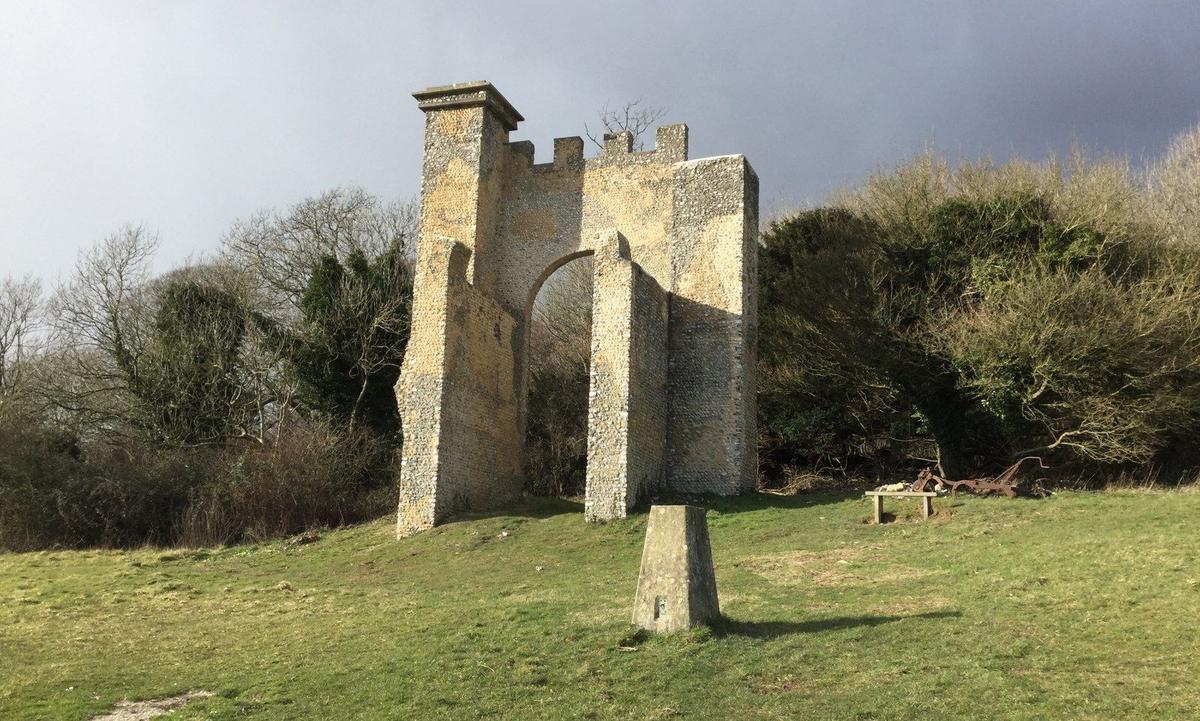
That appetite manifested not just in texts but also in stone. Late 18th-century Europe developed a peculiar taste for ruins that had never been ruined. Across Britain, France, and Germany, aristocrats commissioned sham Gothic abbeys, crumbling towers, broken arches—carefully designed to look ancient. These “folies” were especially common in English landscape gardens, where architects such as James Wyatt and Humphry Repton supplied decay on demand: ruins meant to evoke melancholy and the sublime.
Unlike the songs of Ossian, which were offered as the real thing, a miraculous survival, the garden ruins were not passed off as authentic. They were theatrical evocations of antiquity. Yet the distinction matters less than one might think. Both satisfied the same longing for origins: one openly staged, the other presented as discovery. In both cases, the audience encountered what it had come hoping to find. As Anthony Grafton, the preeminent historian of forgery, notes in what remains the definitive study of the subject, Forgers and Critics: Creativity and Duplicity in Western Scholarship (1990), “one who studies the career of forgery in the West may well wonder if the human mind nourishes a deep-seated desire to be taken in as grandly and thoroughly as possible.”
That’s because fakes are not merely falsehoods. They’re also remedies for an anxious culture.
The Fakes of the Future
If my wager is right, this time will be no different. First will come a stylistic arms race: humans and machines trying to out-human one another. Writers worried about sounding synthetic will begin roughing up the overly polished. Reddit is already filled with plaintive threads by people complaining of being mistaken for bots and counseling each other to deploy more profanity, more verbal tics, more colloquialisms. One of the clues that Shy Girl might have received more than a little help from AI was its overreliance on the “rule of three”—the rhetorical preference for grouping words, phrases, and narrative elements into trios—a principle that has been well absorbed by LLMs. Perhaps we should soon expect a profusion of meandering lists of examples, events, characters, ideas, terms, and illustrations in human writing. My own graduate students have confessed to deliberately leaving typos in their submitted work: small acts of self-sabotage offered up as proof of life. Like our unfortunate decades-long flirtation with distressed jeans, the imperfections will be the point, on the implicit theory that humanness now resides in mess rather than mastery.
The machines, of course, will play catch-up, as a growing share of prompts become variations on the plea “don’t sound like an LLM.” Whatever tics humans adopt as authenticity signals will quickly be absorbed back into the training data. Models will learn to introduce the little stumbles that editors once red-penned away. Just as they learned to mimic fluency, they will learn to mimic friction. The markers of humanness will be digested and redeployed as fast as they are invented.
In response, expect the pressure for evidence to grow. Readers will not simply want a human voice; they will want proof of a human hand. An aesthetic of cross-outs, marginalia, and visible drafts will emerge. I have always had a weakness for The Paris Review’s writer interviews, with their opening photograph of a manuscript page; I expect to love those all the more in the years ahead. Tom Hanks’s endearing infatuation with old typewriters will suddenly seem less quaint, and more like a justifiable self-defense mechanism. Yet even these gestures will eventually lose their force. Cross-outs can be staged. Drafts can be fabricated. When authenticity becomes valuable enough, its outward signs grow plentiful.
When it becomes obvious that humanity cannot outrun its own reflection in the model, the last refuge of the human will be chronology. Publishers will mine the past with fresh zeal, hunting for anything time-stamped firmly on the safe side of the divide. Back catalogs will be picked clean; lost classics will be found. But once the past has been thoroughly mined, the incentive to enlarge it will grow irresistible. We will not only collect pre-GPT texts—we will also begin producing them. Abandoned manuscripts will be found in drawers and old security deposit boxes, correspondences of dead writers will resurface, juvenilia will be recovered from attics and family archives—some of it genuine, some less so. The forgeries will vary in ambition. Some will be grand literary discoveries, complete with elaborate backstories and meticulous paper trails. Others will be more modest: a cache of notebooks, or a conveniently unfinished novella whose greatest claimed virtue will be to have missed the age of machine assistance.
In this way, the future will produce both elaborate hoaxes and the literary equivalent of those English garden ruins: newly made works carefully aged to evoke a vanished humanity—artifacts that do not quite ask to be believed and yet seek to satisfy the longing for origins.
Our Most Human Trait
If any of this is right, a faint suspicion should be creeping in by now—about my claims, the examples I’ve chosen, perhaps the sentences themselves. This is, after all, another text of the GPT era. So, is this a human mind at work, or the result of a set of prompts guided along by an averaging algorithm? Even as I’m writing, I feel that suspicion too. As readers’ preferences change, so do writers’ incentives. In a culture newly alert to provenance, every author will anticipate the reader’s doubt.
There is much at stake for authors trying to overcome those doubts. As Grafton notes, the songs of Ossian won their creator not only fame but also “a series of impressive jobs and pensions that transformed a poor young man forced to do literary odd jobs into a member of the social as well as the literary establishment.” All the more reason to be suspicious then. Which leaves me, as it does every writer from now on, in the position of having to persuade you of my own humanity.
That need rests on an assumption that we still care about individual human vision, that authorship will still matter to us in something like the old way. I’m inclined to think we do and that it will. But I can’t be certain. It wouldn’t be the first time we just shrugged and carried on. The concept of authorship may get duly stretched. Someone will inevitably point out that Renaissance masters ran workshops, that their garzoni did three-quarters of the work. Didn’t Raphael only paint the faces and the hands?
My wager that we will turn to the past, that we will fetishize pre-GPT work, that we will manufacture new old things, may be wrong. Instead, we may simply adapt. We may come to read the way we now eat—content to consume highly processed fare, vaguely aware of what has been lost, but willing to trade it in for abundance and ease. The label says “homemade flavor,” and that might be enough. After all, while mass production gave rise to a cult of the handmade, industry still won the long game, by imitating just enough of its trappings. Jeans arrive pre-torn, boots pre-scuffed, tables pretreated with the patina of imagined family dinners. If that is the pattern, then the future of literature may not be defined by anxious humanism at all. Perhaps a newly devised look of authenticity will suffice.
Those fake ruins scattered through 18th-century English gardens weren’t really meant to fool anyone. Visitors knew they were built yesterday—it didn’t matter. The feel of antiquity was enough. Same was even true of Ossian. Doubts about the poems’ authenticity surfaced almost immediately; Samuel Johnson called them a fabrication. They swept Europe anyway. Napoleon still declared Ossian greater than Homer. Perhaps we will shrug and just learn to enjoy the fake ruins.
Which leaves me with little to offer but doubt itself. As it happens, doubt remains one of the few human traits that AI still struggles to reproduce. LLMs are brilliantly fluent but incurably confident. They are trained to finish sentences, not to tell you when they’ve reached the limits of what they know. The reason runs deeper than design choice: these systems have no independent way of querying what they know versus what they’re confabulating because the distinction doesn’t exist in them. Under the hood, their internal weights track patterns in language, not the reliability of the claims being made. Teaching a system to know when it doesn’t know, and to reliably reveal it, is surprisingly hard. As long as that remains a technical challenge, genuine doubt remains a refuge of the human. I don’t know which equilibrium we will settle into: an elevation of the pre-GPT world or a shrugging acceptance of the hybrid culture that follows. The only thing I can offer with confidence is my own uncertainty. It may be the most human trait we have left.
¤
Featured image: Chris Thomas-Atkin, The Folly [Nore Folly, West Sussex, United Kingdom], 2018, is licensed under CC BY-SA 2.0.
LARB Contributor
Krzysztof Pelc is the Lester B. Pearson Professor of International Relations at Oxford University. His most recent book is Beyond Self-Interest: Why the Market Rewards Those Who Reject It (Bloomsbury and Oxford Press, 2022).
Share
LARB Staff Recommendations
-
Jamie Metzl talks about human-centered technology, why he still bets on our species, and what creative collaboration with machines could look like.
-
Megan Garber’s new book argues that our regime of screens has made us into ‘two-way people,’ split between our flesh-and-blood selves and our digital avatars.
