


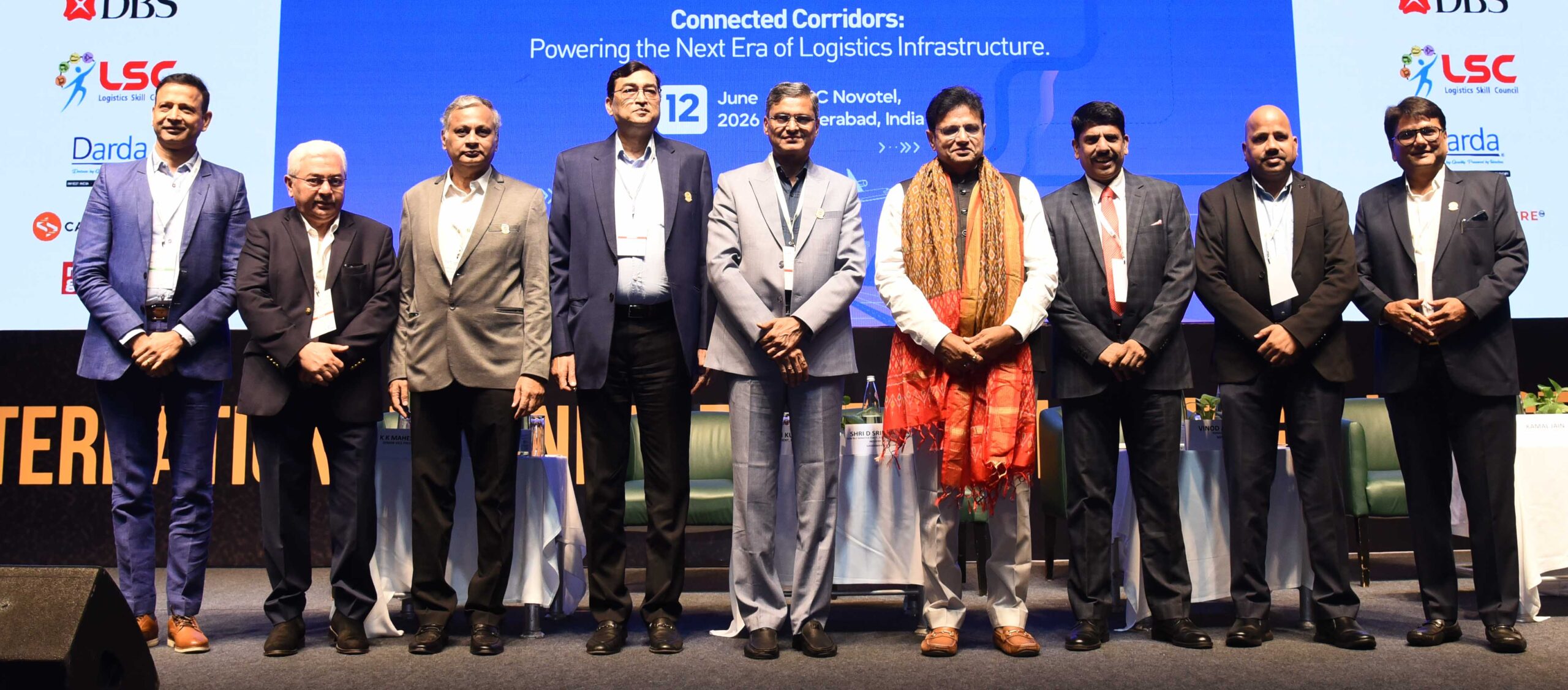
HYDERABAD: Telangana is rapidly emerging as one of India’s most promising logistics destinations, driven by strategic infrastructure investments, progressive policies, and a strong vision for the future, said Shri D. Sridhar Babu, Minister for Information Technology, Electronics & Communications, Industries & Commerce and Legislative Affairs, Government of Telangana, while delivering the keynote address at the International Conference on Shipping & Logistics 2026 (ICSL 2026) organized by the Logistics Committee of Federation of Telangana Chambers of Commerce and Industry (FTCCI) at HICC Novotel, Hyderabad on Friday.
Delivering the inaugural address, the Minister emphasized that logistics is fundamentally about connection—connecting manufacturers to markets, farmers to customers, businesses to opportunities, and nations to the world. “Every connection creates movement, and every movement creates opportunity. Today, we call it logistics,” he said.
Referring to the changing global trade landscape, Shri Sridhar Babu observed that efficiency alone is no longer sufficient. Resilience, speed, reliability, and adaptability have become critical drivers of economic growth and global competitiveness. Countries that can adapt quickly, remain connected, and deliver efficiently will lead the future, he noted.
Highlighting Telangana’s strengths, the Minister said that although the state does not have a coastline, it has transformed its inland location into a strategic advantage. Telangana contributes nearly 5% of India’s GDP, ranks seventh among merchandise-exporting states, and recorded exports of over ₹1.61 lakh crore in 2024–25. The state was also ranked eighth nationally and second among all landlocked states in the Export Preparedness Index 2024.
The Minister highlighted Telangana’s strategic location, strong multimodal connectivity, Logistics Policy 2.0, the upcoming Mega Multimodal Logistics Park at Manoharabad, expanding air cargo capabilities, and world-class skilling ecosystem as key enablers for transforming Telangana into a leading logistics hub.
Inviting investors and industry leaders to partner with the state, Shri Sridhar Babu said, “Telangana is ready to connect markets, support industry, and build the logistics ecosystem of the future. Come, invest in Telangana. Grow with Telangana.”
Giving his welcome remarks R Ravi Kumar, President of FTCCI said Hyderabad is uniquely positioned to emerge as India’s premier hub-and-spoke logistics destination. With the upcoming Multimodal Logistics Park, expanding industrial ecosystem, and growing focus on integrated transportation, Telangana has the potential to redefine logistics efficiency in the country. At the same time, strengthening rail connectivity to Inland Container Depots and developing air connectivity in emerging industrial centres such as Warangal, Karimnagar, and Khammam will be critical to unlocking the state’s full logistics potential. ICSL 2026 serves as an important platform for industry, policymakers, and infrastructure stakeholders to collectively shape a future-ready, technology-driven, and globally competitive logistics ecosystem.”
According to Kama Jain, Chairman of the Logistics Committee of FTCCI, the conference brought together policymakers, government officials, logistics companies, supply-chain professionals, exporters, importers, technology providers, investors, startups, infrastructure developers and academia to deliberate on the future of India’s logistics ecosystem.
The conference featured four high-level panel discussions covering critical aspects of the logistics and shipping ecosystem.
Session 1 was on Unlocking Cargo Potential – Infrastructure for the Next Decade examined the investments and infrastructure required to meet India’s growing cargo demand. Industry leaders from GMR Hyderabad International Airport, Dr. Reddy’s Laboratories, Syngenta, MSN Group, Maersk, MPL Logistics and Nexgen Logistics discussed cargo infrastructure expansion, trade facilitation, multimodal connectivity and logistics competitiveness.
Session 2 on The Future Freight Grid – Rail, Road and EVs focused on integrated transportation systems and sustainable freight movement. Experts from Teamglobal Logistics, HMDA Truck Dock Logistics, Maersk Line India and the Government of Telangana deliberated on rail-road integration, freight corridors, electric vehicle adoption and last-mile connectivity solutions.
Session 3 on Smart Digital Networks – Leveraging AI highlighted how artificial intelligence, digital platforms and automation are transforming logistics operations. Speakers from Tata Consultancy Services (TCS), Stellantis and ParadomeAI shared insights on predictive analytics, supply-chain visibility, automation and technology-driven efficiency improvements.
Session 4 on The Last Mile and the First Skill – Building a Future-Ready Workforce for Landlocked Logistics Hubs addressed the growing need for skilled manpower in logistics and supply-chain management. Experts from Sitara Shipping, VCJ Foundation, Young India Skills University, Zaufany Training and Consulting and Logistics Sector Skill Council discussed skilling initiatives, workforce development and industry-academia collaboration.
Throughout the conference, participants emphasized the importance of multimodal logistics, digital supply chains, warehousing infrastructure, e-commerce fulfilment, EV-led logistics, artificial intelligence, automation, shipping, ports and maritime trade in building resilient and globally competitive supply-chain ecosystems.
The conference gave a strong call for greater collaboration among government, industry, technology providers and academia to strengthen India’s logistics competitiveness and accelerate the country’s emergence as a global logistics powerhouse.
FTCCI President Ravi Kumar, Senior Vice President K.K. Maheshwari, Industries Commissioner Nikhil Chakravarthi J., Principal Chief Commissioner of GST & Customs Arun Kumar, IRS, and Kamal Jain, Chairman, FTCCI Logistics Committee, participated in the inaugural session and emphasized the need for continued investment, policy support and innovation in the logistics sector.
The conference ended with a vote of thanks and a collective commitment from stakeholders to work towards creating a future-ready logistics ecosystem for India.
