


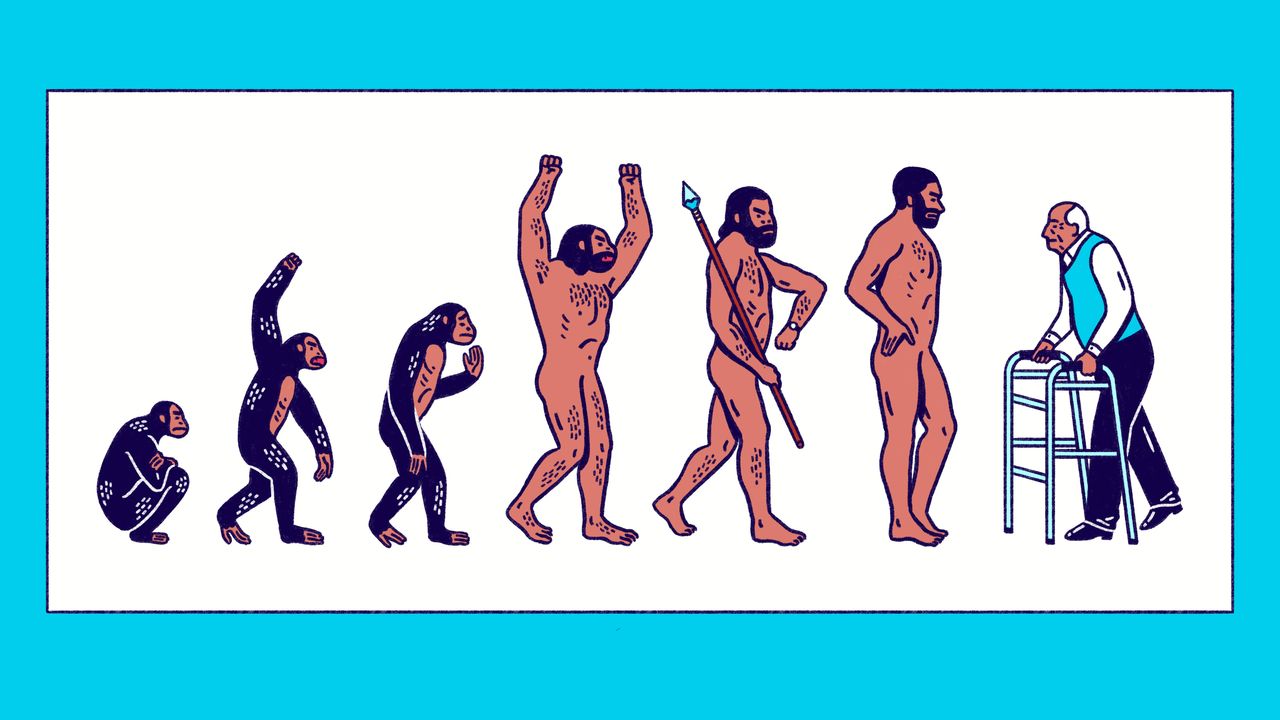
This attitude found its fullest expression in America, during the nineteenth and twentieth centuries. Americans were in love with the idea of youthful, upstart dynamism; they agreed with Ralph Waldo Emerson, who characterized “the forms of old age” as “rest, conservatism, appropriation, inertia; not newness, not the way onward.” Young people wanted to stay young; older people wanted to reverse time; and so “anti-aging practices,” including new regimes of diet, temperance, and exercise, “swept the land.” Feminism was anti-gerontocratic, too, striking blows against old men and their old ways. By the turn of the twentieth century, Moyn writes, “the last remnants of the old respect for old people were shredded.” It became possible to call an old person an “old fogy.” Moyn quotes Randolph Bourne, a young radical journalist, who proclaimed, in 1913, that “old age lives in the delusion that it has improved and rationalized its youthful ideas by experience and stored-up wisdom, when all it has done is to damage them more or less—usually more.”
The pursuit of youth involved a lot of sham science. (There was a long period during which breakfast cereal was understood as a key to longevity.) But in the twentieth century, real medical progress resulted in healthier life styles and extended lifespans. “Giving up smoking and taking statins,” Moyn writes, “along with beta-blockers and blood-pressure pills, and coronary bypass surgery if all else fails, not to mention commitment to diet and exercise—all this has been normalized for vast numbers of people.” The Age of Youth culminated, oddly, in the inauguration of a renewed Old Age.
At various points during this process, observers speculated about the political and economic consequences of a great aging. They noticed that many aspects of our society seem to have been designed with shorter lives in mind. Judges, for example, are often appointed for life—and as lives have got longer, so have terms of judicial service. (The average tenure of a Supreme Court Justice has risen from fifteen years before 1970 to twenty-six years today.) For all but a few professions (airline pilot, air-traffic controller), Congress eliminated mandatory retirement in 1986, deeming it age discrimination; between 2000 and 2010, the number of college professors over the age of sixty-five doubled. (During this period, Harvard’s faculty of arts and sciences had more tenured professors over sixty than under fifty.) Academia is now just one of many professions in which younger participants regard their elders “much as a nation of serfs on the brink of the French Revolution saw the noble lords.”
Today, the A.A.R.P., which helped end mandatory retirement, would presumably oppose its return. Yet Moyn believes that it’s possible to reverse the tide on that front, and on many others. “No law prohibits disparate treatment of people at the younger end of the age continuum,” he notes—so why not concede that age does matter, and resume ushering older workers out the door? “Age limits for political office are a must,” he contends; so are reforms to taxes and campaign finance. He contemplates various schemes for “amplifying the political voice of younger voters,” such as requiring everyone to vote (Australia does it) and lowering the voting age, and raises the possibility of “proxy voting,” in which young people are allowed to vote twice, once for themselves and once for those even younger, who aren’t yet allowed to vote.
Despite the sometimes acerbic tone of his book, Moyn’s aim isn’t to stick it to the old: he argues that Americans also need to expand entitlements for seniors, so that they can more comfortably and confidently retire. If seniors are “hoarding” jobs, houses, and income, that reflects the entirely logical fear inspired by the possibility of decades lived on fixed incomes. “Which is where socialism comes in,” Moyn writes. In his view, it will take big changes to create an “intergenerational utopia” in which, to choose just one example, older Americans have access to government-funded long-term care in their homes. In 2060, I’ll be one of the quarter of Americans who are over sixty-five; if you’re not yet part of the gerontocracy, you’ll be joining before you know it. Maybe, instead of inveighing against boomers, the younger half of Americans need to start making common cause with the older people they will soon become.
