


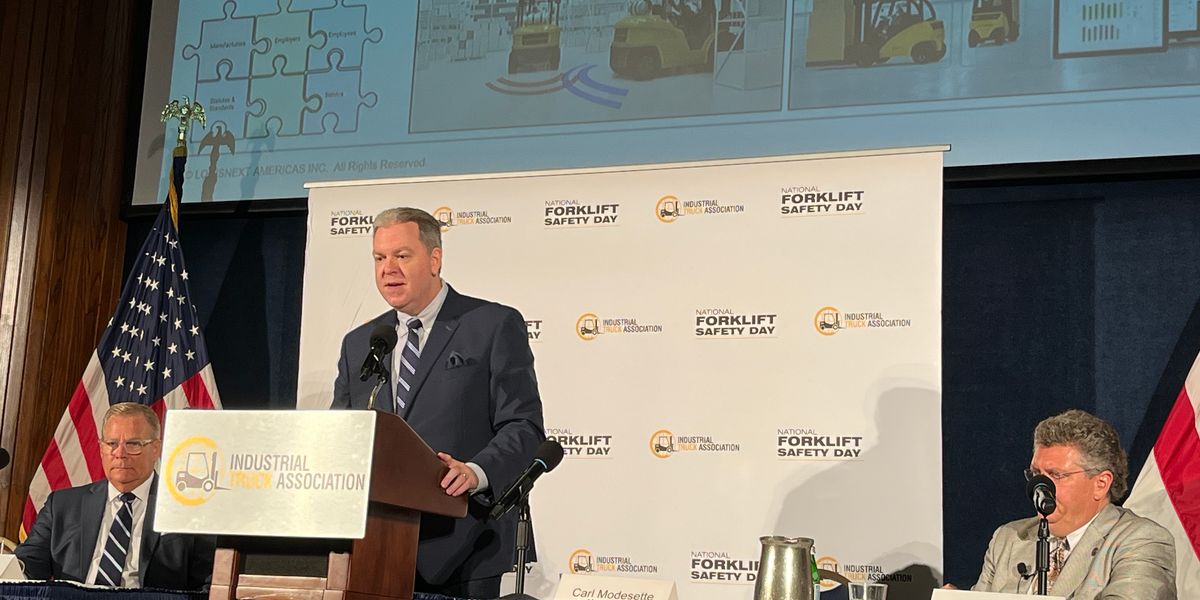
The Industrial Truck Association (ITA) created National Forklift Safety Day as an opportunity to educate customers, policymakers, and other stakeholders about the safe use of forklifts and the importance of proper operator and pedestrian training. Those topics were front and center at ITA’s 13th annual National Forklift Safety Day program, held June 9 in Washington, D.C. The event attracted a full house at the National Press Club and also livestreamed to 470 online attendees.
The program kicked off with introductions by ITA President Brian Feehan and Jim Mozer, ITA Chairman of the Board and Senior Vice President at Crown Equipment Corp. Mozer introduced a key principle that was reiterated in subsequent presentations: While safety-enhancing technologies are helpful and effective tools, “there is no substitute for providing operators with the right training and maintaining an emphasis on safety and supervision.”
Additional speakers addressed a variety of safety-related topics. The following are some highlights from those presentations:
David Keeling, U.S. Assistant Secretary of Labor, Occupational Safety and Health Administration (OSHA), established his credentials by noting that he began his career as a teenager at UPS (where he later trained as a forklift operator), eventually becoming vice president, global health and safety, at the company, and then served as director of global transportation safety at Amazon. While OSHA is an enforcement agency, he said, it also aims to proactively help companies prevent accidents through education. As examples, he cited the availability of on-site consultations and OSHA’s “Safety Champions” program, which is designed for small and medium-sized companies with limited resources. Similarly, while the agency is seeking to hire more inspectors due to the proliferation of e-commerce warehouses, Keeling said, in his view it is equally important for OSHA to engage with safety professionals and enable them to improve safety in their own facilities.
When asked how the Trump administration’s emphasis on deregulation might affect the agency, Keeling suggested thinking in terms of “modernization” instead of deregulation. Most OSHA regulations have been in place since the 1970s, he said, but technology and data that weren’t available when the rules were written could reveal that some are obsolete or need modification. Some forklift-related rules, such as “lock out, tag out,” will come under scrutiny, he added, but the agency will verify that any proposed changes will “do no harm” before they are approved.
Carl Modesette, National Forklift Safety Day Chair and Director – Americas Design Center, Logisnext Americas Inc., explained that forklift safety depends on a “holistic” effort involving lift truck manufacturers, employers, employees (including supervisors, trainers, technicians, and operators), statutes and standards, and equipment service and maintenance. Each of these elements affects the others, either reinforcing safety or undermining it, he said. He also emphasized the importance of adhering to forklift safety regulations like 29 CFR 1910.178 and standards such as ANSI/ITSDF B56.1 and NFPA 505. In addition to summarizing the purpose of relevant regulations and standards, Modesette highlighted key provisions, such as that safe operation ultimately is the responsibility of the operator, and that any modifications to a truck that could affect safe operations must be approved in writing by the manufacturer.
Modesette encouraged fleets to adopt safety-enhancing technologies with care and forethought. That process should begin with a “job hazard analysis” of workers, tasks, tools, and work environment, as explained in OSHA Publication 3071. “It’s important to understand what it is you’re trying to solve and foresee any complications [a solution] could introduce,” he said. For example, workers could potentially come to rely too much on the technology and allow their spatial awareness, alertness, and reflexes to erode. He recommended periodically reviewing safety technology to determine whether the expected results had been achieved, and if not, what may need adjustment.
Bill Sims, President, The Bill Sims Company and Beyond Zero Injuries, an industrial safety consultant to some of the largest companies in the U.S., asserted that while achieving zero injuries is a worthy goal, that only considers past events and measures the absence of incidents. Instead, he said, organizations must be able to recognize potential causes of safety incidents and prevent them. Sims also emphasized the value of “positive reinforcement systems.” Treating employees with dignity and respect, recognizing and rewarding them for “what they did right, not just punishing them for what they did wrong,” and demonstrating that you care about the safety, health, and mental well-being of employees and their families, he said, can lead to dramatic improvements in safety compliance, injury and accident rates, productivity, and retention. “If workers believe their boss cares about them and their families, that builds trust and engagement,” he said.
Crucially, leaders must model good safety practices and demonstrate an ongoing commitment to safety. “Leadership’s behavior drives employees’ behavior, which drives results,” Sims observed. Throughout the organization—regardless of the job, function, or facility involved—everyone must have the same, consistent definition and understanding of workplace safety before a company can work on improving its safety performance, he said.
The above summary represents just a few highlights of the speakers’ presentations. A video recording of the full National Forklift Safety Day 2026 program will be available in early July on ITA’s website at www.indtrk.org/national-forklift-safety-day.
