


When Sean San José took over running the Magic Theatre in 2021, he had a multipoint mission to remake the institution from the inside out.
That meant questioning every assumption, down to the use of terms like “artistic director” and “season” that put off people who don’t consider themselves theatergoers. It also meant opening the legendary home of playwrights Sam Shepard and Luis Alfaro to smaller resident companies – Lorraine Hansberry Theatre, San José’s own Campo Santo and Rainbow Zebra Productions, among others.
And, San José had one more mandate, as he put it: “Rightfully center people of color.”
Now that that new ethos is established, he said, “It’s time to recede from a single-voice leadership.”
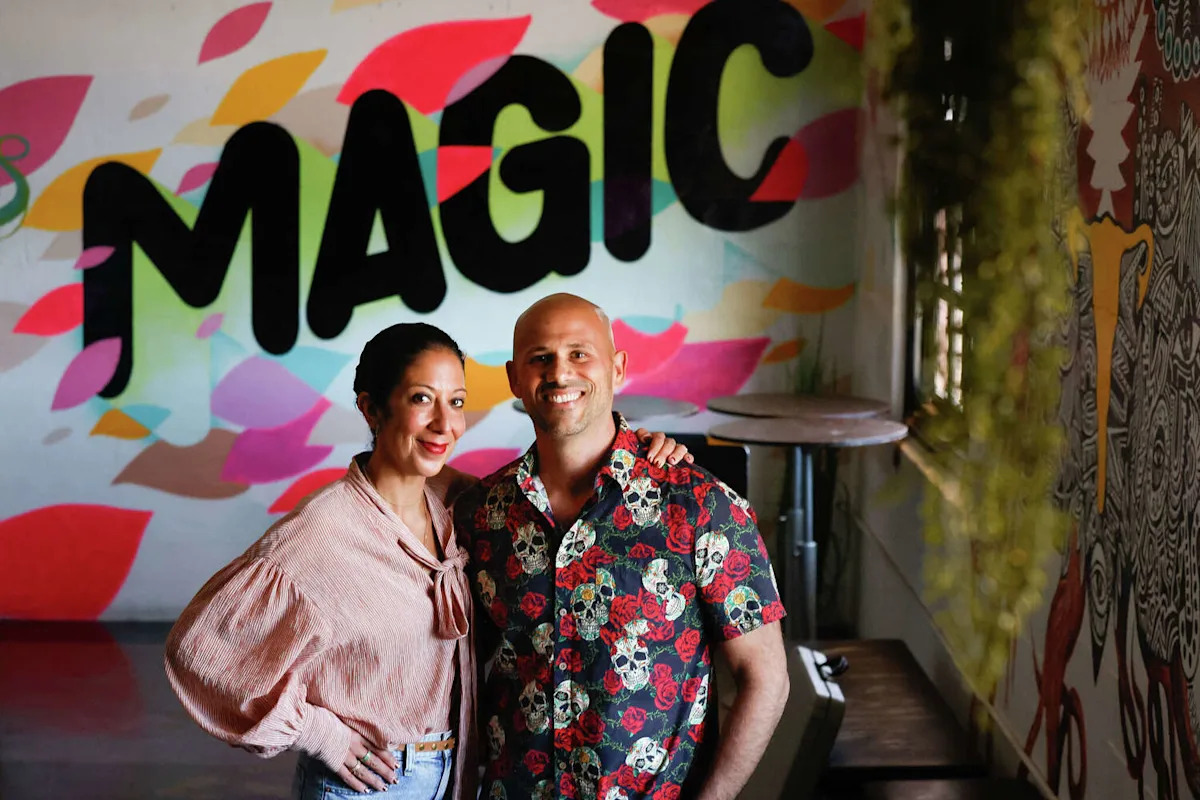
Sarah Nina Hayon, left, and Sean San José stand for a portrait at Fort Mason on Wednesday, June 10, 2026, in San Francisco. San José is stepping down from leading the Magic Theatre after five years at the helm, and Sarah Nina Hayon is the new artistic director. (Lea Suzuki/S.F. Chronicle)
As of June 1, the 59-year-old company has a new triumvirate: Actor and former Magic Theatre board member Sarah Nina Hayon, who also founded New York’s 24SevenLab, is artistic director; actor Daniel Duque-Estrada is producing director; and video designer Joan Osato – who’s held leadership positions with YouthSpeaks, Campo Santo and the Living Word Project – is director of sustainability and growth.
As part of the shift, former Managing Director Kevin Nelson stepped down in May and Director of Growth and Associate Lead Director Liam Nelson transitioned from the staff to the board. San José plans to stay on till the end of June. After that, he’s not sure what’s next, but before leading the Magic he had a rich career as an actor – at American Conservatory Theater, now-defunct California Shakespeare Theater and others – in addition to co-founding Campo Santo.
San José said the whole reason to make art is to do so as part of a nonhierarchical group. So running an institutional theater – being at “the front of the chevron,” as he put it – wasn’t always natural for him. He chafed at having the buck stop with him, being in the position of permission grantor, having fellow artists submissively pitch him ideas in an attempt to please.
“Empowerment is such a deep, deep thing,” he noted, recalling how Deborah Cullinan – now vice president of the arts at Stanford University – gave him a job at Intersection for the Arts before he even fully understood what the job was.
Now he’s excited to empower his successors.
“Everyone wants the exact piece of the pie that makes the whole pie work,” Hayon explained during a group interview with the Chronicle in advance of the Monday, June 15, transition announcement.
“I’m the bat mitzvah hype woman,” she added – meaning it’s her job to excite new audiences and artists about the company, and, as she put it, “rip the top off the theater.”
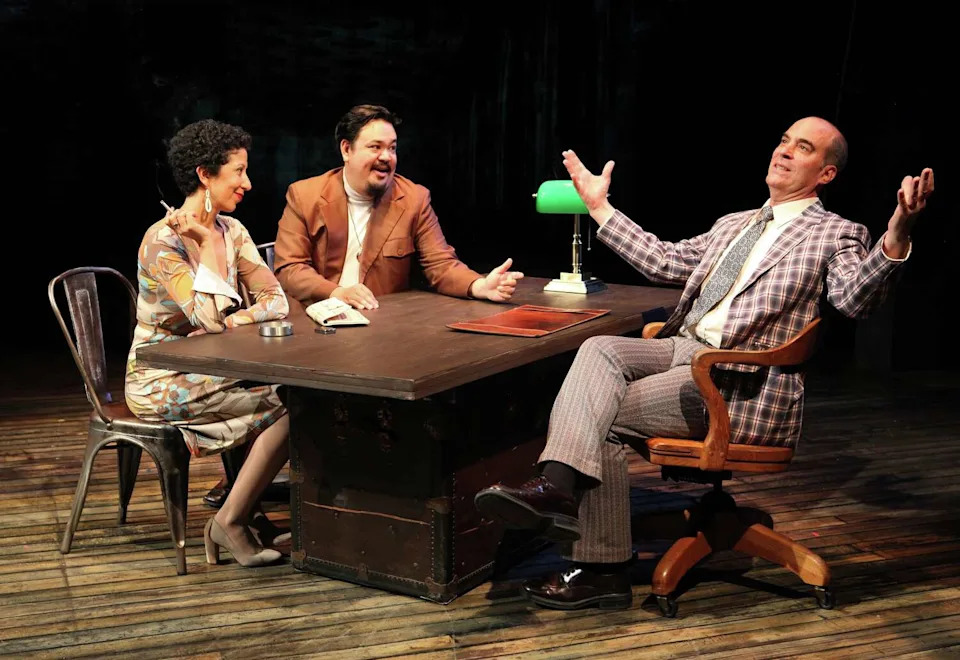
Sarah Nina Hayon as Milagros, from left, Chuck Lacson as Basilio and Lawrence Radecker as Rick in Magic Theatre’s “The Gangster of Love.” (Jennifer Reiley/Magic Theatre)
“Theater doesn’t have to be a play,” she continued, noting it can be a salon or an immersive experience where the audience is seated next to artists.
“The city is hungry,” she went on. “People want something more than to go out to dinner.”
Duque-Estrada is overseeing the calendar, seeking efficiencies such as using the same modular set design for the entire 2027 lineup (which remains to be announced).
Osato, who was at a residency with Tau Dance in Banff, Canada, during the group interview, brings operational acumen and fundraising creativity. She’s the kind of person, San José said, who finds grants that others wouldn’t think to apply for – the “silent but deadly partner” who’s always taking a drag on her cigarette.
“Joan makes the axis of the world turn,” he said.
Writing to the Chronicle via email, Osato said she was passionate about developing new performance languages for national audiences. At Campo Santo and Magic, she went on, legacy artists get “complete and unfettered freedom.”
If the threesome’s roles seem to have more fluidity than the traditional artistic director-managing director split, where one person is the artistic visionary and the other minds the budget, that’s by design.
“I don’t feel like I’m in a room full of artists,” Haydon said, referring to a bunch of pie-in-the-sky daydreamers. “We have our heads in the clouds and feet on the ground.”
Such pragmatism will be key as the company faces ongoing challenges.
“It’s totally f-ed financially,” San José said with a rueful laugh. “Girl, are we going to make it to August?”

Daniel Duque-Estrada in Magic Theatre’s “Aztlán.” (Jay Yamada/Magic Theatre)
Duque-Estrada has been on staff at the Magic since San José came aboard, so he knows what he’s getting into.
“It’s exhausting,” he said, comparing balancing the company’s tenuous finances to being in the emergency room at the hospital.
But he takes comfort knowing the Magic’s not the only company reeling from cuts from the California Arts Council and the city’s arts agencies as well as the National Endowment for the Arts’ reneging on grants. Nor is Magic alone in dealing with war-exacerbated inflation and individual donor skittishness. Other theaters, he said, “are all crying the same tears.”
But if nonprofit theater’s subscription model is struggling, he continued, the art form is eternal.
“When all the data centers blow up, we’ll be telling stories around a campfire,” he said.
The team is trying to look at its lean annual budget of $1.4 million as an opportunity. “We’re immigrants’ kids,” San José said. “There’s a different way of stretching a dollar.” While everyone’s what San José calls “a Frisco kid,” San José is of Filipino and Puerto Rican descent; Osato’s heritage is Japanese; Duque-Estrada’s parents are from Cuba, while Hayon is the child of a Salvadorean mother and Egyptian father.
“Less money?” Duque-Estrada said, as if posing the question to himself. “Need money less!”
Stripped-to-the-studs theater is what excites him most regardless of budget, he continued. “It makes the writing better. It’s flight within the restriction.”

Sarah Nina Hayon, left, and Sean San José in Octavio Solis’ “Se Llama Cristina” at Magic Theatre. (Jennifer Reiley)
Plus, Magic – whose next full production is Ashley Smiley’s “A Rashomon” in November” – has the unbuyable cool factor of making actual art, not slot-filling crowd-pleasers. Magic, Hayon said, “creates a space for artists to take risks without the pressure of commercial productions.” It’s such a draw that, to perform with San José in “Se Llama Cristina” in 2013, she said, “I left my honeymoon early.”
“I’ve hated Sean ever since,” she said with a smile.
Subscribe
There’s more to San Francisco with the Chronicle. Subscribe today for just 25¢.
This article originally published at This S.F. theater is in financial trouble. Its new leaders have a radical plan.
