


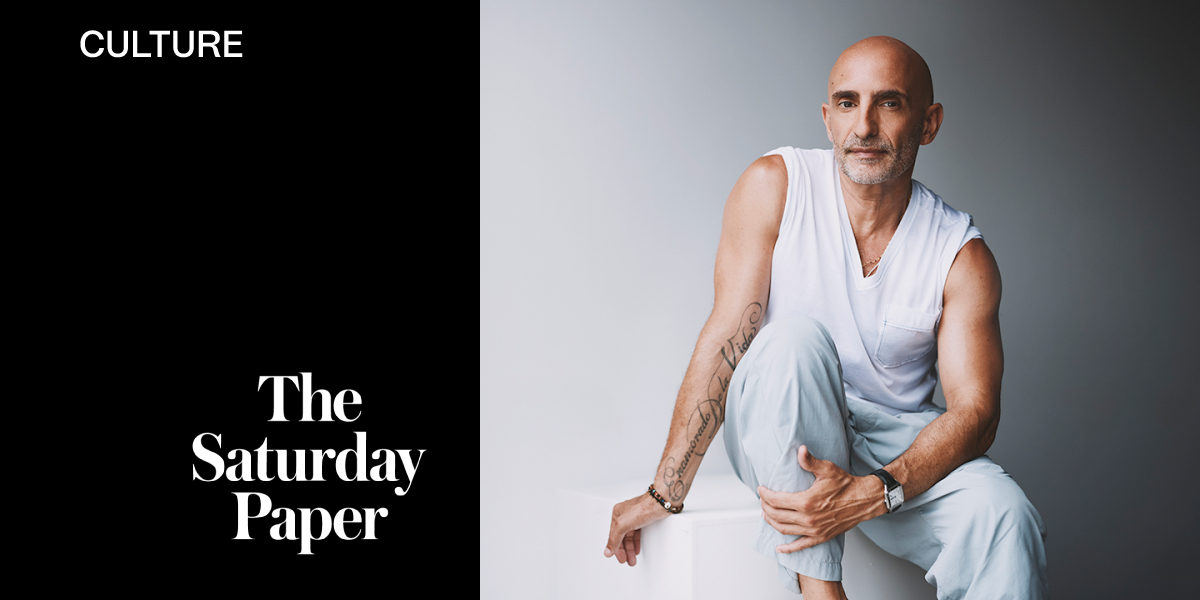
Borders have never mattered to Rafael Bonachela. To the choreographer and artistic director of Sydney Dance Company, art isn’t reserved for those who can afford or understand it. It is inextricable from life. Last summer, he tells me, he caught himself in a pinch-me moment. He was under the Acropolis in Athens, where the dance company was performing Impermanence, part of an international tour that had taken them everywhere from Paris to Ljubljana.
“We had 5000 people at the Odeon of Herodes Atticus,” he says, grinning. “I have a picture I got the usher to take for me and I thought, I could cry. For me, contemporary dance is of the now. It is in the title! I believe that contemporary dance should be open and should feel alive and not push people away.” He pauses. “And the way to do that, a blurring of high art and popular culture, comes from the opportunities that I have been given.”
Impermanence, which premiered in 2021 to critical acclaim, was inspired in part by the destruction of Notre Dame and the bushfires on the east coast of Australia. It features a score by one of Bonachela’s collaborators, Bryce Dessner, the Grammy-winning composer and guitarist for the alt-rock band The National. In the work – to live music by the Australian String Quartet – pairs of dancers pinwheel through the air. They leap and tumble to the ground as the stage burns orange. Watching a work by Bonachela, it is impossible not to feel a visceral pleasure, an attunement to both the limits of your own body and its possibilities for emotional expression that might remain untapped.
Meeting Bonachela in the flesh at Sydney Dance Company (SDC), his warmth is effusive. In his office, next to his computer, is a red coffee cup, evoking the palette of Pedro Almodóvar, one of his favourite filmmakers. On the windowsill, above a couch, overlooking the drizzly Walsh Bay afternoon, is a house plant. I forget this is Bonachela’s place of work, where he arrived two decades ago as one of Europe’s most feted choreographers to direct a dance company on the other side of the world, making an art form sometimes associated with an inner-city elite feel vital, as if it has something to say to ordinary people.
In March, Bonachela announced the end of his tenure, a decision he has been mulling over while working on The Journey Itself Is Home, his newest collaboration with Dessner, which opens this month at the Sydney Opera House. It’s informed by Bashō, the 17th century Japanese poet, the great chronicler of drift and transience.
“The title is not a coincidence, because I knew a year ago I would be departing,” he says. “I didn’t come to Sydney to find home waiting for me. What I’ve realised over the last 18 years is that we make home. Home is not a place – it is in the moving, the working, in the being together. What stays with me is what we have built in that journey, what we have achieved.”
Bonachela’s life has a sense of the cinematic. Picture a working-class boy, the eldest of four brothers, making up dances in the streets of La Garriga, a town surrounded by mountains, in the early 1970s. These were the last years of Franco, the Spanish dictator whose authoritarian regime had shaped the country for four decades. Bonachela’s parents were factory workers.
“What I’ve realised over the last 18 years is that we make home. Home is not a place – it is in the moving, the working, in the being together.”
“We were the first generation allowed to speak Catalan freely,” he says. “Some of our teachers were left over from Franco’s time – they were older, they would wear suits and would hit you with a broom against the wall. Other teachers came to school out of university in jeans and T-shirts. They wanted the school to be different. They wanted the music to be different. It had so much to do with the person I am right now.”
There’s a story Bonachela tells, speaking with his whole body, about seeing the video for Michael Jackson’s “Thriller” one Christmas. “Never mind that the music was beyond, there were people dancing from beginning to end,” he says. It was as if the future had rushed forward to meet him. But his father, part of an older era, had a narrower view. “One of the classic ones, was men don’t cry, you don’t show emotions,” he says. “We had a piece of land where we grew every vegetable. Hard work was how you learnt to be a man.” His mother, who divorced his father, saved him. “My mum took me to dance. She had to fight a lot for me to be able to do that.”
Bonachela took his first dance class at 15, catching a 40-minute train to the Cadaqués Centre in Barcelona. “I paid for one, but the teacher allowed me to stay for the second, and then called my parents to say, ‘You know, this boy has talent.’ ” His classmates possessed a vocabulary that Bonachela was missing. “There was a girl who had come to our high school, who was doing ballet, and she was like, ‘This is a plié, this is a jeté’, and I’m like, ‘Things have names?’ ”
What Bonachela lacked in knowledge, he made up for in instinct. At 17 – without ever seeing the art form onstage – he secured his first professional contract with Lanònima Imperial, one of Spain’s first all-male contemporary dance troupes. He travelled to Zagreb, to Budapest, where he could buy classical music records – Tchaikovsky, Stravinsky – for two cents, “doing this weird dance with funny cigarettes”. The aperture of his world was opening. In 1990, driven by a hunger to “train properly”, he moved to Britain to attend the London Studio Centre during the day. He worked as an usher at night to support himself.
“In Spain, we had not much migration, but when I went to the London Studio Centre, it was people of all colours, of all backgrounds,” he recalls. “I focused on ballet and contemporary, but my teachers thought that contemporary dance was what I was good at.”
In the second year he auditioned for Rambert, the legendary dance company conceived by Marie Rambert, a Polish-born ballerina who had briefly danced with the Ballets Russes. “I signed a contract because it was a job,” he says. “I was living on £80 a week.”
At the time, the early ’90s, Bonachela’s base was East London, in pre-gentrification Brick Lane, during Cool Britannia, the explosive era in which disciplines – art and fashion, music and performance – converged. It was a moment in time, he says, when artists were designing record covers. Bonachela had every issue of The Face. He went to clubs, spent time at Shoreditch’s the George & Dragon, a centre for the city’s queer and artistic communities.
During last year’s opening night of Somos, a thrilling work performed in the round, dancers wearing leather and mesh circled each other, their bodies emitting heat, the stage flashing red, to artists such as Rosalía and Arca. In the hushed crowd, figures from different creative worlds. Bonachela – known for his work’s earthy physicality – never lost his curiosity as he grew older. In the audience, I felt another kind of frisson, rare in this moment of doomscrolling: the sense of watching culture being made in real time.
At SDC, Bonachela has collaborated with designers such as Toni Maticevski and Bianca Spender and cast his dancers in naked tableaus at the Art Gallery of New South Wales as part of Nude Live, which celebrated paintings of the naked form. He lost his confidence once, he says, when a 2001 work, Mai Se Sap, choreographed for Rambert and featuring the Turner-prize winning Spanish artist Ángela de la Cruz, attracted bad reviews.
“I was depressed for weeks and then said I would make a work that was everything I stopped myself from doing – the technicality, the virtuosity,” he says. When that work, Linear Remains, was performed at London’s Sadler’s Wells, it caught the attention of Kylie Minogue, who famously asked Bonachela to choreograph her anthem “Can’t Get You Out of My Head” for the Brit Awards. He went on to win The Place Prize, the dance world’s equivalent of the Turner, for E2 7SD, a duet named for Bonachela’s Hackney postcode.
“There is that saying that ‘there is only one of you’, and I embraced being flashy,” he grins. “And over time, there was more emotion. I left Rambert and started my own company with six dancers and learnt to collaborate with other choreographers. That’s when I realised that dancers [should be] themselves. Dance is to be felt. A lot of people say, I didn’t get it. Well, I’m sorry, there is nothing to get!”
When he moved to Sydney to lead SDC in 2009, after the tragic death of his friend, the German dancer and newly appointed artistic director Tanja Liedtke, he was happy with his life in London. He felt loyal to his dancers. “But it was August here, and I was in a T-shirt, and everything runs the same way – I live in Kings Cross, I go to Paddington – and when I presented my vision, I thought it had more funding,” he says. “You can be more or less talented, but you have to believe in what you do, you have to ask for money, you have to always be fighting.”
He lights up when he talks about New Breed, the showcase he conceived to foster new choreography, and PPY, an SDC training program that cultivates the next generation of Australian dancers. “We are employing a few dancers here but only have 17 jobs, and now we have dancers with Lloyd Newson, with the Gothenburg Danceworks,” he says. “It’s an incredible thing, a ripple effect.”
Bonachela still sees himself as a “hustler”. He tells me about going to an opening at the Museum of Contemporary Art for Isaac Julien – the artist he remembers from his London days – and being entranced by the American singer-songwriter Alice Smith’s performance of “I Put a Spell on You”. It inspired Spell, the centrepiece of Continuum, the 2025 triple bill that also featured new work from rising choreographer Tra Mi Dinh and Bangarra’s Stephen Page. “People think that artists are connected to this ongoing source of miracles and inspiration, and I haven’t found that,” he says. “But I go to exhibitions. I read books. I went to a show and this woman was singing with a piano and she literally put a spell on me. You have to live life. You have to get out.”
To make The Journey Itself Is Home, he travelled to Basque country, which spans Spain’s northern border and France’s south-west coast, meeting Dessner in San Sebastian. “He is this incredibly Zen, beautiful person and we talked, we listened to music and we ate,” he says. “We were in the mountains and after a few days, the idea of The Journey Itself Is Home came to us, after we were talking about Bashō. We would read the poet, watch the sunset every night and ask the dancers to go into nature and improvise.”
The dancers, in turn, looked into themselves, to find their own expressions. “Liam wrote a beautiful poem,” he says. “Some people took pictures, some people recorded themselves. Different people, different ways.”
The Journey Itself Is Home is part of a triple bill called Engine. It also features Love Lock, an electric work by Melanie Lane costumed by the acclaimed designer Akira Isogawa, its staccato, jolting rhythms splicing folk and speculative elements. “Mel is an incredible choreographer and her work is viral,” he says. “On TikTok, we have people in Paris watching it.”
There’s also the Australian premiere of The Mass Ornament from Fran Diaz, a rising Berlin choreographer who grapples with questions of the individual and the collective. “When I saw his work, I knew there was an energy, a fearlessness.”
Leaving SDC represents a kind of leap, a date with the unknown. Bonachela was listening to a podcast the other day, he tells me, about what it means to be happy. “We will never get to fulfil the potential of what we want to achieve,” he says. “There are so many versions of our life.”
There is so much he has accomplished, I point out, this boy from La Garriga who fell in love with the power of movement and music, how it can touch something deep within us. “The amount of things that I didn’t get!” he says. “Everything happens for a reason and the things that you get, you are meant to.”
