


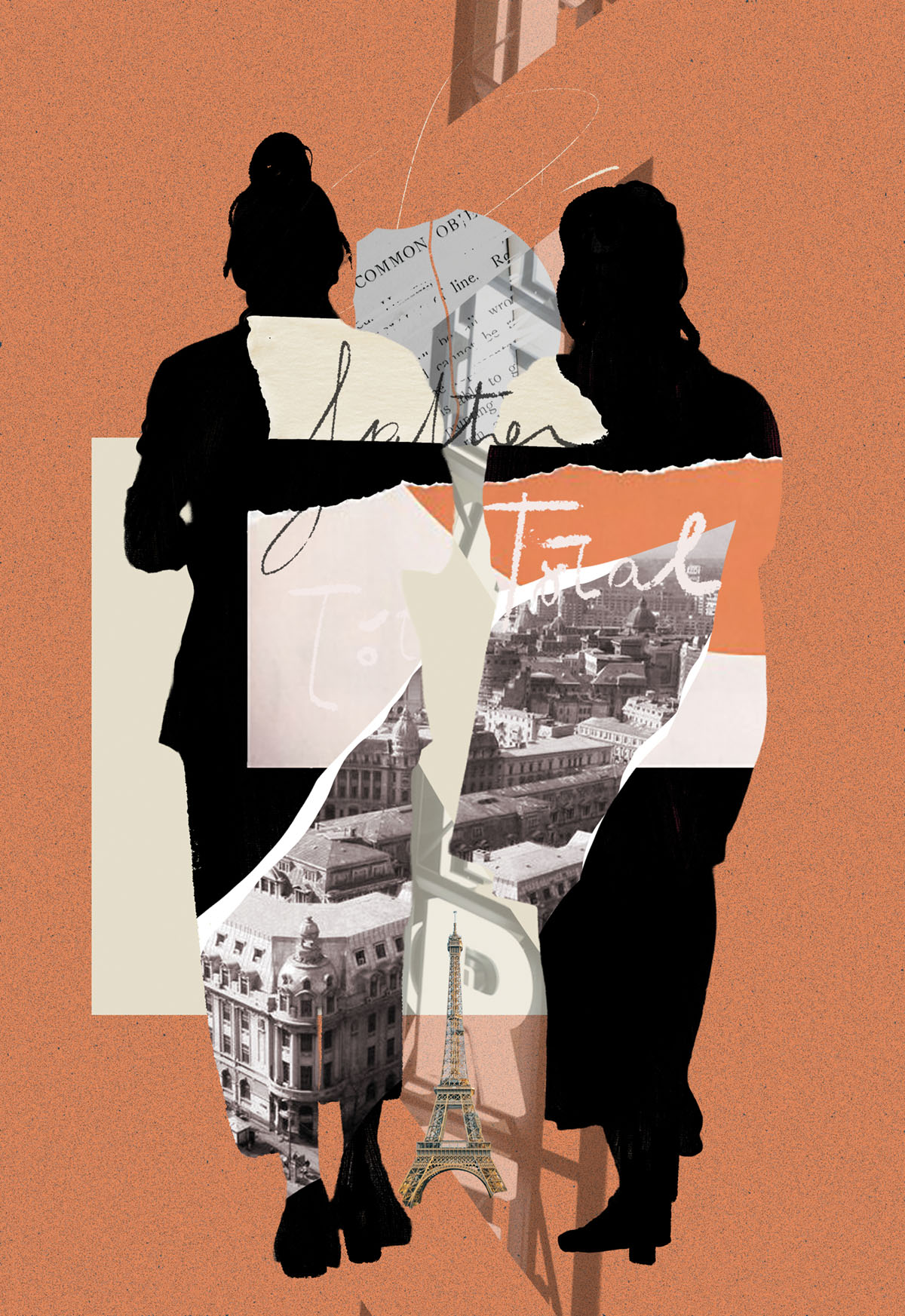
1.
Not how I imagined meeting my playwright: I emerge from the stall, and there she is. Standing in front of the mirror, she applies makeup, then catches my eye in the reflection. We break into grins.
Oana?
Amanda?
Playwright, meet translator, in the most private public space of a building you love: the bathroom of a theater.
2.
I had flown from New York to Paris a few days before, still tweaked with jet lag as I watched the cooling gray skies from the daybed in my cousin’s apartment. The week before I arrived, Oana had flown from Cluj-Napoca, Romania, for rehearsals at Théâtre Ouvert with her French creative team and translator. They were working on a staged reading of the French version of Scenes from the Life of the Family Stuck, a play I had translated with my father from Romanian into English several years prior.
I had already been planning a trip to the City of Light to meet my cousin and see some theater, and when Oana told me she would be there as well for her workshop, I felt even more motivated to visit. I loved the thought of two Romanian writers meeting up in Paris, where so many Romanian literati and artists found inspiration amid the avenues, gardens, and cemeteries. The works of sculptor Constantin Brâncuși, dramatist Eugène Ionesco, philosopher Emil Cioran, artist Lena Constante, and more floated through my mind, and I felt a swell of pride in myself and Oana, two women theatermakers with our southeastern European roots in this city.
3.
I find my pride turned upside down, the whole situation uproariously funny, as Oana snaps a photo of us in the mirror. We laugh, and I wash my hands. “Translator and playwright in a bathroom” sounds like the setup for a literary groaner. But somehow the casualness of the space makes sense. My romanticized notions come back to earth as I think of the spaces where translation has entered into my life: the stage, the kitchen table, now the bathroom. Tender, messy, vulnerable places.
Happening upon Oana so informally, I feel as if I am running into a classmate, a neighbor, a cousin. Someone not ordinarily on another continent, separated by an ocean, mediated by screens and emails. If history and politics had taken another turn, closeness could have coalesced through physical proximity and culture. Instead, we found each other through drama, translation, and a longing for something just out of our grasp.
One last look in the mirror, and we walk back into the theater lobby.
4.
My parents met in Bucharest in the ’70s, two free spirits in the spheres of travel and politics. My mother worked as a press attaché for the Philippine embassy in Romania, and my father as a guide for the national department of tourism. One of the photos I have of them from this era, a glossy black-and-white, shows them seated on an armchair and couch in a lamp-lit, wood-paneled room decorated with framed landscape paintings of large trees. Dressed in business attire with legs crossed and absorbed in their own activities, my father reads a magazine, my mother takes notes. (Scholars—or nerds—through and through.) They married in Bucharest in 1980, and as the Ceaușescu regime took a darker turn, they fled to the States shortly after and made their home in Washington, D.C., and then Virginia, where they had first my brother and then me.
My father avoided speaking Romanian—or rather, avoided speaking to Romanians—when he first arrived. Too much trauma from communism, too much distrust of a surveillance state that forced family members and neighbors to report on one another. English was a new start, not to mention the language that he and my mother shared. Two kinds of accented American English filled our house, peppered with phrases from four Philippine languages and the occasional Romanian word. Not until I was 14, when a friend told me he liked my mother’s accent, did I realize that my parents sounded different from the people around us.
5.
“Translators like to say, we discover our authors,” writes translator and novelist Anton Hur. “But maybe we’re wrong. Maybe the books choose us.”
I find this to be also true of the theater, for both translators and playwrights—the plays choose us. Writing dialogue is not unlike tuning a radio, finding the clearest frequency amid static, music, other voices. Ultimately, playwriting is an exercise in listening.
As a theater translator, I find myself sifting through plays as if through photographs, waiting for a familiar face or location to jump out at me. I skim the scripts written in the language of my father, looking for words that pop, characters that excite, stories that I might have written if I had grown up in Romania. In this case, translating is an exercise in looking.
6.
This is how I found Oana’s play—or rather, how it found me. In 2022, about a year into my literary translation practice, I was perusing an online Romanian library looking for poetry, short stories, and—mostly—plays.
In this way, I found my first Romanian play, Brancusi v. United States by Tatiana Niculescu, and I became hungry for more voices, especially from living women playwrights. Reading and translating their dialogue became a way to understand myself as a woman of Romanian descent and what themes and details we had in common, whether it was writing satirically about international modern art or observing how children cradled farm animals.
During the quiet days between Christmas and New Year’s, I scrolled through a collection of plays from the Cluj Reactor Drama 5, a residency for Romanian playwrights. I paused when I saw Oana’s script, noticing the modular format, the short scenes scattered like snapshots. The long and loose sentences, indented phrases. The playwright’s name, Oana, formatted and repeating as a character name, signaling to me the writer’s predilection for self-reflection and doubling. The words for father— tată, tata, tatăl—scattered like familiar fingerprints across the page.
I imagine that the play saw me, too, a woman in the diaspora looking for her roots. Despite not being fluent in Romanian, I could feel the play calling me.
7.
A week into the new year, I found Oana’s email and asked her whether the English-language rights to her play were available. She emailed back within a few days with enthusiasm and a private link to the scanned archival photos that had inspired her, adding that my message had brought her “unexpected joy.” I turned this phrase over like a gem, delighted that translation could open up this emotion, not only for her but also for me.
8.
When Oana was in a Cluj flea market in 2016, she bought a box of old film negatives. Cleaned and developed, the black-and-white images depicted the daily life of an anonymous Romanian family and its travels throughout Eastern Europe. Gradually, she began to imagine and write stories around these mysterious people and places. She created a book, an installation, and eventually a play—Scene din viaţa familiei Stuck, an experimental work containing 49 short scenes and vignettes.
She named the family “Stuck” (pronounced shtook) and created characters from the photos: mothers, sons, relatives, as well as neighbors, colleagues, and passersby on the street. She imagined the father figure of this family—Janus Stuck—based on one portrait in particular. In it, a bespectacled man reads in a tent, while holding something in his mouth: a leaf, a small flower, a matchstick—too hard to make out from the photograph.
Oana, the playwright, records these observations as a monologue spoken by Oana, the character, in the fourth vignette of the play:
I returned to this image time and time again. I don’t know who this man is, and I didn’t have any intention of finding out. I am afraid that facing reality would destroy the embroidery I keep stitching around this family.
In this portrait, though, there’s something that speaks about him in a loud voice. I named him, playfully, Janus Stuck.
So, who is Janus Stuck?
9.
The online repository that Oana sent me contained 26 folders, each labeled “film” with a corresponding number. Inside each folder were a dozen or so photos. Ruins of cathedrals. Trees laden with snow. A woman in a bathing suit with sunglasses pushed up on her forehead, looking down and away from the camera, presumably at a book, while she sunbathes at the beach. The metal crescent moon atop a mosque. (I recognized this place as Constanţa near the Black Sea, for like hundreds of other tourists, I have stood in this same position and taken this same photo.) A little boy, maybe eight years old, wearing a white beard, a pointed hat, and the festive fur-trimmed robes of Moș Crăciun—Santa Claus—standing inside a carpeted room next to the skeleton of a tinseled tree, tabletop games strewn about his feet. The same woman from the beach, now propping her head on her hand, a flash of light interfering with the camera and covering her chest as her gaze, deep in concentration, drifts away from the photographer.
10.
One of my favorite parts of the play occurs before any scenes begin, with a stage direction that my father and I translated as: In a potential staging, one can use all the scenes or just some of them. Their order may be modified.
I think of most plays as blueprints for a production, but with this stage direction, I imagine this play as a blueprint cut into a hundred pieces that can be reassembled in thousands of ways for wildly different outcomes. It mirrors my fixations around translation, how there can be multiple choices for a single word, phrase, or sentence, but ultimately, a translator must make a decision and proceed. But that doesn’t prevent future translators from making different choices, like a director developing a vision for a new production of a familiar play.
The dizzying array of choices also echoes my feelings around diaspora and immigration, how speaking a language, falling in love, leaving a home, applying for citizenship, all could go down thousands of paths, but somehow, only one version of a life exists.
11.
The first vignette in the script begins with an audio recording of the mother of Janus Stuck reminiscing about a camping trip they took when he was five years old. In later vignettes, other characters—acquaintances, neighbors, coworkers—speak about Janus’s temperament, with Character Oana occasionally asking them questions. Anonymous characters drift in, narrating dreamlike episodes of moving through empty houses, collecting objects, ruminating on love and death among family members.
I know that my translation with my dad might read as too close to the Romanian, a little less fluid than how an American might say things, but I want these non-English sounds and grammatical structures to be in the text.
12.
As Oana and I emailed each other, I learned that she named Janus Stuck as a play on the phrase io nu știu, Romanian for “I don’t know.” I also like the English meaning of stuck, as if the family is waiting for something or someone, and the pronunciation of Stuck. I roll the word around in my mouth, enjoying the hard K that comes out. I know that my translation with my dad might read as too close to the Romanian, a little less fluid than how an American might say things, but I want these non-English sounds and grammatical structures to be in the text. They remind me of hearing Romanian as a child.
13.
Janus also comes from the Roman god of doors, gates, passageways, paths, transitions, beginnings, and endings. Depicted with two heads facing in opposite directions, the deity also lends his name to the month of January. Is he coming or going? Maybe both at once.
14.
Scene 40 is where I fell in love with the play. Janus describes driving his laboring wife to the hospital for the birth of their second child on a snowy day. At the end of his reminiscence, Character Oana shares a similar memory of her own birth, to which Janus responds: If you don’t mind me asking, who are you?
As in Luigi Pirandello’s Six Characters in Search of an Author, the theatrical character turns on the theatermaker, asking questions and sharing his own story (but of course, one written for him by the playwright). As Janus and Character Oana converse, with the former asking the latter to leave him alone, yet still sharing details about his fictional background, it’s a moment of recursive madness. The madness turns tender when Oana asks Janus to be her father, comic when he immediately replies, No.
Despite their back and forth, he eventually advises her to go her own way in life:
I don’t know your father, but I am sure that he, like me, is an ordinary man, like all our peers. Same lack of power, same weakness, same bastards. The ground is sliding under our feet and we try to stay upright as best we can.
As my dad and I translated these lines, I wondered how many times he had felt that the ground was sliding out from under him.
15.
Translating with my father has two potential origin stories.
In 2017, I moved with my husband and young children to Los Angeles for a graduate degree in playwriting. I began drafting Lena Passes By, a diasporic fable about a Filipina-Romanian-American superhero who travels to Bucharest to find a magical ingredient to cure her ailing Romanian father. Despite her supernatural talents, Lena herself does not speak Romanian until she eats an enchanted bowl of mămăligă, a polenta-like dish, offered by trickster cousins. Suddenly, she is as fluent as if she had always lived around Romanians. Her transformation is represented by the cousins’ speech, which at first is Romanian, then accented English, and finally American English for the remainder of the play.
When I first started this play, I would write the characters’ dialogue in English, then ask my father to translate the relevant scenes into Romanian. With great patience, he would sound out the words over the phone and describe the letters to me, which I would repeat back, asking whether he meant a with a hat (a-circumflex, â), a with a cup (a-breve, ă ) or i with a hat (i-circumflex, î ). Or he would Anglicize the orthography, turning ţ into tz, or ș into sh. I would ask, t with a tail? s with a tail? I wanted to see the diacritics on the page, to see these markings that reminded me of letters and books from my childhood home.
Later, I would ask Romanian friends living in Romania to check the dialogue, trading bilingual conversational lessons over Zoom for the work done. When Lena Passes By had its first staged reading in May 2020 as a culmination of my degree, it was performed virtually because of the Covid-19 pandemic. Though the thrill of live theater felt subdued, and Zoom’s features at the time limited simultaneous speaking (so we had to adjust the play’s choral and chanting effects), I took heart in the fact that not only did the actors speak their bilingual dialogue beautifully, but my father, across the country in Virginia, was also watching online.
When I asked him later what he thought, he said he didn’t quite get it but was happy to hear my voice.
16.
My second translation origin story begins in 2021, when my interest in literary translation was sparked by an introductory online class for which participants did not need to be fluent in the language they were translating but could simply have a working knowledge of it. At this point, I’d had two major changes in my Romanian American cultural experience.
First, motivated to write the characters for Lena Passes By, I had improved my own language skills by taking a summer school session of Romanian. Second, because of the pandemic, my father had moved from Virginia to Los Angeles to live with us.
The online instructor asked us to translate an excerpt from a popular fiction piece (originally written in English) into the language of our choice. As I looked at the Romanian words that encapsulated the familiar story, all the As with hats and cups, all the Ts and Ss with tails, I was surprised by how much Romanian I remembered. I next translated a poem from a Romanian children’s book into English and took the first draft to my father. No longer having to call or email, I crossed the living room and knocked on his bedroom door.
I was expecting a few notes on words or phrases, but he got up, walked to the kitchen table, and put on his glasses. He sat down, picked up the paper, and began to read aloud. As he switched between Romanian and English, I started taking notes, correcting my mistakes, and including variations on phrases in the margins. I asked him about the next sentence, and the next.
Over the next few days, we continued to meet at the kitchen table until I had English drafts of all the poems in that book.
17.
When I am translating a Romanian text with my dad, I feel as if I am in rehearsal. This act of translation is not the game of improv that Romanian conversation is. I am not so much put on the spot, heart racing, nervous system alert, tongue sore after an hour of conversation in a new but familiar language, one whose sounds my mouth and teeth cannot quite shape despite what my ears detect. I resort to gestures and smiles, laughter and Rominglish, streaked with the pain of not knowing this language yet eager with the desire to be understood.
No, as a translator, I can backtrack, experiment, slow down, take my time. As in rehearsal, the fun and discovery come from repetition and variation on a moment. I’m still in relation with another person but mediating through their written words, fixed by the marks on the page and meandering around those letters. As in rehearsal, my different choices will lead to a different performance. I am an actor, uncovering multiple meanings and choosing one. I am a director, taking those choices and shaping them into a vision for an audience. And my father becomes my scene partner, volleying the words back and forth until we find the ones that satisfy us.
18.
I introduce Oana and my cousin in the Théâtre Ouvert lobby. My cousin is also Romanian, but her parents settled in Paris while she was a child, in the early ’80s, around the same time my parents left for the United States. I consider her as French as I am American.
Sometimes I wonder how my life would be different if my parents shared French instead of English. Would they have remained in Europe, or gone to Canada? Would I see my cousin more than once every few years? Would I have been able to learn Romanian more easily, having already learned a Romance language?
I don’t understand French, but I still expect to understand this performance. Even if the language is different, its heart is the same.
19.
My father, fluent in Romanian, is not necessarily fluent in the language of the stage. When we translate, he sometimes reads the Romanian to himself, then translates aloud into English. Occasionally he stops, furrows his brow, and repeats the sentence as a question. I usually respond, No, I get it—I get it. I see what a director can do.
I might close my eyes. Behind the language, I can see the movement onstage. The empty space, now filled with shadow and light.
Oana’s play is particularly abstract. In Scene 27, we come to a melee of characters, with the stage direction setting the scene: Fragments of eavesdropping you might want to share with someone else—
One character speaks loudly on the phone: Pista died. Pista died … Pista, man, died … Died. Died! Meghalt. Died, man … died!
It’s very absurdist, my dad says, his voice wrapped in a doubtful chuckle, as if he is not sure what he just said or how it builds the story. Despite my dad’s hesitation about the play’s logic, I can hear and see how actors would inflect their voices, play with a phone prop, gesture wildly, or commit to stillness. I can imagine how a director would offer different guidance based on the feeling or mood he or she might want from the scene.
I write down the English words, which are ultimately traces of emotion for an actor to follow, to make decisions for breath and sound.
20.
My early memories of my father’s native language summon up liminal spaces—cars, hallways—and unseen listeners. Invisible scene partners, offstage characters.
As a child, buckled in the back seat of our red Toyota, I heard Romanian swear words in conjunction with a jolt—my father hitting the brakes to avoid an oncoming car. The language was instinctual, fiery, a weapon against stupidity or a defense against impending danger.
In another memory, I lingered in the hallway outside my parents’ bedroom while my father spoke on the black cordless phone to his mother. We all referred to her as “Granny,” and she lived back in Bucharest. This time the language was soft, explanatory, somehow wounded but also hopeful. I would hear my name and my brother’s rolled into their conversation.
Granny spoke Romanian, French, and scant English. When my father would hand the phone to me, I would try out a tentative, Ce faci? followed by many mhmms and I love you. Te iubesc? Love you …
But also in this sea of conversation was my name, slightly varied. A small suffix to make it diminutive, loved. Amanduța.
Though Amanda speaks English, she still has a Romanian name. She exists in another version.
We move words back and forth, we consider different versions, alternative visions. What do we want to prioritize in our translation? Lyricism, rhyme, meaning, emotion? (Which emotion?) What shape will we shift our translation into?
21.
In his essay “The Strangeness of the Theater Translator,” William Gregory writes that among the fields of translation, theater “is the least well-defined, most misunderstood, and, dare I say, marginal of translation specializations,” with these practitioners asserting and redefining themselves in three communities: theater, academia, and literary translation.
Because of my diasporas—my parents from different continents and races, speaking different languages—it’s precisely within these margins and multiple communities that I feel myself thriving. Yes, a minority. Yes, in need of constant redefinition because if anything, theater workers are shapeshifters. We are accustomed to altering the emptiness of the stage and adapting to our bodies’ needs in the moment, how a gesture in a performance on one night might change because of a broken prop or surprised timing. No matter how many times we repeat something, it becomes new because the moment is new.
And translators are shapeshifters. We move words back and forth, we consider different versions, alternative visions. What do we want to prioritize in our translation? Lyricism, rhyme, meaning, emotion? (Which emotion?) What shape will we shift our translation into?
22.
Once, I acted as Oana. At a translation conference in 2024, I chose an excerpt of Scene 40—the scene where Oana asks Janus to be her father—for a public reading. A friend and fellow translator read for Janus, and I took on the Oana persona.
The playwright who translated the play was now also the actor who was playing the character of the playwright who wrote the original play. Look at that last sentence—full of play. Roles like nesting dolls, playwright-translator-actor-character vibrating around a persistent core, the desire of a woman (me? Oana?) to understand her father, to tap into the mystery of family and embrace it.
In a photo of that reading, my black T-shirt is partially blocked by my arm, but it reads, NOI HOTĂRÂM CE POVESTE NE SPUNEM.
We decide what story we tell ourselves.
23.
When I worked with a theater company in Los Angeles to mount a staged reading of Oana’s play in 2024, we rehearsed in a community darkroom. Cameras and photography equipment spilled from the boxes around us. We were a team of seven: myself, the director, and five actors, including a Romanian actress originally from Bucharest and a mixed Filipina actress reading the role of Character Oana.
Now in our rehearsal space, I felt less like a translator making decisions about words and sentences and more like a dramaturg. I provided cultural and historical background and the occasional pronunciation note. The Romanian actress in our group would also fill in gaps, providing context (such as how people in Romania today celebrate certain holidays) and an alternative sound to my American-accented Romanian.
Our script-in-hand performance took place on a bare auditorium stage. As usual with standard American staged readings, there were no props, no additional sound effects or lights. Sitting in five chairs in a line, the actors propped their binder scripts on the black music stands before them. I didn’t take my father to that reading. Those days, he had too much trouble staying seated for long, his arthritic knees and joints the culprit.
But I did bring my daughter. Eight years old, she curled up in the seat next to me in the auditorium and whispered, You and Tata Ursu translated this?
Yes, I said. And now the actors will share it with us.
24.
In Paris, I note the differences in how the French team has arranged the rehearsal room. Tables and chairs form a semicircle. Props—cassettes, boxes, and an audiotape player—sit on a table. This performance brings the technology from the script onto the stage, making the story feel more archival and material, emphasizing the vintage machines that captured moments from my parents’ and grandparents’ generations.
As the play starts, I hear the mother of Janus Stuck, her words spoken not through a live actor, as in my version of the American staged reading, but instead through the audiotape—a recording as the playwright intended, frothy with static. In my memory, I hear my grandmother’s voice on the telephone. Romanian, French, or English: What lies behind the sound is a persistent desire, a dialogue between separated family members.
25.
I can’t quite follow the French, but I know this play so intimately that I can perceive the through line among the vignettes. When we arrive at Scene 40, in which Oana asks Janus to be her father, I find myself surprised. I cannot help but compare it with the LA version, where the actress chose to portray American Character Oana as vulnerable, pleading, hesitant, thinking that she could be rejected at any moment. In this version, French Character Oana bravely asks Janus to be her father—inviting him to the role as if it would be an honor. She need not implore or petition.
I wonder whether I missed something in the Romanian, or whether the French translation just happens to be more confident. Or perhaps the director simply envisioned a more self-assured Oana, either from the text or this specific actor.
As a theatergoer, I am happy that the actor committed to the choice and followed through in creating a character who is unwaveringly sure of her invitation. As a translator, I am curious. As an American in the Romanian diaspora, I wonder what that kind of confident, playful relationship with a father would look like.
26.
As my father navigates elderhood, I find myself navigating my own journey as a daughter also turning into a caretaker. I add his medical appointments to my calendar. I serve him the same food as I do the kids. Occasionally, I lecture him about watching too much YouTube on his phone, but I pipe down if I hear that it is Romanian language news. I know that he is reconnecting with his homeland in the ways available to him.
Translation becomes a place where we can have the kind of confident, playful relationship that I see in the French version of Oana’s play. This translator relationship shifts our other bonds and ties. The script becomes a place to discover Romanian in a new light, and our identities of father and daughter move to the background, clearing space for new identities to emerge, such as scene partner and detective, with words as clues for our characters’ own identities.
Take the word meghalt in the abstract Scene 27. My father did not know its meaning but guessed that it was Hungarian. I searched for it online, and we discovered that it meant “died,” a semantic repetition of the original Romanian word and our English version. But now, I suggested, this could mean that the character—or the person to whom the character was speaking—was Hungarian, or at least spoke that language. My father, born and raised in Bucharest, then suggested that other words had Hungarian (and subsequently, Transylvanian) connotations, making it easier for us to understand names like Pista and exclamations like fain (“great!” or “cool!”).
In another instance, we looked through the photos in the online archive in hopes they would help us better understand the play. Staring at one monochromatic image, we noticed Cyrillic letters on a university building. My father, required to take Russian under communism, knew the alphabet and began to translate. I Googled the letters, and we found that the university is in Bulgaria.
I marvel that my father contains so much language.
27.
Even though my father is far away as I watch this French performance of Oana’s play, I am pleased that my cousin can be with me. My cousin, who actually knew our grandmother in person, who could speak to her in Romanian. My cousin, who also studies drama. I feel sober joy that the absence of my father is filled by the gracious presence of my cousin. I sense that this play is traveling not only through cultures, countries, and languages, but also through generations. And somehow, through my family.
I write notes in a little white notebook, and I notice my cousin is doing the same on a piece of paper. Later, she will hand me the notes, written in French and blue ink, promising to translate them into English later.
28.
As my cousin and I leave the theater and step into the lamplit evening, we bid Oana goodbye and walk to the Métro, discussing the play. Days later, Oana and I will meet again, this time outside the Théâtre de la Concorde after a matinee. It will be raining, as it does in Paris in autumn, and I will have forgotten my umbrella, but I will bow my head and pull my black rain jacket over myself.
Oana and I will walk to a touristy bistro, the only place open during this sleepy hour between lunch and dinner. We will order crème brûlée and wine, talk about theater and our writing projects, and say how happy we are to have finally met.
In this moment, I will feel that I am part of the Stuck family. I, too, have imagined the possible futures, journeys, and languages of this family and mine through playwriting and translating. The world of Romania, which I knew most directly through my father instead of a larger cultural milieu, has become more nuanced and textured. Every play I translate with my father will continue to widen the aperture of what I know about his old home. Oana’s play in particular has transformed a world of communism, trauma, and escape into a place of dreams, poetry, and the recovery of one’s family. Together, my father and I have made blueprints for more homes.
Somehow, this little family—whether through photos, drama, or translation—travels on.
