


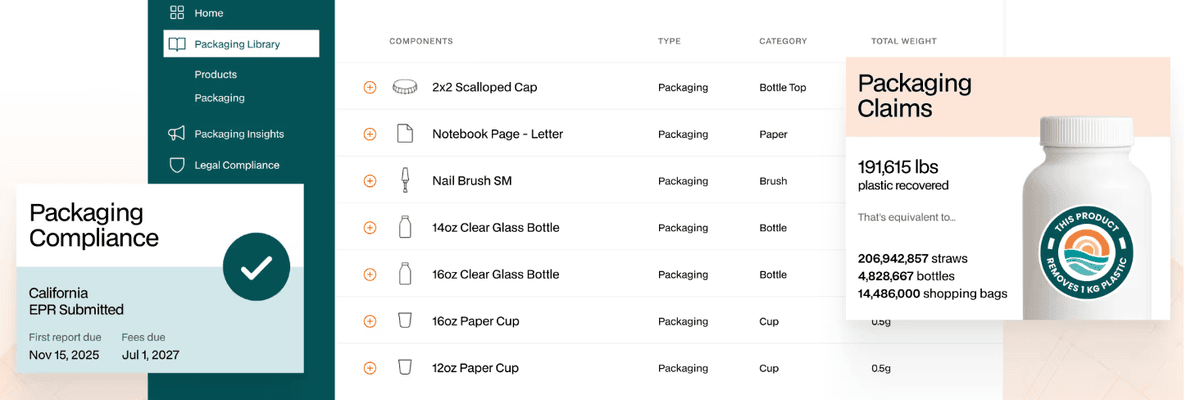
With California’s Individual Source Reduction Plan deadline of August 1 fast approaching, brands selling packaged products in California are under pressure to model, document, and submit defensible plans to reduce pollution, industry experts say.
To reach that goal, those plans must follow options in five approved source reduction pathways: Material Switching, Lightweighting, PCR Content, Elimination, and Reuse/Refill, according to rePurpose Global, a firm that provides a packaging compliance and sustainability platform.
The California rule is one of a growing number of Extended Producer Responsibility (EPR) laws, which generally mean that producers are now financially responsible for the collection and processing of their product packaging. Other states with similar laws being debated in courts or statehouses include Maryland and Oregon.
New York-based rePurpose says its “Packaging Simulator” product offers a solution, providing a tool that gives consumer brands real-time impact modeling across every packaging decision, replacing months of manual spreadsheet analysis with one-click scenario comparisons. “California’s SB 54 is the most significant packaging regulation the U.S. consumer industry has faced this century, and most brands are still trying to navigate it with tools that weren’t built for it,” Manika Doshi, CEO of rePurpose Global, said in a release.
However, a different kind of solution may come from the courts, since last week the industry group National Association of Wholesaler-Distributors (NAW) said it had joined 17 attorneys general in a federal legal challenge to the California EPR Law. The coalition led by Nebraska Attorney General Mike Hilgers opposes California’s “Plastic Pollution Prevention and Packaging Producer Responsibility Act,” known as SB 54.
Along with Nebraska, the attorneys general of Alabama, Florida, Georgia, Idaho, Indiana, Iowa, Louisiana, Missouri, Montana, North Dakota, Oklahoma, South Carolina, South Dakota, Texas, Utah, and West Virginia joined the action. The coalition is asking the court to block enforcement of California’s EPR law while the case proceeds.
According to that group, California’s “vast and complex law” requires businesses to register with and pay fees to the Circular Action Alliance (CAA), a private DC-based entity appointed by the state and authorized to both set and collect fees on everything from glass and aluminum to paper, cardboard, and plastic packaging.
“No state should limit interstate commerce, let alone delegate the power to set and collect taxes to a third party outside of the scope of public scrutiny,” said Eric Hoplin, President and CEO of NAW. “A federal court blocked enforcement of a similar law in Oregon earlier this year, and we are asking the court to do the same in California.”
