


Truck fleets around the world report that driver recruitment difficulties are worsening, with that shortage topping operators’ concerns across most surveyed markets, according to a global driver shortage report from world road transport organization group IRU.
IRU researchers found that the driver shortage is the most pressing concern for 65% of operators in Europe. And even as that challenge lingers, fleets will soon begin to lose may of their most experienced employees, since around 20% of Europe’s driver workforce and 24% of Australia’s are expected to retire within five years.
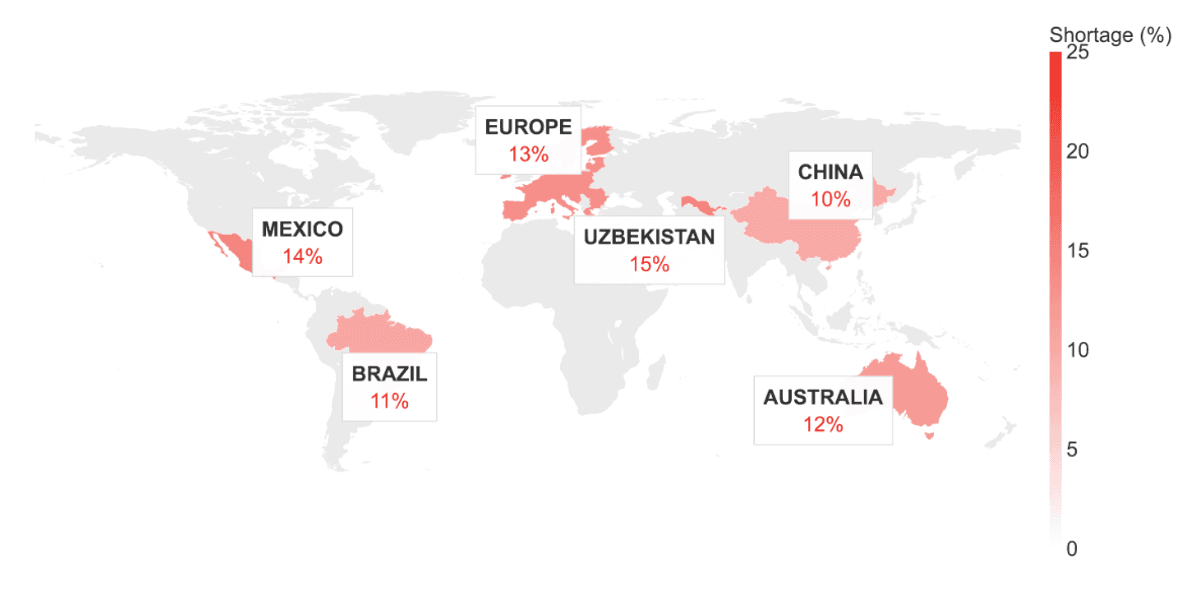
Counting nations across different regions, IRU’s 2025 driver shortage survey found that around 2.9 million truck driver positions, equivalent to 11% of the workforce, remain unfilled across 18 markets. Europe has one of the highest shortage rates, at 13%, representing around 502,000 unfilled truck driver positions. But in almost every market surveyed, the 2025 shortage rate was higher than the 2021 baseline.
That shortage is no longer closely linked to short-term economic cycles. Instead, four dominant factors are: ageing workforces, barriers to entry, a lack of adequate infrastructure, and changing expectations about work. Specifically, changing workforce expectations are making long-haul driving less attractive to younger generations.
Reasons for the trend also vary by geography. In Europe and Australia, demographics are the main pressure. In Mexico and Brazil, structural labor constraints and underdeveloped training pathways keep shortage rates high. And in Uzbekistan and China, freight demand is growing faster than the supply of available drivers.
The pressure is particularly severe for long-haul operators and smaller companies. Operators with fewer than 50 employees reported shortage rates 6 percentage points higher than those of large companies. One reason for that: Small operators with fewer than ten employees, which account for 98% of EU road freight enterprises and 79% of the workforce, often have fewer resources to invest in recruitment, training and international hiring.
The report also listed possible solutions.
- Women and younger people remain heavily underrepresented. So removing barriers to training, improving facilities, and modernizing the image of the profession could open access to a much wider pool of potential drivers.
- Pay remains important, but operators increasingly describe a “wage wall”. Higher wages alone are no longer enough to attract or retain drivers. Rather, increasingly decisive variables include: cab and trailer conditions, secure parking, time at home, predictable schedules, and work-life balance.
- Isolated company-level action is unlikely to be enough. The report points to examples from Finland, the Netherlands, and Türkiye where cooperation between operators, associations, and public authorities has helped create more effective recruitment pipelines.
“IRU is calling for coordinated action from governments and industry. The shortage cannot be solved by recruitment campaigns alone,” IRU Secretary General Umberto de Pretto said. “The sector must improve the quality of the job and make professional driving a career that people can enter, build and remain in.”
