


Transportation and logistics stakeholders should prepare for elevated cargo theft risk during the July 4 holiday period, when organized theft groups may take advantage of changes like reduced staffing, facility closures, and staged freight, according to CargoNet.
“The July 4 holiday creates a predictable disruption in the supply chain,” said Keith Lewis, vice president of operations at Verisk CargoNet. “Cargo thieves understand when freight is likely to be parked, when facilities may be closed, and when normal verification procedures may be under pressure.”
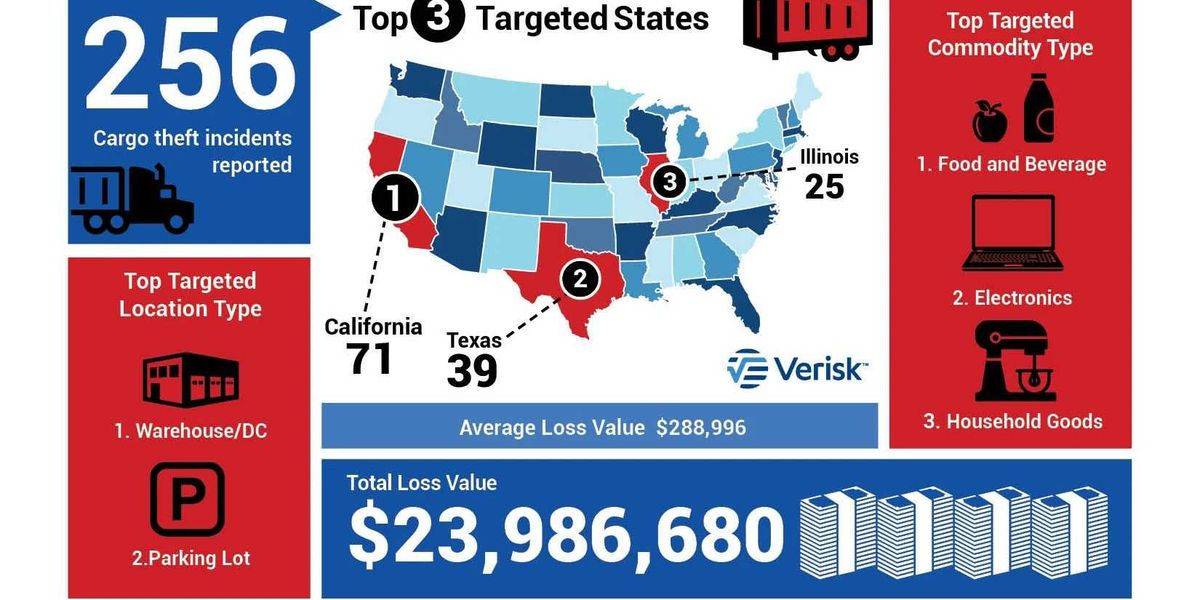
Statistics prove the point, as New Jersey-based CargoNet analyzed 256 theft events that occurred between July 1 and July 7 from 2021 through 2025. The data shows theft activity was highest on July 3, before dipping on July 4 and July 5.
Even worse, this year that annual July 4 warning comes amid a broader shift in cargo theft severity. In the first six months of 2026, CargoNet estimates cargo theft loss values have already exceeded $359 million. While reported incident volume has declined compared with recent full-year trends, the average stolen commodity value has climbed to approximately $341,518 in 2026.
That theft value has climbed because thieves are targeting expensive goods such as metals like copper, molybdenum, antimony, tungsten, and zinc, as well as enterprise computer and networking components such as RAM modules, fiber optic transceivers, storage drives, and enterprise server blades. Many of these shipments can exceed $1 million in value, making holiday disruptions especially consequential for shippers, brokers, carriers, and insurers.
Thieves are gaining access to those goods by applying more sophisticated strategies. CargoNet warns that identity-based fraud and theft-by-deception schemes continue to evolve. During 2026, the firm has observed increased compromise and misuse of software-based business phone systems, which can allow remote actors to make and receive calls from a motor carrier’s verified phone numbers and, in some cases, monitor active calls.
Criminal groups are also gaining access to motor carrier accounts on compliance platforms that brokers use to validate carriers before awarding load tenders. CargoNet has observed reports involving remote access tools, credential compromise, and social engineering schemes in which fraud actors deceive motor carriers into adding them as authorized users. These tactics can give the appearance of legitimacy at the exact point when a broker is deciding whether to tender a shipment.
“These schemes are becoming more personal, more technical, and more convincing,” Lewis said. “Fraud actors are no longer relying only on spoofed emails or fake documents. They are trying to operate from inside trusted phone systems and compliance workflows that brokers use to validate carriers. Around a holiday weekend, when teams are short-staffed and decisions are being made quickly, that false appearance of legitimacy becomes especially dangerous.”
