


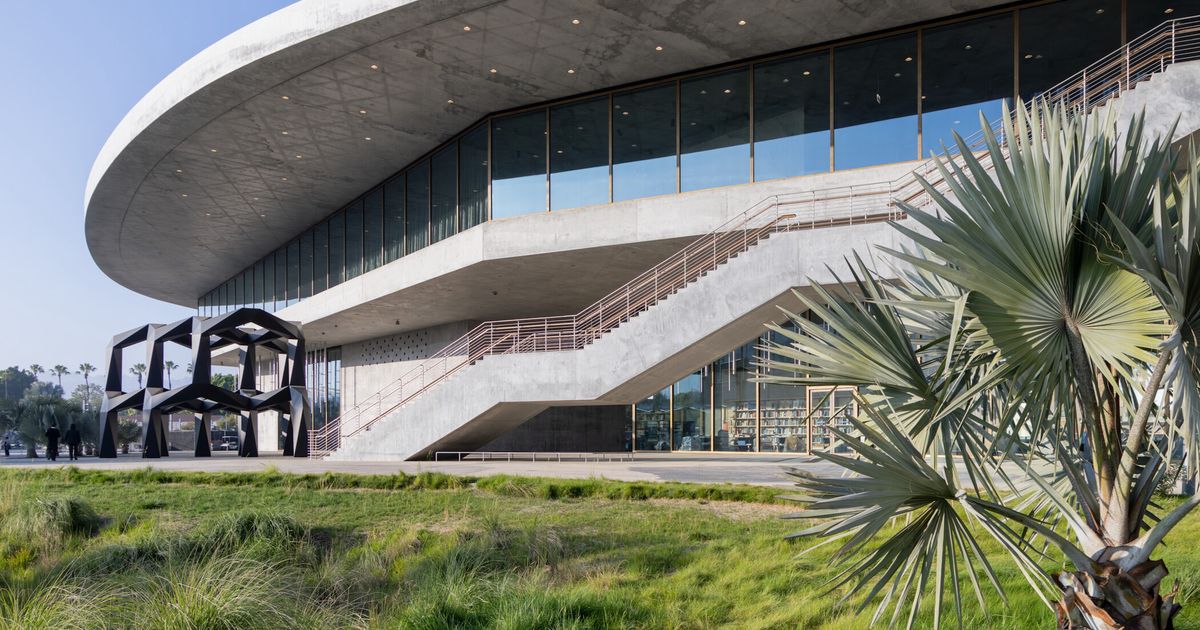
The Los Angeles County Museum of Art’s new David Geffen Galleries, designed by the Swiss architect Peter Zumthor, officially opened in May. But before the general public were allowed in—after paying 25 to 30 dollars per adult ticket and another 23 dollars for onsite parking—the 347,500-square-foot concrete and glass building had already hosted Vanity Fair’s annual Oscars party, an “opening gala,” with individual tickets starting at 10,000 dollars and tables costing up to 175,000 dollars, and a private ribbon-cutting ceremony, which also inaugurated the first of three dining concepts: a café run by the luxury grocery chain Erewhon, best known for its twenty-dollar smoothies.
Behind the parties, fashion shows, partnerships, and high ticket prices is Michael Govan, who has served as director of LACMA for twenty years, and has from the start been gunning to replace the museum’s original 1965 campus. Govan has built a career around constructing new museums—his rap sheet includes the Massachusetts Museum of Contemporary Art, Guggenheim Museum Bilbao, Dia Beacon, and LACMA’s Resnick Pavilion and Broad Contemporary Art Museum—and he specializes in finding the money to do so, mostly by changing museums’ relationships to money altogether. In both regards, the David Geffen Galleries, constructed at an estimated total cost of 724 million dollars, stands as his magnum opus.
Govan has asserted that the project will transform the fabric and function of art museums altogether. Contrary to the conventional encyclopedic museum model, which he sees as needing to evolve, his new concept is “non-hierarchical.” He has devised a curatorial schema that allegedly wards off western biases and equalizes human history’s artistic traditions; he mandated that Zumthor design a single-story building, so that all the artworks would be displayed on the same level. According to Govan, the building’s floor-to-ceiling ribbon windows, and the fact that its amoeba-like footprint stretches over Wilshire Boulevard into a former parking lot, engender transparency and connectivity between the institution and the city.
Contrary to this progressive rhetoric, Govan’s remodeling of the largest art museum in the western United States has been undemocratic and opaque. The architecture critic Joseph Giovannini has reported that he departed from established norms to handpick his own architect, concealed budgets and blueprints from taxpayers, attempted to quash negative coverage, ignored his own curators’ input, and was overheard dismissing objections to his plan as “dissent by minor people who don’t matter.” In a Vanity Fair profile, Govan shrugged off the outcry. “When we proposed the Guggenheim in Bilbao . . . there were protests in the street,” he told the reporter. “There were no protests in the street here.”
Speaking of minor people, to make room for the David Geffen Galleries’s single-story concept, Govan moved the museum’s curatorial, conservation, and photography departments to a satellite building across Wilshire Boulevard. Nearly half of the works that had previously been on view, meanwhile, were placed into long-term storage. After learning that most of their donated artworks would no longer be shown, the Ahmanson Foundation—LACMA’s primary donor of European Old Master paintings and sculptures—ended its partnership with the museum. Three years prior, the chief curator of European art resigned, telling Giovannini that Govan has “destroyed [his] life’s work.” In the past year the COO, the CFO, and the deputy director for curatorial and exhibitions have also departed. In December 2025, the museum’s staff voted overwhelmingly to unionize—citing burnout, precarious employment arrangements, expanding workloads, and stagnating wages.
The David Geffen Galleries are nothing different for a nation whose art museums are increasingly privatized, cost-prohibitive, and operated by and for billionaire-class boards who have scarce connection to, or conception of, the public to whom they claim to cater. More and more often, they privilege commerce over cultural patrimony, “engagement” over education, and gestures of liberal correctness over genuine accountability. As acute symptoms of the United States’ forever war on state funding for the arts, these phenomena are hardly novel, nor isolated. Far from radically reworking the power structures of US museology, LACMA is their apotheosis.
Govan’s tactics are not his own, nor are they new. They are straight out of the playbook of his longtime mentor and confederate Thomas Krens. Krens attended Williams College—cradle of the “Williams Art Mafia”—and became the director of the school’s art museum in 1980. A few years in, he handpicked Govan, a young art history and studio art major, to assist him in turning a vacant textile factory into the Massachusetts Museum of Contemporary Art. When Krens was appointed director of the Solomon R. Guggenheim Foundation in 1988, he brought the twenty-five-year-old Govan along to serve as his deputy. It was Krens’s idea to franchise the financially beleaguered Guggenheim, and he and Govan oversaw its Frank Gehry–designed offshoot in Bilbao, which opened in 1997. Despite widespread objections to the Basque Government “hand[ing] over most of its tax revenue earmarked for culture to a powerful New York institution,” the project prevailed. The “Bilbao Effect” has become shorthand for the supposedly transformative economic effect that a showy building and a sprinkle of culture funding can have on a post-industrial city.
During his tenure, Krens also sold off substantial works in the Guggenheim’s collection—almost unheard of at the time—and mounted shows about motorcycles (a personal passion) and Armani suits (paid for by Armani). In 2000, Krens told the Los Angeles Times that he wants to “reinvent museums as ‘platforms of culture,’” and was accused of turning the Guggenheim into a “McDonalds-like” enterprise. In 1994, Govan branched out to head the Dia Art Foundation, where he promptly devised the construction of its Beacon, New York museum, inside an old cookie factory. He has steadily emulated Krens and his museum practices ever since. “Look at the language Tom uses all the time,” Govan told The New Yorker in 2000. “Instead of ‘museum’ it’s ‘destination,’ ‘museum-going’ becomes ‘leisure activity,’ sometimes ‘visitors’ become ‘customers.’”
These ideas find their ultimate expression in the David Geffen Galleries. Govan has batted away concerns that he has reduced the LACMA’s total exhibition space, and refers to the building as a sculpture in itself. Its curvilinear form and monolithic stature do have a certain statuesque, brooding quality, but the galleries are overdesigned and underaccommodating. The ceaseless concrete is tough on the eyes and body—the few benches are crowded with weary visitors—and the acoustics are ill-considered and clamorous. The staunch, unremitting grayness, and the impudent impracticality of these materials, feel contrarian for the sake of it. There’s a fine line between a great work and a gimmick. Zumthor’s conceit comes across as hubristic, unoriginal, and aggressively masculine.
The museum’s stochastic layout seems designed to disorient. Tomblike galleries are scattered across the open floor plan, separated by a tangle of irregular corridors. Depending on the hour and weather, the works of art displayed in these liminal spaces are assaulted by narrow bands of harsh, cool daylight or shrouded in near darkness. Works inside the windowless galleries—oases from the clamor—are granted more stability. Govan has dismantled the old upstairs-downstairs hierarchy, only to replace it with a more brutal dichotomy between inside and outside, housed and unhoused.
In the galleries’ inaugural presentation, works are organized by bodies of water: the Atlantic, Pacific, and Indian Oceans, and the Mediterranean Sea. This concept has promise: thematic groupings such as “Modernism in the Marketplace” and “Luxury Arts of the Ottoman Empire” certainly ignite curiosity. But their superimposition onto the galleries’ Byzantine layout only engenders more confusion. One must succumb to aimlessness and random encounters, which, according to the 432-page companion publication Wander, is the objective. “My dream was of visitors wandering, through art and ideas,” Govan writes in the foreword, “as one might meander through a park.” This quaint thought harkens to the distinctly modern archetype of the flaneur, whose idle and detached exploration amounted to a resistance of industrial capitalism’s churn. Two centuries and an attention economy later, strolling and scrolling are the new market imperatives; America’s vestigial third space is the mall. One must recall ArtClub2000’s recapitulation of some GAP corporate verbiage that describes an archetypal customer: “Wandering with no specific intent or has something specific in mind but doesn’t tell what it is.”
The experience of wandering the David Geffen Galleries is not unlike visiting GAP, or any other store. The near eradication of wall text—save for a short introduction to each section, and skeletal captions—encourages a fetishistic rather than didactic relationship to the objects on view. The goal is to make visitors browse, rather than learn. To locate a particular work, historical period, or region is a struggle; rather than dismantle hierarchies between artistic traditions, the museum dismisses an object’s original cultural meaning and function as near-irrelevant. A Pat Steir painting, an eighteenth-century “possibly Guatemala[n]” cabinet, and a 1969 stoneware vessel by Hans Coper are to be admired for their formal qualities and covetability. This does not produce the cultural equality that Govan espouses. It is overwrought, vibey, melting-pot erasure, for the sake of spectacle above all.
Rosalind Krauss’s “The Cultural Logic of the Late Capitalist Museum” (1990), a treatise on art institutions’ shifting operations and objectives in postindustrial society, reveals the origin of Govan’s recycled rhetoric. Krauss recalls Thomas Krens telling her that the encyclopedic museum has become an anachronism, “intent on telling a story, by arraying before its visitor a particular version of the history of art.” The “synchronic museum,” as he calls its new alternative, “would forego history in the name of a kind of intensity of experience, an aesthetic charge that is not so much temporal (historical) as it is now radically spatial.” After hearing Krens speak of exhibitions and catalogs as ‘product,’” Krauss concludes that “this industrialized museum will have much more in common with other industrialized areas of leisure—Disneyland, say.” Visitors will no longer view artworks as singular objects originating from a place and point in time, but within a simulacral “hyperspace,” detached from either.
Thirty-six years later, this museum model has been aggressively enacted, within a more accelerated capitalism than even Krauss or Krens could have predicted. Inside the sheep’s clothing of cozy liberal rhetoric, Govan has stolen away an ostensibly public institution’s capacity to educate and serve its city writ large. In his assertion that his museological agenda liberates LACMA’s collection from historical inequities, he fails to recognize that art, and its curation, can never be curative. Revolution must strike at the base, not merely the superstructure. There is nothing emancipatory, nor original, about creating a luxury venue that privileges sensibility over scholarship, allure over accessibility, and fine dining over gallery square footage. The David Geffen Galleries are a dark mark on the cultural history of Los Angeles, but the greatest threat they pose is to the mind. If we believe their myths of equity and inclusion and institutional renewal, we risk forsaking our collective, continuous pursuit of all three.
