

Mumbai Floods 2026: Climate Change, Not Just Super El Niño, Behind Extreme Rainfall, Say Experts – Indian PSU

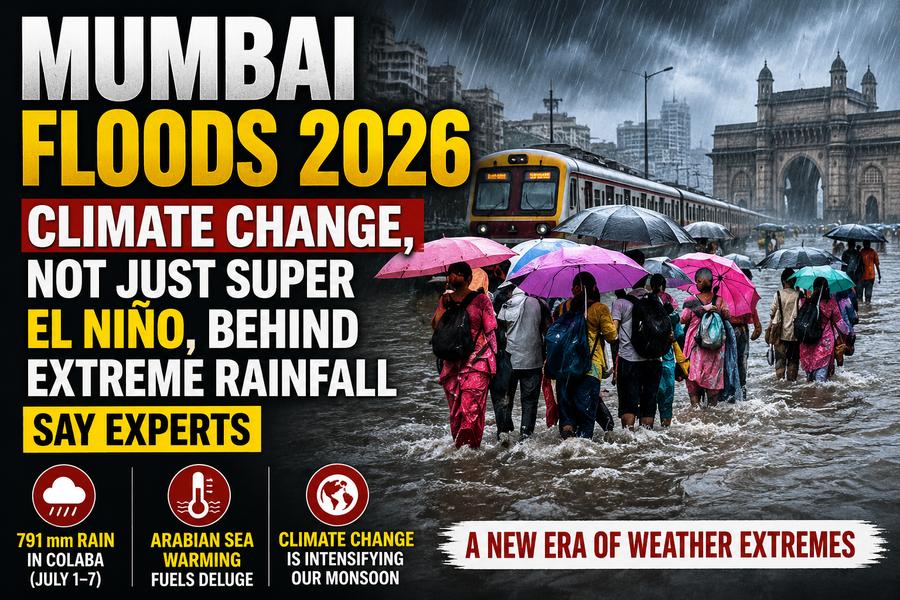
The devastating floods that disrupted life in Mumbai during the first week of July 2026 have reignited the debate over the role of El Niño in India’s monsoon. While the rapidly strengthening El Niño over the Pacific Ocean delayed the onset of the Southwest Monsoon and kept rainfall subdued through June, climate experts say it cannot fully explain the intensity of the recent deluge.
Instead, scientists argue that climate change has fundamentally altered the nature of the Indian monsoon, leading to fewer rainy days but far more intense downpours that overwhelm cities, trigger flash floods and expose weaknesses in urban infrastructure.
The 2026 monsoon began on a weak note, leaving India with a rainfall deficit of nearly 40 percent by the end of June. However, the situation changed dramatically within days as the monsoon entered an active phase, bringing exceptionally heavy rainfall to Mumbai and much of India’s west coast. By July 6, the country’s cumulative rainfall deficit had narrowed to around 20 percent.
Mumbai experienced one of its wettest starts to July in recent years. Between July 1 and July 7, the Colaba observatory recorded 791 mm of rainfall, surpassing its entire July climatological average of 768.5 mm. The Santa Cruz observatory received 879 mm, almost reaching its monthly normal of 919.9 mm. The city witnessed four spells of triple-digit rainfall within a week, highlighting the growing frequency of high-intensity rain events.
According to Mahesh Palawat, Vice President – Meteorology and Climate Change at Skymet Weather, several weather systems combined to create ideal conditions for prolonged heavy rainfall.
“Monsoon is presently in an active phase, with several weather systems prevailing across the country. A depression over Odisha and a cyclonic circulation over Maharashtra, along with continuous moisture feed from the Arabian Sea, led to repeated cloud regeneration over Maharashtra, resulting in heavy rainfall,” he said.
Palawat added that climate change has altered monsoon dynamics over the past few years. Weather systems forming over the Bay of Bengal are increasingly moving westward instead of their traditional northwest track, while record warming of the Arabian Sea has significantly increased atmospheric moisture available for intense rainfall.
Climate scientist Dr. Raghu Murtugudde, Emeritus Professor at the University of Maryland and former Professor at IIT Bombay, said El Niño explains the delayed onset of the monsoon, but global warming is intensifying rainfall.
“El Niño just cannot be separated from global warming anymore. When both the Arabian Sea and the Bay of Bengal become active, enormous moisture reaches the core monsoon zone. The Western Ghats then force this moisture-laden air to rise, producing extremely heavy rainfall over Mumbai,” he explained.
Experts say this reflects a broader shift in India’s monsoon behaviour. Instead of rainfall being distributed over several weeks, a large share of seasonal rainfall is increasingly occurring during a few intense spells.
Dr. K. J. Ramesh, former Director General of the India Meteorological Department (IMD), said this transformation is evident even during El Niño years.
“During El Niño years, the number of rainy days is generally lower. But due to global warming, the character of the monsoon has changed. Rainfall is increasingly occurring in short-duration, high-intensity events, irrespective of El Niño,” he said.
Recent scientific studies also point to the warming Arabian Sea as a major driver of extreme rainfall across western and northwestern India. Researchers have found that rapid warming over the Middle East—nearly twice as fast as many other inhabited regions—is increasing atmospheric instability over the Arabian Sea, pushing more moisture towards the Indian subcontinent. One study estimates that Middle East land heating contributed nearly 46 percent of the increase in extreme rainfall over northwest India and Pakistan between 1979 and 2022.
Long-term rainfall data support these findings. Compared with 1981–2000, average monsoon rainfall during 2001–2024 has increased by nearly 15 percent in Mumbai and 23 percent in Pune, indicating that western India’s cities are becoming increasingly vulnerable to extreme rainfall.
The Mumbai floods of 2026 underline a growing scientific consensus: while El Niño continues to influence the timing of the monsoon, climate change is increasingly determining its intensity. As warming oceans load the atmosphere with more moisture, extreme rainfall events are becoming more frequent, posing serious challenges for urban planning, disaster preparedness and climate resilience across India.
The writer of this article is Dr. Seema Javed, an environmentalist & a communications professional in the field of climate and energy
