


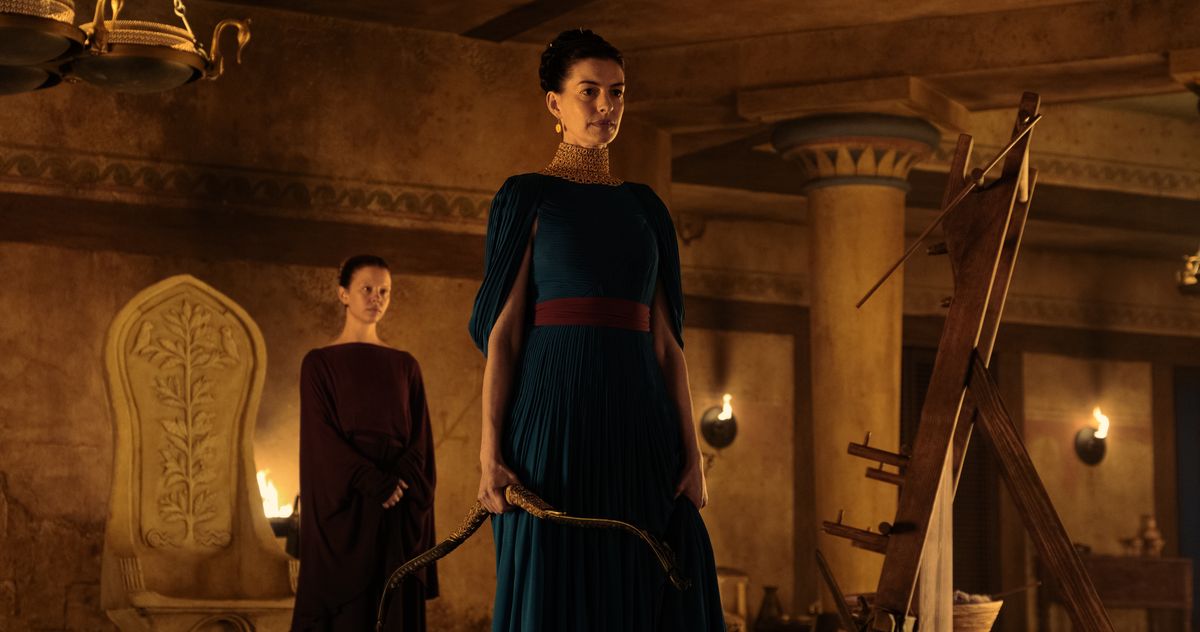
Photo: Melinda Sue Gordon/Universal Pictures
Christopher Nolan’s The Odyssey isn’t out for another few weeks, but don’t tell that to the worst guys you know because they’re already complaining about it online. Right-wing trolls (including the richest man in the world) and enraged redditors have berated Nolan over casting a trans man in the movie; over Telemachus saying the word dad in the trailer; and over casting a Black woman as both the most beautiful woman in the world, Helen of Troy, and the Greek queen, Clytemnestra. Oh, and that helmet design doesn’t seem Greek enough. All that anger comes from a place of misplaced protectiveness over an approximately 3,000-year-old story they likely aren’t experts on to begin with.
And nobody knows more about being a target of The Odyssey’s most insecure fans than Emily Wilson. Wilson’s translations of The Odyssey and The Iliad are some of the best-known pieces of contemporary translation, and they’ve turned the University of Pennsylvania professor into both a star and a specter of controversy. She was the first woman to have a translation of The Odyssey published in English and immediately scored acclaim and backlash for what some saw as overly simplistic wording. She explains her translations in her forthcoming book, Crossing the Wine-Dark Sea, writing, “I didn’t want to produce a translation that was longer, wordier, or that risked being flabbier than the original.”
Nolan has cited Wilson’s work as one of many inspirations for his forthcoming film — specifically her version of the opening line, “Tell me about a complicated man.” I talked to Wilson about the upcoming adaptation, the political controversies surrounding her work, and why people get so heated when it comes to The Odyssey.
What is the job of a translator of Ancient Greek as you see it?
The English language has never coexisted with Ancient Greek. The Homeric poems have been translated into English and other vernacular languages for only the past 400 years. Translation is a very mysterious thing because my goal is to create something that’s deeply equivalent but uses zero of the same words. Acknowledging the difficulty of that helps you get your head around the fact that there are several responsible ways to do translation. Any kind of text is going to have several elements to it, including the sound of the style, the semantic meaning of the language, and, in the case of a poem like The Odyssey, the meter. Every language, not just ancient to modern, has different syntax and a different natural word order. There were a huge number of macroscopic questions as I started: Am I going to use meter? What kind of register am I going to use?
How would you describe your style as a translator?
On one level, I want to be a chameleon. I’ve published translations of several different ancient poets as well as the Homeric poems. I don’t want them all to sound the same. There’s a density of literary allusion in the Tragedies of Seneca that isn’t there in the Homeric poems. One of my top priorities was to use traditional meter. There was no such thing as free verse until the late 19th century. The modern norm of using free verse to translate metrical originals is debatable, and I wanted to offer something different. The second big priority was to lean into the fact that this text has multiple points of view. I want that to be audible in the translation.
What was your goal in translating The Odyssey and The Iliad?
An editor at Norton wanted a new translation and asked me to consider doing it. I would never have done it on my own, but once I talked to the editor, I reflected on what I have trouble getting across to students in the classroom. Most translations from the 20th and 21st century use free verse, and I can tell students until I’m blue in the face that this is actually a poem, it has rhythm, and if you read it out loud it has a music to it. But then I show them the translation and it creates a weird experience in the classroom where they have to take something on faith rather than experiencing the text. Also, one of the big themes of Homeric scholarship over the past few decades has been the flexibility of the narrative perspectives in the original poems and the subtlety of the narrative shifts. A lot of the translations I’ve used for my students flatten that multivocality.

The Odyssey and The Iliad translator Emily Wilson.
Photo: Roberto Ricciuti/Getty Images
There’s also a sense reading your translation, especially versus other translations, that it’s more accessible, with simpler language. High-school students could read this without needing to spend time interpreting the text’s direct meaning. Was that an intentional choice?
Yes. It’s not that I think syntactical simplicity is something to aim for in itself. Homeric Greek is not dense language; it has this syntactical clarity. Matthew Arnold, in the 19th century, famously said the qualities of Homer are the plainness, the rapidity, and the nobility. I wanted to evoke those qualities syntactically. If you learn Ancient Greek, you can read Homer in the second year. You definitely can’t read Pindar, but you can read Homer. I want the reading task not to be harder than the original is for someone who’s fluent in the language. I don’t think struggling to figure out where the main verb is in the sentence is interesting work. The poem has other emotional, psychological, scene-setting depths.
There is something stereotypically masculine about the kind of chest-pumping, overly stylish translations of your predecessors.
I’m really skeptical about any gender essentialism on that. Other women have published translations of Homer into Italian and into other languages I can’t read. I’ve read some of the French translation by Anne Dacier from the 17th century, and it’s fairly loquacious. Could you pick the translations of The Odyssey by a woman out of a lineup? Absolutely not. But journalists wanted it to be about that. I get that you’re trying to create a story, but I just don’t believe it.
There was also a negative response from readers who were angry at your translation. How did you approach that?
It isn’t really about my translation. It’s a stand-in for a whole lot of made-up culture-war things. The people who are getting angry haven’t spent years studying Homeric Greek. There are people who have conspiratorial ideas about how professionals don’t know anything: Here’s this Ivy League professor; she obviously doesn’t know as much as me and I did my own research. That’s one element of the culture war. There’s a lot of anxiety about gender, race, and whiteness tied to the discourse about greatness. I don’t think any of that has anything to do with me, but somehow people have latched on to this. I think it’s because the coverage of my translation, when it came out in 2017, had the word woman in the headline. People get threatened by that.
What was it like to find yourself in the middle of the culture war?
It’s very weird. There’s a whole new resurgence of the culture war with the Christopher Nolan movie coming up. I thought it had all died down. I try to remind myself quite regularly that it has nothing to do with me because I genuinely believe it’s this strange cultural phenomenon. After I published the Odyssey translation, it was both celebrated in quite simplistic ways as a work of girl power and it also faced backlash. I thought, Maybe this is actually useful as I engage with this epic poem that is so much about shame, blame, glory, celebrity, eternal fame, and the vulnerabilities of fame that can be generated by other people’s discourse. So I sort of tried to translate it into helping me imaginatively as I was thinking through how the Iliad’s version of celebrity is similar and different to the very fraught culture wars of today. At least I’m not getting speared in the eyeball. That’s great.
With Nolan’s movie coming up, I was wondering what you see as the relationship between translation and adaptation?
There can be gray areas. Anne Carson sometimes does translations that are closer to an adaptation than a straight translation. I know Christopher Nolan read several translations, including mine, and it probably contributed to the movie.
He specifically cited your opening line, “Tell me about a complicated man,” as a reference point for him. What do you think drew him to your opener?
It’s evoking the ambivalence of a narrator’s perspective on the protagonist and what kind of poem this will be. It’s not going to be straightforward, and it’s going to be interesting for that very reason. You’re not going to get bored because this is a character who will be constantly transforming himself just as the narrative of the poem will be constantly transforming itself.
What was your response when you heard the movie was happening?
It’s wonderful because it means there are going to be both more general readers and potentially more students who will be excited about Ancient Greek literature. I hope some of them will sign up for Ancient Greek, where the enrollments are always borderline in trouble.
Did that happen after the release of Troy in 2004?
There was a jump. Not so much with the Ancient Greek classes, but the big gen-ed classes, like Intro to Greek or Roman Myth, definitely see an enrollment spike. I honestly didn’t love Troy, but the special effects and Brad Pitt in a skirt were fun. This is going to be the same kind of thing. It’s going to have lots of interesting things to discuss, and it will get new audiences engaged with the IP.
Did Nolan reach out to you to discuss the story?
No, he didn’t.
Is there anything you feel protective of or worried about with the story?
It’s not my story. People can do whatever they like with it. The Odyssey has been reinvented more times than you can count already. In a way, Nolan is in the long tradition of Homer being dramatically adapted for the stage. Euripides’ Helen is a really weird riff on the Odyssey and Iliad where Helen never went to Troy at all. Nolan’s not going to do that.
Have you followed the online discourse about the film so far?
It’s made-up controversy. Nobody’s seen this movie. It’s just the usual triggers about race and gender, and I just find it very tedious.
Has this reignited the controversies surrounding you and your translation?
I added a “misogynistic trolling” button to my website! Most of the time, I can avoid it by avoiding social media and it’s fine. But I get the occasional email.
Some people were mad at Tom Holland’s Telemachus saying “dad” in the trailer because it seems so modern. What’s your take on that?
The movie is be composed in English, which is not actually the same language as Greek. It’s also, as we can tell already from the trailers, not composed in metrical poetry. That’s okay. I actually think it’s quite rare for a Hollywood movie to use pentameter in the script. There are several words for “father” in Greek, and there are intimate words, like táta, which is equivalent to daddy. It exists. Telemachus doesn’t address Odysseus by the intimate word for father. He does use that word for the enslaved father figure. Nolan is making a different choice than the Homeric narrator makes in terms of who Telemachus has that bond with.
Nolan has also double cast Lupita N’yongo as both Helen of Troy and Clytemnestra, which people are angry about in a baseline racist way. What do you think of the dual casting?
They’re sisters who are counterparts to their cousin Penelope. We have this trio of elite women who are the representatives of what an elite wife could be like in the absence of her husband during war. Does she just stay immobilized in the household like Penelope? Does she invite a lover to her bed like Clytemnestra? Or does she go off with her lover like Helen? The poem is presenting Helen and Clytemnestra who parallel both each other and, in a mirror image way, Penelope in her marriage to Odysseus. Of course, Clytemnestra is offstage in The Odyssey. She’s referred to, but we don’t ever get a big scene beyond Agamemnon’s version of his death and complaining about what his wife did to him.
Elliot Page also stars in the movie, in a part that’s still unclear. Is there precedence for transness in Greek myth?
The Odyssey is not a historical document. But within the world of Greek myth, transness exists. I think it’s unlikely that Elliot Page is Tiresias because he’s too young, but Tiresias in the world of myth encountered two snakes copulating and got turned from a man into a woman and then encountered the same snakes and got turned back again. His prophetic abilities and insight into the divine are partly from having experienced both life as a woman and life as a man.
Why do you think people feel such ownership of The Odyssey?
I find it quite baffling. It’s people who don’t care about the poem, yet when it comes to this culture-war internet discourse, they perform anger about it and a protectiveness of it. It has to do with an idea of a totally stable notion of greatness and masculinity: My identity as a man taps into this tradition, and the tradition has always been this way, and my imagined idea about ancient literature confirms that. Anything that challenges that interpretation of what ancient history is threatens their identity in terms of their gender and racial identities.
In your forthcoming book, you talk about your translation of the story of the Sirens, whom previous translators have sexualized but whom you don’t. You made an interjection into the world of translation. Is that a fair summation?
I only realized after my translation was published how many previous translators had done what I see as an interjection: Giving the Sirens these luscious, plump lips from which they sing as if they’re mermaids as opposed to the scary bird mouths that will devour you with this song that’s about the desire to know everything. I’m actually not interjecting; I’m pushing back against an interjection. It’s similar with the language of “sluts” or “whores,” which is often used in other translations when Telemachus hangs the 12 women who have served the suitors and then chops the limbs off the one enslaved man. The original doesn’t use derogatory language during that scene, but quite a lot of translators put it in to make sense of the scene from a modern perspective. This ancient poem isn’t interested in scolding women for their sexuality, but in the establishment of honor in the elite household.
Looking at those two changes, it seems to me that your translation has a feminist function, whether it’s intentional or not.
I think the bar should be higher for feminist translation. There are people whose project that is.
How would you describe the work of pushing back against those kinds of misogynist interjections found in other translations?
It is not anti-feminist, but that’s a different thing. There are translators who just translate women authors as a deliberate feminist move. That’s a very different thing.
I’m curious about what it would look like to make a feminist version of The Odyssey. It seems that could be a helpful framework to have ahead of Nolan’s movie.
I’ve been watching a lot of Nolan movies in preparation for all of this, and it seems to me that we don’t know what the script’s going to be like. If it’s the usual Nolan plot of “A guy is on a quest far from home and struggling to get back to an objectified female character,” then I’m not sure I see that plot as inherently particularly feminist. But who knows? Maybe he’s going to do some different version of that. It would be useful to think about Madeline Miller’s novel Circe. It takes a single episode from The Odyssey and makes the minor female goddess character, Circe, the primary character in the whole thing. That novel is a feminist retelling of The Odyssey because it’s blowing up the original plot. The Odyssey itself is not a female-centered story. Despite having some amazing female actors, I don’t think Nolan’s going to do a female-centered story, either.
Nolan’s movies are often perceived as having problems with female characters being flat compared with the male characters. Do you see that?
Totally. Yes, I do see that.
Are there female characters you’re particularly interested in seeing how he adapts?
I’m interested in the degree to which Odysseus and Penelope’s heteronormative marriage at the center of the narrative is presented as idealized from both partners’ perspectives. It seems to me that, in the original poem, we’re shown how difficult it is for Penelope to be in the elite wife position. We get this amazing sequence at the end of Book 19 where she tells her disguised husband a story of how she dreamed there were geese in the yard and an eagle swooped down and killed her geese, and in the dream she was crying. The eagle explains, “Actually, I’m Odysseus. I came back and killed all the suitors. Yay, great.” Odysseus then mansplains the dream and says, “It’s going to be fine.” She says, “But dreams don’t all come true. Maybe it’s more ambivalent than you’re saying.” It seems to me that passage invites us to think the killing of the suitors isn’t a great thing for Penelope. He establishes glory, but the marriage bed means something different for both of them. She repeatedly says this bed and my face are marked by my tears. The poem is subtle about the fact that Penelope is quite unhappy, including when he comes back. I’m not sure if Nolan’s going to present it as if they’re back together, so … great for both of them!
