


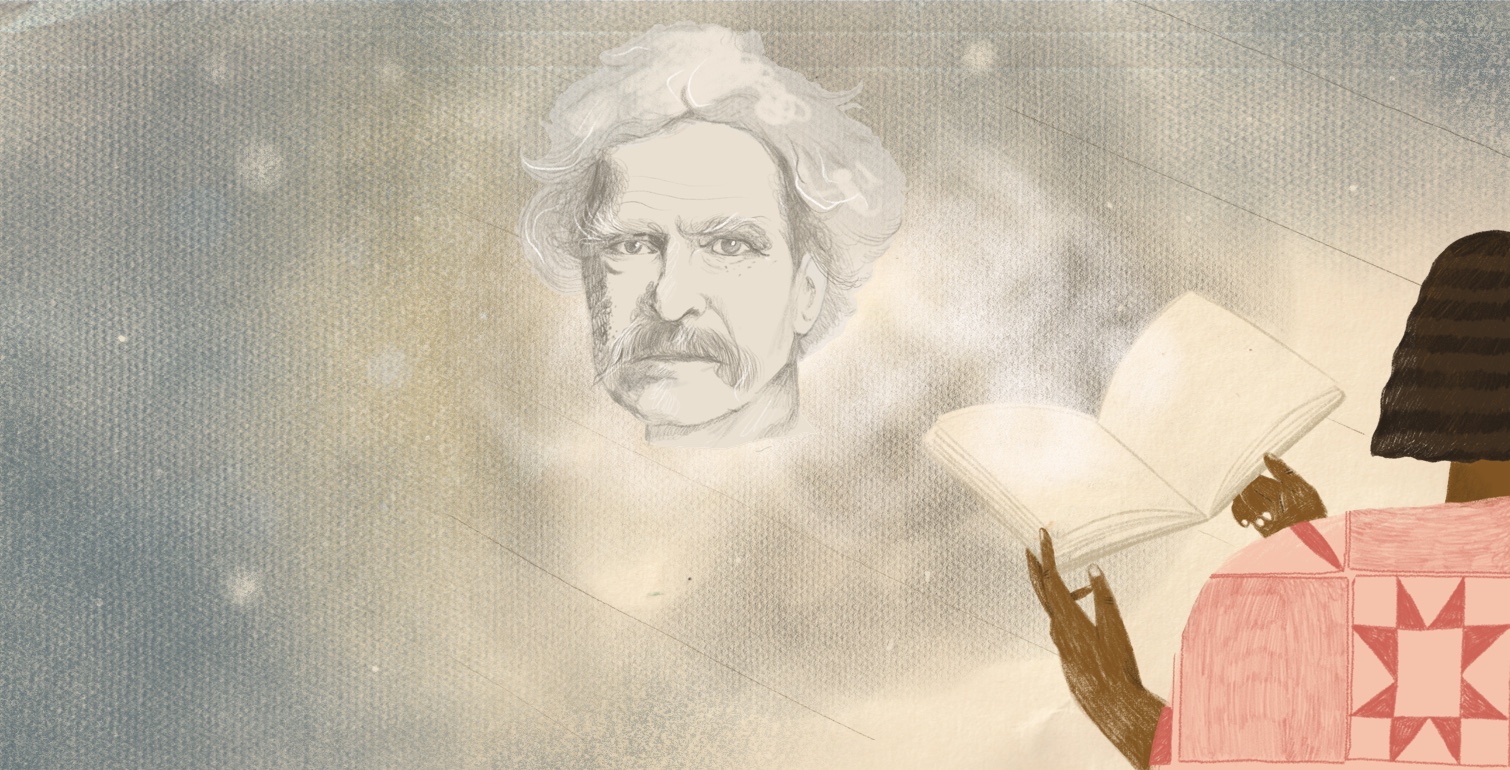
Coffee spilled across my bedsheets as I read the San Francisco Chronicle, my hometown paper, last June. An op-ed was denouncing the Trump administration for killing the Mark Twain Papers and Project’s federal grant. I dabbed at the mess and sipped the article’s outrage. Summed up: How dare this government defund the largest archive of perhaps our most-quoted American author? A motive wasn’t clear.
I tried to imagine what Mark Twain, dead more than a century, might have said to provoke the president. That question sent me back to a novel that once jolted my nervous system with its racial slurs and kicked off my year of researching Twain, arguing about him, even trying to out-Twain him with my jokes.
I remember our Texas university classroom in 1995, its air conditioner rattling like it had bronchitis. Our American literature professor was a Black woman with a tiny fro and a forgetful manner—a look and teaching-style I would adopt decades later.
One day, she wrestled up a Bible-sized Adventures of Huckleberry Finn. “We’re reading this,” she beamed behind thick glasses. “But we’re not reading it out loud.”
No one asked why. Undergraduates would rather walk barefoot across hot gravel than look silly asking a follow-up question. Yet from the first chapter—set before the Civil War during slavery’s primetime and narrated by a Southern white teen steeped in bigotry—I understood. That word. The one that Dave Chappelle had joked “would make Black people mad for the rest of history.”
“By and by they fetched the niggers in and had prayers, and then everybody was off to bed. I went up to my room with a piece of candle and put it on the table. Then I set down in a chair by the window and tried to think of something cheerful, but it warn’t no use.”
I was swiftly overtaken, unnerved by the hard “r” in a word I associate with racial terror and by Huck’s stream of consciousness, which delivers the entire plot. If you haven’t read Mark Twain’s Adventures of Huckleberry Finn—published more than two decades after America unshackled 3.1 million Black captives—picture a comedy-action movie about a couple of buddies outsmarting slavery. Huck’s adventures depend on an enslaved man named Jim whose freedom is precarious. What mostly animates the narrative is “Will this runaway get caught?” And for most of its forty-three chapters we follow this unlikely pair—a white kid fleeing abuse, an exploited Black man—racing down the Mississippi River in one breathless getaway after another. It should be called The Underground Railroad Job. Or Freedom Run.
The year before it landed on my Texas college syllabus, Royce West, a Democratic state senator, tried to eject Adventures of Huckleberry Finn from public classrooms by cutting off funding to teach it. His reasoning: the novel’s subservient depiction of Jim harmed Black children’s self-esteem. My 20-year-old confidence was already under siege by thrift-store grunge, acne, and over-plucked eyebrows. If anything, I was very disturbed to be reading this, in a moment when our culture maintained its own center of gravity—The Fresh Prince of Bel-Air on TV, Waiting to Exhale in theaters, Coolio’s “Gangsta’s Paradise” on the radio. Yet on the page, a Black sidekick endured indignities for uneasy laughs.
Upset has surrounded Adventures of Huckleberry Finn since its 1885 U.S. debut, when scolds fixated on its poor grammar and irreligious tone. Massachusetts’ Concord Public Library immediately deemed it “the veriest trash.” But others saw its roughness as innovation: a wild tale told in the speech of a rogue. It felt so authentically American that it soon became a seminal text in our canon. Huck Finn eventually became required reading for generations of schoolchildren.
By the late 1950s, a race-conscious critique of the book began to take hold on the political left. As the Civil Rights Movement reshaped public life, calls to ban the book emerged across every region of the nation. “Should America’s children be introduced to this book?” has been asked in schools, libraries, and public debates ever since.
In 2018, Huckleberry Finn was removed from the Duluth, Minnesota school curriculum with the help of the local National Association for the Advancement of Colored People, which cited the book’s use of “hurtful language that has oppressed people for over 200 years.” In 2020, four Burbank, California parents—three of them Black, the Los Angeles Times points out—successfully pushed Huck out of classrooms, citing potential harm to the district’s 400 or so Black students. The following year, a nearby Santa Clarita school district advised teachers against assigning the book, fearing insensitivity after George Floyd’s murder by a white Minneapolis police officer.
The novel remains one of the American Library Association’s most challenged books—tracked through public records, media coverage, and confidential reports, though a spokesperson recently told me that many attempts to challenge or ban it go unreported. The organization classifies efforts to remove or restrict public access to Huck Finn as censorship.
Maybe my old lit professor found a middle path by only banning us from reciting Twain’s words. Which is ironic, because she asked us to pay attention to Twain’s sentences and their spoken quality. Hear the looseness in Huck’s telling of a prank on Jim, asleep against a tree:
“Tom said he slipped Jim’s hat off of his head and hung it on a limb right over him, and Jim stirred a little, but he didn’t wake. Afterwards Jim said the witches bewitched him and put him in a trance, and rode him all over the State, and then set him under the trees again, and hung his hat on a limb to show who done it… Niggers is always talking about witches in the dark by the kitchen fire; but whenever one was talking and letting on to know all about such things, Jim would happen in and say, ‘Hm! What you know ‘bout witches?’ and that nigger was corked up and had to take a back seat.”
I remember peering around our Texas classroom, expecting someone to address that thunderstorm of a word. Nobody dared. Instead, we treated Twain’s novel like a cursed object that summons demons if read aloud, and I wrestled alone with my thoughts: Huck Finn drops the N-word more than 200 times, enough for an N.W.A. album. Do I have to be okay with reading this? When Jim appears terrified, eyes bugging out, speaking in dialect crafted by a white author, is that literary blackface? Is Twain racist?
Huck Finn drops the N-word more than 200 times, enough for an N.W.A. album. Do I have to be okay with reading this?
“The question of whether Mark Twain was a racist,” writes Shelley Fisher Fishkin in her 2025 book Jim: The Life and Afterlives of Huckleberry Finn’s Comrade, “is the least interesting and most narrow way to address Jim and to approach Twain’s novel.” A clapback to my younger self.
Fishkin, a white Stanford professor and Twain scholar, argues the character Jim is admirable, smart, kind. A father figure to Huck, he’s one of the first positive portrayals of a Black male in popular American literature. For critics who argue the novel causes harm, Fishkin insists that the problem lies in how it’s taught, stripped of the history of slavery and the racism that outlives it. Absent that context, she compares assigning Huckleberry to serving fugu fish: prepared wrong, it’s toxic.
A year after I first read it, Toni Morrison’s introduction appeared in an edition of Twain’s book. The Black author—whose novel Beloved tells the haunting story of a mother who spares her baby from slavery by killing her—recalls her first childhood Huck Finn encounter as one of “fear and alarm.” Morrison felt complicit in something distasteful, even shaming. Revisiting it, though, she saw the “over-the-top minstrelization of Jim” as “an ill-made clown suit that cannot hide the man within.” Morrison reads Jim as dependable and affectionate, while most of the white male characters are hypocrites, corrupt, ignorant, or violent. Making the best man in the book Black? That forces white readers to confront their prejudices, she argues.
By the way, Morrison’s rereading was “provoked” by 1980s’ book-ban efforts, which she condemns as an “elementary kind of censorship designed to appease adults rather than educate children. Amputate the problem, band-aid the solution.” For Morrison, the censors miss what gives the novel its power as an “amazing, troubling book,” one that addresses an unresolved argument about American racism and civil rights for Black Americans—the very “combustible issues Twain raised.” Its provocations are what make it endure. “It is classic literature,” she says, “which is to say it heaves, manifests and lasts.”
Huck’s discomfort—and the urge to soothe it—was on my mind when I read at Litquake, San Francisco’s largest literary festival, just a few months after the government said it wanted to turn off the Twain archive’s money. A middle-aged crowd filled an old teahouse to hear my satirical piece, “Trigger Warnings Added to Classic Literature.” In it, I invented a publisher called Harm Reduction Classics “going the extra mile to make the canon safe for reading.” The mature laughter at my comic advisory for Huckleberry Finn reinforced that, for much of the twentieth century, the novel was a staple of American high school English classes. I’ve only found one young person who had read it this century.
“It had some problematic language,” my journalism student Solana said. A 21-year-old blonde from Massachusetts, she recalled an “awful” live reading in high school: Solana felt pain for her Black classmates. It’s hard to know how often Huck Finn is assigned nationwide—our curriculum is decentralized and syllabus data is patchy. Yet even outside school, a first-time Huck reader may come away struck by its dank Mississippi setting and unsettling racial hierarchies. My San Francisco friend Houman, a pub-trivia wiz from Iran, recently read it on his own time. His summary: “Floating down the river, being racist.”
I don’t teach Twain’s fiction. While researching this essay, I spoke with an older white college professor who opened his California class on Twain by announcing: “We are going to honor the words as written. Anyone who has a problem reading ‘nigger’ in Huck Finn should leave.” Once, a Black student stiffly stood up and departed, he told me, triumphantly. “Only one.”
His other students probably shrank under the professor’s authority, sitting stunned like possums in headlights—or like me at that moment.
Problematic language could not be the government’s issue with Twain—President Trump’s own rhetoric is far more profane. Within hours of retaking the White House in 2025, the Trump administration began reneging on federal grants linked to Black people, women, transgender people. Soon, any project they classified as “woke” would get its public financing axed.
On April 2, 2025, an email landed at the Mark Twain Papers and Project at the University of California, Berkeley, canceling its already approved $450,000 National Endowment for the Humanities award and dropping one of the longest-running grant recipients in NEH history. In 1967, Twain’s archive first received NEH-supported funding through an editorial program administered via the Modern Language Association’s Center for Editions of American Authors. By 1976, the Twain Project began receiving direct NEH grants, awarded continuously and totaling more than $10 million. Until that email.
Getting into the bureaucratic violence behind that cut, plus the legal fight that tried to stop it, could make a great TV courtroom procedural I would call “Cancel Court: Twain on Trial.” What stands out is how UC Berkeley, my alma mater, didn’t officially resist the grant cancellation nor protest it. Instead, a law school professor there personally recruited plaintiffs, including the director of the Twain archive, for a class-action lawsuit. She mounted the case independently, pulling together enough ragtag lawyers to start a baseball team. (Suggested name: The Loopholes.)
The government’s cancellation email, press releases, and legal defense were vague. After a lower court ruled those UC grants must be reinstated, funds were slowly paid to the plaintiffs, even as the case moved to the Ninth Circuit federal court of appeals. There, the government’s lawyer offered crisp case law but this hazy justification: “We don’t want to pay for this project on Mark Twain anymore. We’d rather spend it on something else.”
Meanwhile, the same agency fighting to terminate the Twain archive’s $450,000 had just solicited sculpture proposals for Trump’s National Garden of American Heroes, part of the 250th anniversary celebration of the U.S. Declaration of Independence. One proposed honoree: Samuel Clemens—whose pen name was Mark Twain. Of course they’ll bronze the man, but bury his words.
Striking in his all-white suits and Southern drawl, Twain was a novelist, newspaper columnist, and touring lecturer so funny he’s considered our nation’s second-ever stand-up comedian. Twain helped invent a comic American voice that was irreverent, wary of groupthink. “Whenever you find that you are on the side of the majority, it is time to reform—or pause & reflect.” While he enjoyed global recognition before his death in 1910, I’m told his folksy humor never quite landed with the French.
He’s still widely remembered in California’s rural Calaveras County, known for cattle, methamphetamine labs, and the first story to make Twain famous, “The Celebrated Jumping Frog of Calaveras County.” In the 1860s, Twain passed through Calaveras as a struggling writer and overheard a Gold Rush tale involving a frog-jumping contest. In 2006, I lived there, the only Black person in a small newsroom. I covered the annual fair, crowded with ordinary livestock and sugary funnel cake, but also athletic amphibians—a nod to Twain’s short story. Every May, tourists stickily swarm the fairgrounds, whether they’ve read his now-canonical frog tale or not, because, as he said, “A classic is something that everybody wants to have read and nobody wants to read.”
Americans still quote him exhaustively because he names what we know but struggle to say. “Travel is fatal to prejudice, bigotry, and narrow-mindedness, and many of our people need it sorely on these accounts,” wrote the man who journeyed beyond his provincial Southern roots, broadening his views on slavery, women’s suffrage, American imperialism, and religion. Twain’s warnings about gullibility never age: “How easy it is to make people believe a lie and how hard it is to undo the work again!” He framed patriotism as something separate from obedience: “Loyalty to the Nation all the time, loyalty to the Government when it deserves it.” And every election season, a barb credited to him resurfaces: “Suppose you were an idiot. And suppose you were a member of Congress. But I repeat myself.”
Americans still quote him exhaustively because he names what we know but struggle to say.
In the 1860s, Twain also wrote columns in and about my foggy city. I love this line attributed to him: “The coldest winter I ever spent was a summer in San Francisco.” Twain—infamously misquoted—didn’t say it. Still, at a Lower Haight café one misty winter day, my neighbor Zula, an older Black woman in rain boots, a green beanie, and a red overcoat resembling a sleeping bag, declared to me: “My Mark Twain? I love Mark Twain!” and recited the weather misquote without missing a beat. She said they shared a reckless star sign: “He’s a Sagittarius just like me. He was born under Halley’s Comet and died under it.” As she gushed, Zula made my own preoccupation with Twain seem downright restrained. “I love Mark Twain because he believed in himself, toured the world, and put San Francisco on the map!” Then she said she hoped her death would align with a comet, too.
To meet Twain in his afterlife, I headed for his literary remains stored in a part of UC Berkeley I had never explored. (This was around the fall of 2025 when my old school turned 160 names of students, professors, and staff to federal investigators probing antisemitism.) I entered the pale-stone Bancroft Library. At reception, I surrendered my purse and phone, keeping only pencil and paper, as if entering a classified zone. When I arrived at arguably the largest collection of any single 19th-century American writer, I met my guide, Robert Hirst. Recently retired after more than four decades directing the Mark Twain Papers and Project, he had the relaxed authority of someone who no longer needed to prove he belonged: his wire-rim glasses glinted on his crinkled peach-colored face, his rounded midsection strained gently against West Coast casual.
Hirst spoke of Twain as if the writer were still alive.
“He doesn’t throw anything away,” the elderly scholar said, before guiding me into a literary shrine that felt more like a dental lobby: gleaming floors, an empty reception desk, a glass case displaying small Twain artifacts arranged with the clinical precision of teeth models.
Over two visits, he took me through offices and climate-controlled storerooms I can only describe as “filing cabinet jungles.” Like some benevolent dealer, he gave me three Twain-book freebies. When he wasn’t unpacking the U.S. government’s attack on the archive, Hirst was deflecting my criticism of Twain’s best-known protagonist.
“Huck is a victim of his environment,” Hirst bristled when I called out the character’s overuse of that racial epithet. “He never sees through the evils of slavery.”
While I liked talking to Hirst, I couldn’t help but feel disappointed that he wouldn’t entertain complex comments from a Black reader. So I brought up the Black writer who reimagined Huckleberry Finn from Jim’s point of view.
In James, Percival Everett’s 2024 Pulitzer Prize-winning novel, Jim can’t be mistaken as a comic minstrel appendage. This character is erudite, strategic, and fluent in standard English, adopting “slave speech” only when white people are listening. It’s irresistible to read James as a corrective: that book shows the bodily terror of slavery, its whippings, rape, murder, in ways Twain never does.
Yet Percival Everett has said he didn’t set out to indict Twain. “I’m writing the novel Twain was not ill equipped, but unequipped, to write,” he told NPR in 2024. Twain, raised in a slaveholding family in Missouri, briefly joined a Confederate militia before abandoning the Civil War and reinventing himself in the West. He may have written Adventures of Huckleberry Finn in Reconstruction’s ashes, as white supremacy surged again and Black Americans were stripped of basic rights, as a kind of moral tale. But, in Twain’s narrative, Jim never quite escapes his secondary-character status.
James takes place inside many of Huck Finn’s primary set pieces, yet invents a Tarantino-revenge fantasy starring Jim. When I brought up how radical this felt, Hirst sniffed and shared an anecdote. After Everett’s novel was published, he visited Berkeley. Hirst said he showed him Huck Finn drafts and revisions and the modern author was wowed: Everett said he had underestimated how much intelligence, savvy, and bravery Twain had invested in Jim.
Then Hirst told me that in Twain’s 140-year-old book, Jim also does something radical: he delivers a counterblow to whiteness that Everett’s James leaves out, when Jim, in a hurt reprimand for a prank, calls Huck “trash”:
“En all you wuz thinkin’ ’bout wuz how you could make a fool uv ole Jim wid a lie. Dat truck dah is trash; en trash is what people is dat puts dirt on de head er dey fren’s en makes ’em ashamed.”
See how bold that was! Hirst insisted. “Speaking to a white man and calling him ‘trash.’ And Huck took ‘fifteen minutes’ to ‘humble’ himself to apologize ‘to a nigger.’” He paraphrased a line from chapter fifteen and I struggled to fix my face at him saying the eternally angering word.
Hirst also seemed annoyed. He would not accept Everett’s attempt to construct a richly sketched interior life for Jim.
“The real Jim is not recognizable,” he protested. “It is Everett as Jim.”
That’s a flattening move, treating characters as stand-ins for their authors. I wouldn’t equate Twain with his bigoted Huck.
I could rummage through Twain’s personal life to prove he was friendly to Blackness. As a boy, Twain spent nights enthralled by Black storytellers who were enslaved by his extended family. Eventually he married into an abolitionist family and befriended Frederick Douglass (who did render slavery’s horrors in his memoir and rejected anniversaries of the Declaration of Independence in his speech “What to the Slave is the Fourth of July?”). Twain financed a Black student’s education at Yale Law School, a man who later went on to mentor Thurgood Marshall, the first Black Supreme Court Justice.
Biography can offer hints, but the work is clearer. And Twain kept returning to American slavery, not to document its brutality, but to attack systemic racism and insist on the shared humanity of Black people. In Pudd’nhead Wilson (1894), a novel about a white and Black baby switched at birth in the antebellum South, he even lampoons racial categories as arbitrary.
Naturally, his words carry the echo of lived experience. There’s the “monstrous big river” he once piloted, the Mississippi, with its cluttering bullfrogs, swift currents, sweet flowers, and rank dead fish all rendered in Huckleberry Finn. Jim, too, emerges from Twain’s own life, according to Ron Chernow in his 2025 biography Mark Twain. Drawing on the Twain Papers, Chernow writes that in Twain’s boyhood, a friend’s older brother helped hide a fugitive slave who had crossed the Mississippi from Missouri into Illinois. When white woodcutters discovered the Black man, they chased him into the river, where he drowned. Days later, his corpse surfaced, terrifying Twain and his friends. Twain reworks this nightmare: in his story, the fugitive slave escapes on the Mississippi—and Jim lives.
A decade before publishing Huckleberry Finn, Twain interviewed “Aunt Rachel,” a formerly enslaved Black woman. His resulting 1874 Atlantic Monthly piece avoids humor to relay her unflinching account of a slave auction that shattered her Virginia family:
“I knows all ’bout slavery, ’case I ben one of ’em my own se’f. Well, sah, my ole man—dat’s my husban’—he was lovin’ an’ kind to me… jist as kind as you is to yo’ own wife. An’ we had chil’en—seven chil’en—an’ we loved dem chil’en jist de same as you loves yo’ chil’en.”
Aunt Rachel’s real grief carries into Twain’s fiction, when Huck notices Jim’s despair over those he left behind in bondage:
“He was thinking about his wife and his children, away up yonder, and he was low and homesick; because he hadn’t ever been away from home before in his life; and I do believe he cared just as much for his people as white folks does for their’n. It don’t seem natural, but I reckon it’s so.”
Rereading Twain’s novel, three decades after my muted literature class, the enslaved man is clearly its moral center. Huck’s evolution tracks with his growing compassion for Jim. Like (spoiler) when the white teen rejects his church and society’s racist teachings, and doesn’t turn Jim over to some slavecatchers—even though he thinks it’ll cost him his soul. “All right, then, I’ll go to hell,” Huck says.
What’s less obvious is how the novel creates space for modern readers to recognize and articulate their own encounters with racism. So argues Fishkin, the Twain scholar. She points to Ann Lew, a San Francisco high school teacher in the 1990s who initially tried to ban Adventures of Huckleberry Finn from the curriculum before reconsidering its potential. By teaching students to read Jim as a resourceful, self-defining character, Lew found that the novel created a door: her largely nonwhite students began sharing their own experiences with racial profiling and discrimination, including vulnerabilities around being non-native English speakers. “Reading Huck Finn with students opens rich opportunities for discussions about race,” Lew said.
Satire makes fun of something to expose its truth in a way that can be notoriously difficult to decode. What is often misread in Twain’s most famous novel is this: he satirically uses racism to ridicule racism.
His 1865 Virginia City Territorial Enterprise column takes the same approach to make fun of white resentment over Black San Franciscans marching in the Independence Day parade, months after Abraham Lincoln’s assassination. That Fourth of July parade, Twain wrote, featured “a long double file of the proudest, happiest scoundrels I saw yesterday—niggers.” He described the procession as a grotesque color gradient, from “lightest colored darkies” to “unalloyed niggerdom,” before adding that “the day was dusty and no man could tell where the white folks left off and the niggers began.”
Only then did his real target come into focus: white bigots.
“The ‘damned naygurs’—this is another descriptive title which has been conferred upon them by a class of our fellow-citizens who persist, in the most short-sighted manner, in being on bad terms with them in the face of the fact that they have got to sing with them in heaven or scorch with them in hell … on a footing of most perfect equality.”
White supremacy is petty and theologically incoherent. That’s Twain’s point, camouflaged in a performance of dumb intolerance. Yes, he wallows in racist language so thoroughly that today’s readers miss the turn. But Twain wasn’t in league with white grievance then, and he wouldn’t link arms today with Trump, who has brayed that discrimination against the white majority is America’s real problem, and has screeched at Smithsonian museums for focusing too much on “how bad slavery was,” and has fused racial scapegoating of Black and brown people with state power. Twain, who said “Patriotism is usually the refuge of the scoundrel. He is the man who talks the loudest,” would have skewered Trump. I can hear him saying something like: “Suppose you were a bullying, bigoted grifter. And suppose you were the U.S. president. But I repeat myself.”
White supremacy is petty and theologically incoherent. That’s Twain’s point, camouflaged in a performance of dumb intolerance.
On my final trip to the archive last fall, Hirst and I sat in an area that seemed like a book-signing station at a literary conference. Hanging above us was a half-nude black-and-white photo of the author. Walrus mustache. Giant, shaggy skull. Narrow shoulders, baby biceps, skinny yet hairy pecs. The overall effect: Stalin’s head on Timothée Chalamet’s body.
“If you want to get the neck right, you’ve got to see the shoulders,” Hirst offered about the topless Twain photo, which was the model for a plaster and bronze bust. I wondered if the Garden of Heroes sculptor would study this image. Hirst interrupted my reverie to divulge what he heard about the archive’s canceled grant. An NEH program officer told Hirst the grant might have been cut because it had been approved by the last guy’s administration—a way to clear out anything Joe Biden had touched. The life work of a literary giant sabotaged by bureaucratic pettiness.
By December, the government had beat Twain: the Ninth Circuit said it had the right to cancel the grant. Undeterred, Hirst told me he would continue fundraising for the archive, even in his retirement. (Thanks to the lower court’s ruling, the archive had already pocketed the full $450,000 it was originally promised.)
By then, Twain had already taken up residence in my psyche. When my therapist led me through a grounding exercise for the terrors of 2025, I was asked to imagine three “wise guardians.” Weirdly, Benjamin Franklin showed up. John Steinbeck. Then Twain. All former newspapermen. All freethinking, imperfect white guys who tried to make sense of America. I’m overexplaining. Look, in a middle-aged panic, you have the right to call on whoever’s free.
Which is just to say: Trump made me revisit Twain. As his regime narrows what can be studied or questioned or said, it’s inspiring many of us to reread America’s most-debated texts. Next up: the Bill of Rights and the U.S. Constitution.
