


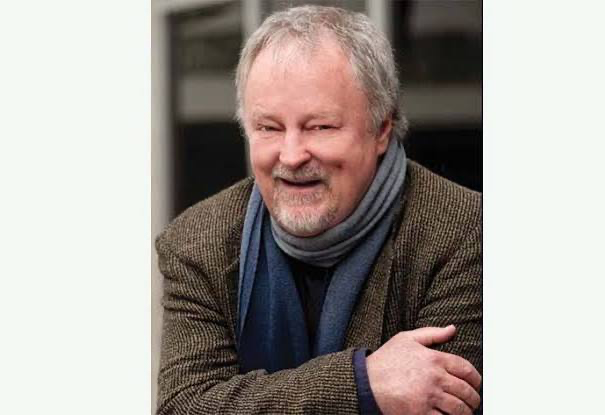
I once described Bill McGlaughlin, who has died at the age of 82, as manifesting “a singular combination of gravitas, humor, and informed sincerity.” He began his musical life as a trombonist, later became a conductor and composer — and America’s single best-known classical music radio host.
Classical music radio turned toxic decades ago. It connotes arthritic programing for aged or timid listeners, and an orotund baritone spewing platitudes. Bill’s baritone was never orotund — I would describe it as breathless and excitable, quivering with feeling. That such an original radio presence acquired such popularity goes to show that conventional wisdom is often flawed wisdom.
One of my most remarkable experiences being interviewed about classical music occurred in Chapel Hill, North Carolina, on an early morning TV show. I was curating a “Dvorak and America” festival for the North Carolina Symphony, and had been invited to talk about Dvorak on live television. Which I did. Meanwhile, my interlocutor was visibly perturbed by instructions she was receiving via her headset. I couldnt hear the instructions, but I knew the gist: “Get that guy to stop talking.” Which I did not.
Equally remarkable was the experience of being interviewed, years ago, by David Osenberg, who runs a classical music radio station unlike any other: WWFM. Dave’s questions were unpredictable and my answers were long. Shortly after that exchange was aired without mishap, Dave suggested we fashion a regular program based on the thematic concerts I was concocting for PostClassical Ensemble in Washington, D. C. Most took the form of advocacy for underplayed American composers like Bernard Herrmann, Silvestre Revueltas, and Lou Harrison. We knew the program needed Bill McGlaughlin.
On the resulting shows, Bill and I talked more than we listened. Here’s a sample of “PostClassical” as broadcast by WWFM on February 21, 2020. The topic was Wilhelm Furtwängler’s wartime Berlin broadcasts. This was Bill’s response to a 1942 broadcast of Schubert’s Ninth Symphony, movement two:
So that’s BIll counting the extra beats Furtwängler interpolates when Schubert’s juggernaut suddenly stops and yields a cavernous silence. And then he unforgettably says: “This time we broke it, we really broke civilization.” And I concur.
But Bill and I didnt always agree. We had a running battle over Aaron Copland, whose music I find over-praised and over-played. One fine afternoon, Bill’s patience ran out: “So you better get over it, Jack,” he announced. So much for that topic.
Another show dealt with great American orchestras back in the days of Toscanini, Stokowski, and Koussevitzky. The most extreme was Dmitri Mitropoulos’s Minneapolis Symphony, whose stylistic base was Mahler, Schoenberg, and Berg. Mitropoulos was especially proud of his 1940 recording of Schumann’s Second Symphony. We auditioned some of that until Bill interrupted. “It makes me really jittery,” he confided. “I can’t understand this Schumann. I know that Schumann was meshugana. This is so crazy-making for me. Help me out!”
Bill admired my recent novel The Marriage: The Mahlers in New York and eagerly wrote about it. But Bill was about uplift and I savor Mahler’s torment. Bill commented: “The overall trajectory of Mahler’s life in these years could leave a reader despondent. Then, just when we’re about to abandon all hope, Joe gives us the story of the premiere of the Eighth Symphony in Munich, one of he greatest triumphs of Mahler’s life. This chapter is filled with love and music and children and leaves us with the will to go on.” His comments ended: “Mahler is now heard around the world. And this book deepens our experience and satisfaction and love.”
He was one of a kind, irreplaceable.
To audition the entire “PostClassical” broadcast dealing with “Furtwängler in Wartime,” click here.
To hear Furtwangler’s 1942 Schubert performance, click here. The climax in question peaks at 23:07.
