


The unnamed narrator of Deborah Levy’s latest novel, My Year in Paris with Gertrude Stein, is trying—and failing—to write an essay about the enigmatic author, art collector, and high priestess of modernism. She’s come to the City of Light in an attempt to get her arms around Stein, but her subject proves slippery, and neither Stein’s biography nor her body of work are much help. By the book’s end, a friend comforts her: “Gertrude Stein was a big presence, but I don’t think anyone can ever get to the bottom of it.”
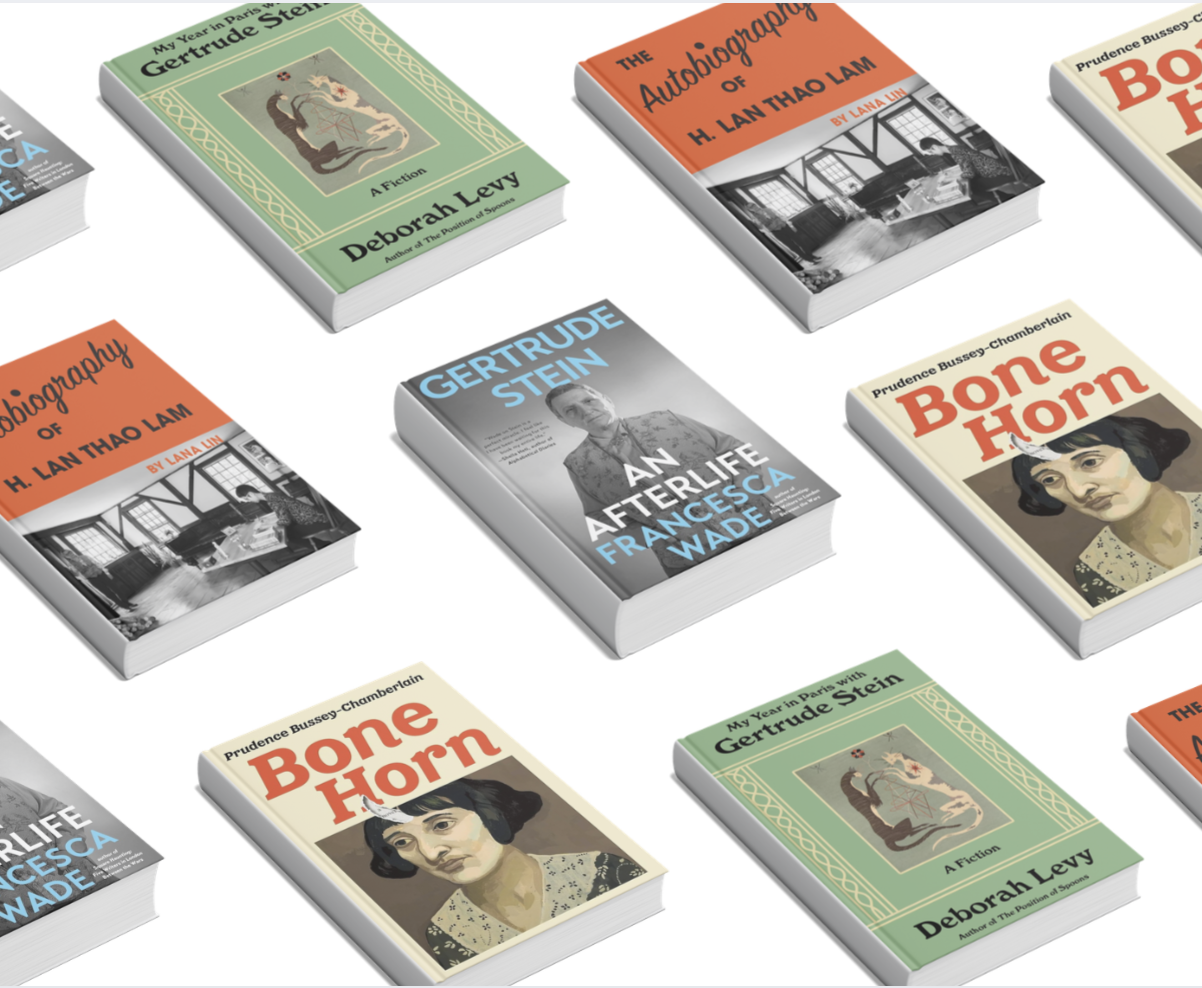
Levy’s narrator—and by proxy, Levy—isn’t the only one trying to “get to the bottom” of Stein and her imprint on literary culture. Something’s in the air: My Year in Paris with Gertrude Stein, published last month by FSG, is just one in a recent cluster of genre-spanning books that interpret, adapt, and play with Stein’s legacy, as well as that of her longtime partner Alice B. Toklas.
Francesca Wade’s innovative biography Gertrude Stein: An Afterlife, published by Scribner, thrust Stein and Toklas back into the spotlight last October, while Lana Lin’s The Autobiography of H. Lan Thao Lam, released that same month by Dorothy Project, emulates Stein’s best-known work to chronicle her own life and longtime relationship. And published last month by Soft Skull—just a few weeks after Levy’s novel—was Prudence Bussey-Chamberlain’s Bone Horn, a queer detective story hinging on a strange case related to Toklas.
Wade, who recently won the Biographers International Organization’s award for best biography of the year, believes the books’ timing is likely coincidental—but it’s also a boon.
“It’s just so fascinating to see the different parts of Stein that people have been drawn to,” she says, “whether building on her work and her formal experimentation, or taking up new aspects of her biography.”
Things bubble up
Wade, for one, was interested in Stein’s self-mythology and how her legacy was posthumously constructed by scholars as well as Toklas, who’s often seen as a supporting character in Stein’s story. A trip to Yale’s Beinecke Library to see the newly available papers of Leon Katz—a PhD student who spent months interviewing Toklas in the 1950s, but never published the conversations—helped clarify the scope of Wade’s book, which both tries to capture Stein and analyzes others’ attempts to do the same.
When Scribner VP and editorial director Kathryn Belden received the manuscript on submission, she was less intrigued by its subject (she admits she “may have tried to read Stein once and didn’t get too far”) than its approach, which interrogates the very genre of biography. She’s chuffed by the company that Wade’s book now keeps.
“It is funny when things bubble up like this,” Belden says of the revived interest in Stein and Toklas. “But they do! And there must be reasons.” Among them, she speculates, is a growing appetite for “stories about overlooked, underappreciated women and people from marginalized groups.”
All of these books, Wade also notes, are “poised on a bit on that tension between the life and and the legend—sort of engaging with those two strands of [Stein’s] reception at the same time.”
“As someone who has been specifically interested in in Stein’s afterlife,” she adds, “it feels like a self-fulfilling prophecy, in a way, that that afterlife is only expanding further, as we speak.”
Homage and critique
It was early into Lin’s romantic relationship with the artist H. Lan Thao Lam when she got the idea to riff on Stein’s ventriloquized autobiography of Toklas. She was inspired by Toklas and Stein’s “iconic lesbian relationship,” she says, because it offered a model of queer love—one that “revolved around artistry and creativity and mutual support and care”—to which Lin and Lam could aspire.
In many ways, Lin says, their steadfast partnership “rhymed with Lan Thao’s and mine—or what I projected might be our future.” The Autobiography of H. Lan Thao Lam, longlisted for the 2025 National Book Award, narrates Lin and Lam’s life stories—as well as their love story—from Lam’s point of view.
Danielle Dutton, cofounder and publisher of Dorothy, was grabbed right away by Lin’s project when it came to her through the annual open reading period at the small press, which publishes two books per year—most of them experimental and authored by women. Dutton has long admired Stein, though she was ultimately drawn by how Lin’s book “mimics the Stein formally, but also opens up important questions about homage and critique.”
The publisher isn’t surprised by recent curiosity about Stein. Since she lived and wrote at the turn of the century—a period of rapid political, cultural, and technological change—“it makes sense that people might be looking, now, to see how artists of the past worked through such intense tumult,” Dutton says.
While Lin doesn’t count herself as a Stein fan, the literary device that powers Stein’s Autobiography “really captivated my imagination,” she says, especially in the way it speaks to how relationships can shape identity. At the same time, she couldn’t ignore how Stein’s work flattens and excludes people of color—and by extension Lin, who is Taiwanese American, and Lam, a former Vietnamese refugee. This absence, she says, “felt important to speak back to.”
The project of Lin’s Autobiography, then, was twofold: “to not only pay homage, but also intervene and insert Asian American presence—the people of color presence—into that narrative.”
The mystery that is the past
At some point, Bussey-Chamberlain read, somewhere, that Picasso once claimed Toklas had a horn on her forehead. This anecdote (she later located its origins in Diana Souhami’s 1991 book Gertrude and Alice) would become the seed of her debut novel, a work of detective fiction, in which a lesbian literature-scholar-turned-private-investigator is tasked with recovering that horn. Once Bussey-Chamberlain learned about Stein’s well-documented love of detective novels, the book took root.
Bussey-Chamberlain wrote Bone Horn with a specific publisher in mind: the London-based Cipher Press, which launched in 2020 and whose titles, she says, are “always queer, but without the mainstreaming of queerness that happens in so many other places.” The book was published in the U.S. by Soft Skull, an imprint of Catapult Book Group.
Elizabeth Pankova, assistant editor at Catapult, says that, as a detective story, the book foregrounds “the mystery that is the past”—and our hopeless attempts to solve it. The same could be said of Levy’s novel, in which its essayist narrator also attempts a literary investigation of her own. (Levy and her editor, FSG president and publisher Mitzi Angel, declined to be interviewed.)
As for the renewed mainstream interest in Stein and Toklas, Bussey-Chamberlain nurses a couple theories. For one, she believes the time is right to revisit Stein and Toklas’s partnership, which would be easy to dismiss as heteronormative for “having a genius in the front room and a wife in the kitchen.” But, like Lin, she believes their relationship was more complex and collaborative than previously thought.
She also wonders if “there’s something about Stein’s difficulty and unintelligibility, or opacity, that is interesting people again.” Indeed, one imagines ChatGPT would fail miserably if prompted to write in the style of Gertrude Stein. Ultimately, the obfuscation and abstraction of her work, the concentration and attention it demands, “might be an antidote to this cultural moment.”
And what would Stein make of her newfound relevance? “I think she would love it,” says Wade. “She was always wanting to get her due and wanting to find her readers—she set up her own publishing house, she left these instructions in her will for all of her work to be printed posthumously. And I think this was out of a belief that her work would find readers if it was available to them.”
“Anything that showed that people were still coming anew to her work, and finding such different kind of possibilities in it,” she adds, “would be a kind of vindication of those efforts.”
