

Full-Fledged DFC Operations and GCT Push accelerate Freight Growth; Loading Rises Consistently from 1,098 MT in 2014-15 to 1,670 MT in 2025-26

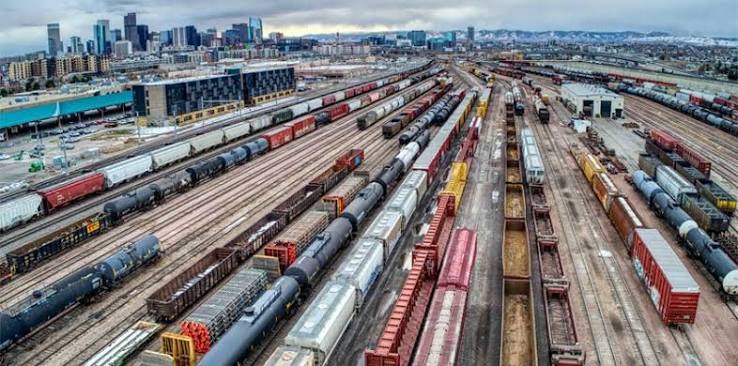
Indian Railways Strengthens Freight Ecosystem Through Terminal Development, Wagon Investment Schemes, Rapid Cargo Services and Improved First-and-Last-Mile Connectivity
NEW DELHI: For strengthening freight logistics, regional connectivity and to increase the freight movement share of Railways, Indian Railways has implemented a multi-pronged strategy to enhance freight efficiency, ensure seamless regional connectivity, and provide robust first-and-last-mile solutions. The key initiatives are categorized below –
(i) Terminal Development: To improve the efficiency of rail freight handling at the terminals, Indian Railway has adopted two-pronged approach: encouraging development of modern rail freight terminals under Gati Shakti Multi-Modal Cargo Terminal (GCT) policy and augmenting/ upgrading the infrastructure at railway owned goods sheds.
For encouraging setting up of cargo terminals through private investment, ‘Gati Shakti Multi-Modal Cargo Terminal (GCT)’ policy has been launched. Location of the GCTs is decided on the basis of demand from industry, potential of Cargo traffic, availability of railway infrastructure and overall logistics potential of the area.
So far, 142 Gati Shakti Cargo Terminals (GCTs) have been commissioned with an estimated freight handling capacity of 224 million tonnes per annum (MTPA). The policy has mobilized private investment of approximately ₹10,000 crore through these GCTs. Freight handled at these GCTs during 2025-26 is 146 MT.
(ii) Wagon Investment Schemes: Indian Railway has already implemented various schemes for private sector to invest in wagons including the commodity focused specialized wagons such as wagons for cement, oil, steel, fly-ash etc. So far, around 275 rakes of special purpose wagons and 397 rakes of general-purpose wagons are operational, which are expected to improve modal share in commodities like bulk cement, fly-ash, steel products, iron ores and coal etc. Besides, there is a separate scheme for transportation of automobiles under which around 54 rakes owned by industry are operational.
(iii) Joint Parcel Product-Rapid Cargo Service (JPP-RCS) scheme: This scheme offers tailor–made logistics to meet specific needs of the customer and provide door-to-door parcel services. Under the scheme, provision has been made for online booking of parcel space in these services through Aggregators (in addition to India Post) on ‘Virtual Aggregation Platform (VAP)’.
(iv) CONCOR, a PSU under Ministry of Railways is also providing Door-to-Door parcel services by utilizing the JPP-RCS over Delhi-Kolkata and Mumbai-Kolkata sectors. CONCOR is also providing Door-to-Door logistics under a pilot project at Sonik Goods shed.
Budget allocation and Network Expansion: Capacity enhancement of railway network has been taken up by Indian Railways in a big way during last 12 years. The details of commissioning / laying of new track across Indian Railways is given below: –
| Period | New track Commissioned | Average commissioning of new tracks |
| 2009-14 | 7,599 Km | 4.2 Km/day |
| 2014-26 | 36,429 Km | 8.32 Km/day (nearly 2 times) |
As on 01.04.2026, across Indian Railways, 514 Railway infrastructure projects (169 New Line, 29 Gauge Conversion and 316 Doubling) of total length 40,000 Km, costing approx. Rs.8.31 lakh crore are sanctioned. The summary is as under: –
| Category | No. of Projects | Total LengthNL/GC/DL (km) | Length Commissioned tillMar’26 (km) | Total Exp. upto Mar’26(Rs. in Crore) |
| New lines | 169 | 16,634 | 3,361 | 1,57,572 |
| Gauge conversion | 29 | 3,987 | 3,045 | 24,227 |
| Doubling | 316 | 19,379 | 6,177 | 1,23,454 |
| Total | 514 | 40,000 | 12,583 | 3,05,253 |
Dedicated Freight Corridors: Ministry of Railways had taken up construction of two Dedicated Freight Corridors (DFC) viz. Eastern Dedicated Freight Corridor (EDFC) from Ludhiana to Sonnagar (1337 Km) and Western Dedicated Freight Corridor (WDFC) from Dadri to Jawaharlal Nehru Port Terminal (JNPT) (1506 Km). Both the DFCs i.e. Eastern DFC (1337 Km) and Western DFC (1506 Km) have been commissioned.
On an average about 443 trains are operated per day on DFCs. The Dedicated Freight Corridors have demonstrated robust operational performance. Freight volumes have steadily increased, with higher average speeds, faster turnarounds, and enhanced reliability. DFC has contributed to creating additional paths on the conventional network by diverting freight traffic to EDFC and WDFC. As a result, Railways have been able to run additional goods and coaching services over its network.
Dedicated Freight Corridor (DFC) Project will have positive impact on transportation and logistics sector as it will enable enhanced movement of Double Stack Container (DSC) trains, higher axle load trains, faster access of northern hinterland by Western Ports and development of new terminals/linkages with industries along the DFC.
A new Dedicated Freight Corridor connecting Dankuni in East to Surat in West, has been announced in the Union Budget 2026. The work of preparation/updation of Detailed Project Report (DPR) for this corridor has been taken up.
The above initiatives have been helpful in increasing freight loading and revenue during the last few years. Freight loading since 2014 is as below:
| Year | Freight loading (in Million Tonnes) |
| 2014-15 | 1098 |
| 2015-16 | 1104 |
| 2016-17 | 1109 |
| 2017-18 | 1162 |
| 2018-19 | 1223 |
| 2019-20 | 1210 |
| 2020-21 | 1233 |
| 2021-22 | 1418 |
| 2022-23 | 1512 |
| 2023-24 | 1591 |
| 2024-25 | 1617 |
| 2025-26 | 1670 |
The freight loading of Indian Railways has increased to 1,670 MT in 2025-26 thus IR has become the second largest freight carrying Railways in the world.
This information was provided by the Union Minister for Railways, Information & Broadcasting and Electronics & Information Technology, Shri Ashwini Vaishnaw, in a reply to a question in Rajya Sabha on Friday.
