Sign up for the Slatest to get the most insightful analysis, criticism, and advice out there, delivered to your inbox daily.
This summer, there’s a certain number of books to be read. Along with the book stacks come bingo cards with squares for different types of books, and prizes. And, of course, all that reading culminates in a pizza party. It’s a childhood dream—books in exchange for pizza—come to life. Jill Nawrocki is 45, and thanks to a lifelong love of reading sparked in part by Pizza Hut’s beloved preschool-through-sixth-grade program that traded monthly reading achievements for personal pan pizzas, she’s creating a Book It! summer for her friends.
Nawrocki, who lives in Brooklyn, New York, has intentionally built community around books. For the past few years, she and a friend have organized a book swap. Wanting even more chances to read and connect, this year they decided to host a Book It!–inspired reading challenge, with about 30 people participating. She described it as “a combination of what we remember from Book It!, with the pizza at the end and people being really enthused to read, and summer reading challenges from our libraries growing up.” Think of it as a chance to celebrate reading with a nod to childhood.
Scroll through Book It! posts online and you’ll see plenty of adults re-creating the challenge themselves, whether it’s reading 100 books with their book club to “earn” Pizza Hut pizza or pulling out the iconic buttons from their own childhood to share with their kids. Book Riot published a list of summer reading challenges for “adults who still miss getting personal pan pizza prizes,” including one from WNYC, and many libraries, of course, run their own summer reading challenges for all ages.
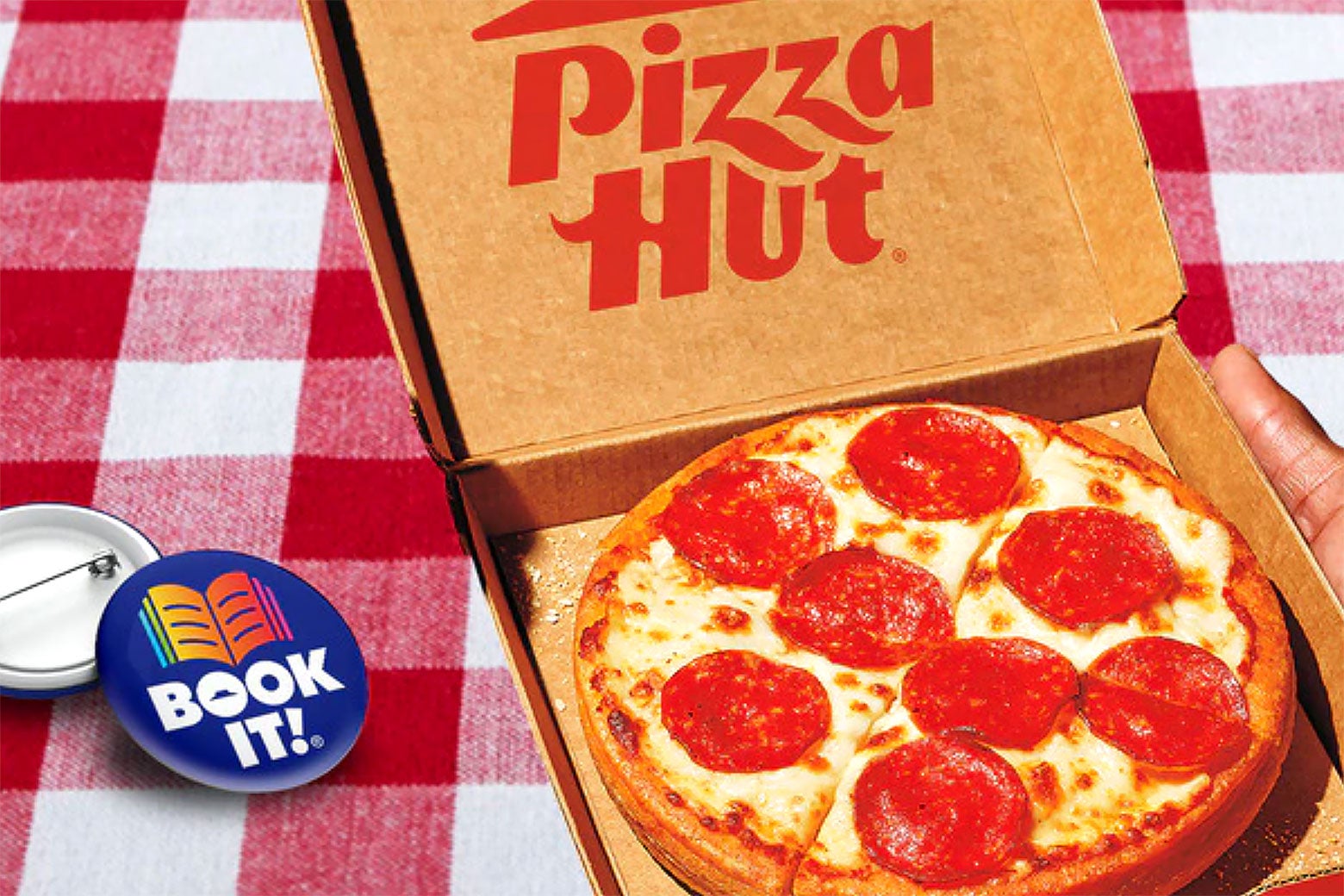
Pizza Hut’s Book It! program is part of the lore of countless childhood readers turned adults. According to Pizza Hut, over 70 million children have participated since the program was founded in 1984, a Reagan-era initiative. Picture it: Tiffany-style lamps that felt impossibly classy, checkered tablecloths, the gathering place of Little League teams, families looking to celebrate, Girl Scout troops post-meeting—and yes, bookworms.
Part marketing initiative, part reading engagement program wrapped in a delicious one-topping package, Book It! carries a kind of nostalgia that has managed to sustain generations. When Pizza Hut announced that “Summer Stories,” the summer edition of Book It!, was back this year, comment sections were flooded with posts from older generations recounting how the program got them into reading (and begging for an adult version). For many, the nostalgia for Book It! is a reminder of just how meaningful an early love of books was.
“We’re always thinking about methods to get people to come back to reading, and so one of the things that we found has been really successful is really leaning into nostalgia,” said award-winning author and founder of Loudmouth Books bookshop Leah Johnson. Loudmouth, based in Indianapolis, is running its own summer reading program for grown-ups, including a pizza party. They also host a Scholastic Book Fair for adults, which Johnson said is a huge hit. “How can we take this thing that is often looked at as a chore in adulthood and turn it into something that is as joyous as it was when you were in the first grade?” Johnson said.
Johnson has her own memories of participating in Book It! as a kid: “I used to feed my whole family on that program,” she said. “For kids who are bookish, and also were growing up in poverty, I think that the Book It! program literally was like a saving grace.”
Now, in the bookstore, when they’re able to capture the magic people felt when they were kids, “it gets people to buy books, gets people to read, gets people to show up, and it gets people to engage,” Johnson said. And engagement in reading matters: It’s been widely reported that reading for pleasure is declining among both adults and children, and there’s a constant debate over whether reading is in crisis.
Engagement of a different sort was also a factor in Book It! itself from the beginning. “It was a win for the kid, it was a win for the parents because they did get the kids to read, and it was definitely a win for Pizza Hut,” said Lisa Parcell, a Kansas Health Foundation distinguished professor and director of the Elliott School of Communication at Wichita State University. She called Book It! one of “the most clever moves in brand history.” With the promise of a kid earning a free pizza, the whole family would often come along, purchasing other pizzas along the way.
Parcell was part of the team that assembled the Pizza Hut Museum on Wichita State’s campus, where the original founders created the company in 1958. In the museum, there’s a section for Book It! where people can write memories on napkins, a nod to how the original sauce recipe was written. Parcell said most Pizza Hut memories tend to be about three things: first dates, celebrating something with family, or Book It!.
Terrance, a 39-year-old in Kentucky, was encouraged to participate in the program by a teacher. He grew up playing multiple sports, and isn’t sure he would’ve gotten into reading without that incentive. He still remembers the scratch-and-sniff sticker that was supposed to smell like pizza.
As a kid, he loved being able to “open different worlds” through books. But being able to use something he enjoyed anyway to get access to food he otherwise wouldn’t have was also meaningful. “There were a bunch of kids in my family, and we had zero money, and Book It! was a cheat code to eating,” he said, recalling how he’d let his brothers take stickers too, so they could get two personal pan pizzas all the siblings could share.
Since the program’s inception, some experts have voiced concerns over a corporation being so embedded in schools, and that the incentive structure meant students focused more on the reward than on actual enthusiasm for reading.
For his part, Terrance understands the skepticism around corporations, “but sometimes they do good stuff, and this is one of them, because I know from experience that it fills gaps that are created in society.” Especially now, when everything costs so much, Terrance said, he loves seeing that the program is back. (Plus, as author and journalist Kim Kelly put it in an essay about Book It!, “nostalgia makes everything taste better.”)
According to Amy Stornaiuolo, a professor of education at the University of Pennsylvania, research shows that extrinsic motivation like that from the Book It! program is “insufficient for building the kinds of reading identities and practices that are most sustaining for long-term reading comprehension and reading enjoyment.” For students who want to read anyway, it can be an “amplifier,” but for those who don’t, it could backfire.
Extrinsic motivation has to be part of a larger whole that includes building a love of reading in a classroom, a library, or at home, and associating reading with pleasure, Stornaiuolo, who participated in Book It! with her own kids, explained.
As a kid who was already motivated to read, Matt Bukowski, a 39-year-old in Virginia, remembers the program being “a highlight for me as an already bookish kid who wasn’t necessarily winning awards for running the fastest or jumping the highest.” He still recalls the luxury of the personal pizza coming out in a sizzling pan. “It was like a little trophy ceremony,” he said.
Now a parent himself, Bukowski doesn’t want to teach his kids that all skills should be monetizable—but he does want them to be proud of what they’re interested in. Through their public library’s summer reading program, Bukowski’s kids have already won tickets to a baseball game, and his 5-year-old daughter is determined to keep going. She loves reading regardless, he explained, “but now she’s got that affirmation of: When I go to the library, the librarian gives me a high-five and a stamp and a book and a piece of paper. It means all the world to any little kid,” he said.
Jill Nawrocki, who is planning the pizza party for her reading group, also thinks about the wider encouragement toward reading in her life: Her parents read to her; librarians pointed her toward new books; in school, they’d have “read-ins.” Now, the summer reading challenge’s group chat is popping with book recommendations, which is what they were hoping for, Nawrocki said.
They were even considering buying old Book It! buttons for their friends. She’s also looking into the frosted red plastic cups that are “so very specifically Pizza Hut.” Anything in those red cups has a specific flavor, she said. “It takes you right back.”