


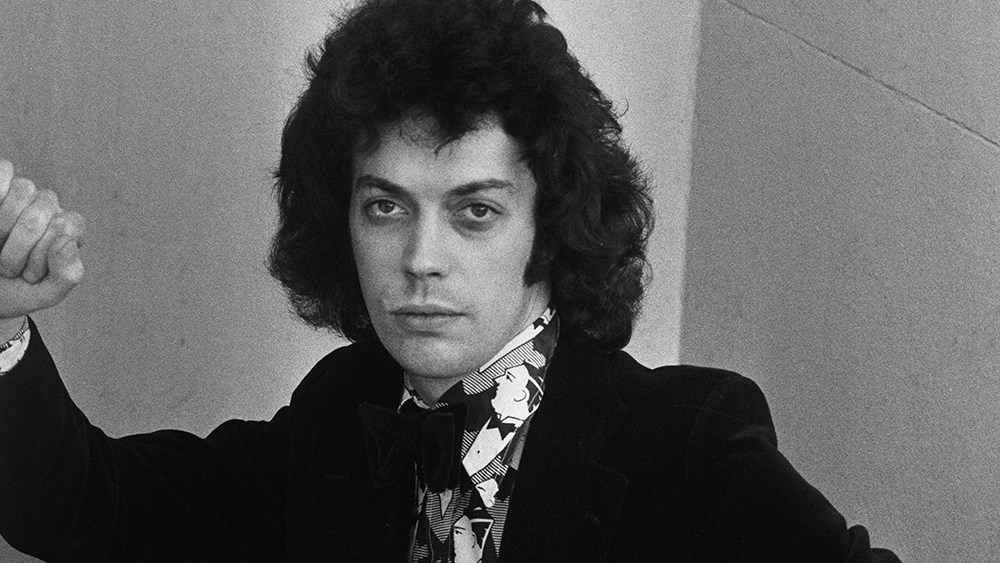
Tim Curry, who soared to fame in the ‘70s as the flamboyant star of the campy horror movie stage spoof “The Rocky Horror Show” and its screen version “The Rocky Horror Picture Show,” died on Tuesday in Los Angeles. He was 80.
Curry’s longtime manager, Marcia Hurwitz, confirmed to Variety that Curry died peacefully at his Toluca Lake home. A cause was not immediately available, though Curry had suffered from several health issues since having a severe stroke in 2012.
Though the versatile English actor, singer and voice performer garnered a Daytime Emmy Award and Tony and Olivier Awards nods for a variety of other roles, Curry’s career was defined by his wicked Dr. Frank N. Furter, the “sweet transvestite from transsexual Transylvania” in composer-playwright-actor Richard O’Brien’s left-of-center musical comedy.
He originated the character on stage in London for director Jim Sharman, brought it to theaters in Los Angeles and New York, and took it to the screen in Sharman’s 1975 film, which flopped initially but found new life as a cult movie. Like Boris Karloff and Bela Lugosi, whose respective turns as Victor Frankenstein’s monster and Dracula in the ‘30s Universal horror films — which inspired “Rocky Horror” — cemented their movie personas, Curry’s profile was forever etched by his performance as the outrageous, bustier-clad mad scientist.
“It seemed like something that would go,” Curry said of the part in a 1975 TV interview in London. He added, prophetically, “I was hesitant in that, if it worked, it might be a difficult image to shake off. But really, I’ve often thought that it wasn’t worth doing unless you took a risk.”
At the height of the “Rocky Horror” boom of the late ‘70s, Curry joined A&M Records’ roster, cutting three rock albums, including “Fearless” (No. 53, 1979) and “Simplicity” (No. 112, 1981).
Though Curry would forever be the face that launched a thousand Time Warp dances at midnight “Rocky Horror” screenings around the country, he proved to be far more than a one-trick pony over the course of a career that spanned more than half a century.
In 1968, he began his career as a stage actor with an appearance in the London company of “Hair,” the “American tribal love rock musical.” Into the mid-‘70s, he distinguished himself in appearances at the Royal Court Theatre, the Citizens Theatre, and in other companies, playing Shakespeare, Brecht, Buchner and Stoppard, before “Rocky Horror” launched him to stardom.
He collected kudos for his work on the boards: His 1981 work as Mozart in the New York production of “Amadeus” snagged a Tony nomination, while his performance as the Pirate King in the Drury Lane’s 1982 staging of Gilbert and Sullivan’s “The Pirates of Penzance” secured a Laurence Olivier Award nod. Later, he returned behind the footlights as the swashbuckling, booze-swilling actor Alan Swann in the Broadway musical version of “My Favorite Year,” and as King Arthur in the New York and London productions of “Monty Python’s Spamalot,” the musical rendering (directed by Mike Nichols) of the English comedy troupe’s Arthurian comedy “Monty Python and the Holy Grail.”
Despite a prolific career in film and TV — and possibly because his Frank N. Furter was so indelibly lodged in the public consciousness — Curry never attained the kind of screen stardom commensurate with his gifts.
He enjoyed strong roles as con man Rooster Harrigan in John Huston’s musical “Annie” (1982) and (beneath a layer of elaborate makeup that took five hours to apply) the arch-villain Darkness in Ridley Scott’s fantasy “Legend” (1985). He also appeared (drolly, as the butler Wadsworth) in the screen adaptation of the mystery board game “Clue,” which also attained cult status after an initial flop. His TV work of the period included a starring role as villain Bill Sikes in the 1982 TV movie of “Oliver Twist” and a 1989 record industry arc on the CBS crime show “Wiseguy.”
Though Curry occasionally took straight dramatic roles in features like “The Hunt for Red October” (1990) and “The Three Musketeers” (1993), his métier proved to be comedy. He notably appeared as Plaza Hotel concierge Mr. Hector in “Home Alone 2” (1992), heavy Jigsaw in the “Lethal Weapon” spoof “Loaded Weapon 1” (1993), Long John Silver in “Muppet Treasure Island” (1996), Russian terrorist Major Vladakov in the film version of “McHale’s Navy” (1997) and Gomez Addams in the direct-to-video “Addams Family Reunion.”
On TV, he captured a Daytime Emmy voicing Captain Hook on the 1990-91 Fox animated series “Peter Pan and the Pirates,” and made a memorable Pennywise the Clown in the first, miniseries version of Stephen King’s horror novel “IT” (1990). His stabs at toplining a live-action series TV were short-lived: Both “Over the Top” (1997) and the revival of “Family Affair” (2002) folded after their first season.
After the turn of the millennium, Curry was usually seen as a second lead, mainly in comedic vehicles like “Charlie’s Angels” (2000) and “Scary Movie 2” (2001), with occasional dramatic detours such as the horror film “Ritual” (2002) and the biopic “Kinsey” (2004).
Beginning with “FernGully: The Last Rainforest” in 1992, Curry was frequently employed as a voice artist for theatrical and home video animated features, among them “The Pebble and the Penguin” (1995), “The Rugrats Movie” (1998), “Rugrats in Paris” (2000) and “The Wild Thornberrys Movie” (2002), the latter a spinoff of the long-running kids’ show, in which he also was featured.
That work stood him in good stead after 2012, when a severe stroke confined the actor to a wheelchair. In later years, cartoon and video game voicing served as his principal employment.
In a poignant 2016 appearance, Curry appeared as the narrator in the TV movie remake “The Rocky Horror Picture Show: Let’s Do the Time Warp Again,” in which Frank N. Furter was portrayed by trans actress Laverne Cox. Four years later, at a Wisconsin fundraising event for Joe Biden’s presidential campaign, he played Frank N. Furter in a live table reading of “The Rocky Horror Show.”
He was born April 19, 1948, in rural Grappenhall, Cheshire. Following his father’s death in 1958, his family moved to South London. A gifted singer and actor as a youth, he graduated from the University of Birmingham with a dual degree in English and drama.
His appearance as Woof in “Hair” was his first professional theatrical work. Along the way, he got to know Richard O’Brien, who had been a member of the show’s touring company. O’Brien showed Curry the manuscript of a play he was writing: a musical send-up of classic creature features and “old dark house” horror films and B science fiction pictures, with a comedic overlay of post-sexual revolution naughtiness. Certain that the show could become a hit, he auditioned for its leading role, singing Little Richard’s “Tutti Frutti” at his tryout, and was offered the flashy pivotal part of Frank N. Furter by director Sharman.
After its smash bow in London, American record producer Lou Adler brought the play to L.A.’s Sunset Strip showcase the Roxy, where it enjoyed a healthy run (with its cast augmented by another star-to-be, Meat Loaf). In the more staid surroundings of Broadway’s Belasco Theatre, the original New York production folded quickly, running a mere 45 performances. Upon its original release, it looked like 20th Century Fox’s film version, starring Curry, O’Brien, Susan Sarandon and Barry Bostwick, would suffer a similar fate, despite some notices that reserved Curry’s performance for special praise.
Roger Ebert wrote that the actor “bears a certain resemblance to Loretta Young in drag. He’s the best thing in the movie, maybe because he seems to be having the most fun. He’s also a capable actor….[U]ntil the climactic scene in which everyone’s hurtled into outer space, Dr. Furter’s been the perfect hostess.”
Fox appeared ready to immediately write off “Rocky Horror,” which tested abysmally and was consigned to a dismal date in Columbus, Ohio. However, as the New York Times reported in 2015, the film’s publicist Tim Deegan noticed that L.A.’s independent repertory house the Nuart was drawing large crowds with weekend midnight screenings of John Waters’ scabrous comedy “Pink Flamingos.”
“I was totally convinced there was a midnight audience,” Deegan said. After successfully pleading his case to Fox’s film division prexy Alan Ladd Jr., Deegan convinced New York’s hip Greenwich Village fixture the Waverly Theater (which ironically enough had been celebrated in a song from “Hair”) to book midnight showings of the film in the spring of 1976.
By the time the Los Angeles Times’ Danny Sullivan visited a midnight screening at the Balboa Cinema in Newport Beach in 1990 for a story about the movie’s extraordinary second life, “The Rocky Horror Picture Show” had been showing there every weekend for 12 years. By that time, Curry was the adored star of a riotously attended midnight hit that screened in around 175 U.S. theaters, where raucous fans yelled out the dialogue, danced in the aisles in full costume and pelted the screen at key moments with rice, toast, and (of course) frankfurters.
“‘Rocky Horror,’ Sullivan wrote, “is more a performance than a movie, because during screenings, art imitates art.”
