

‘One with the dust’: how I survived Burning Man when everything went wrong | Burning Man festival

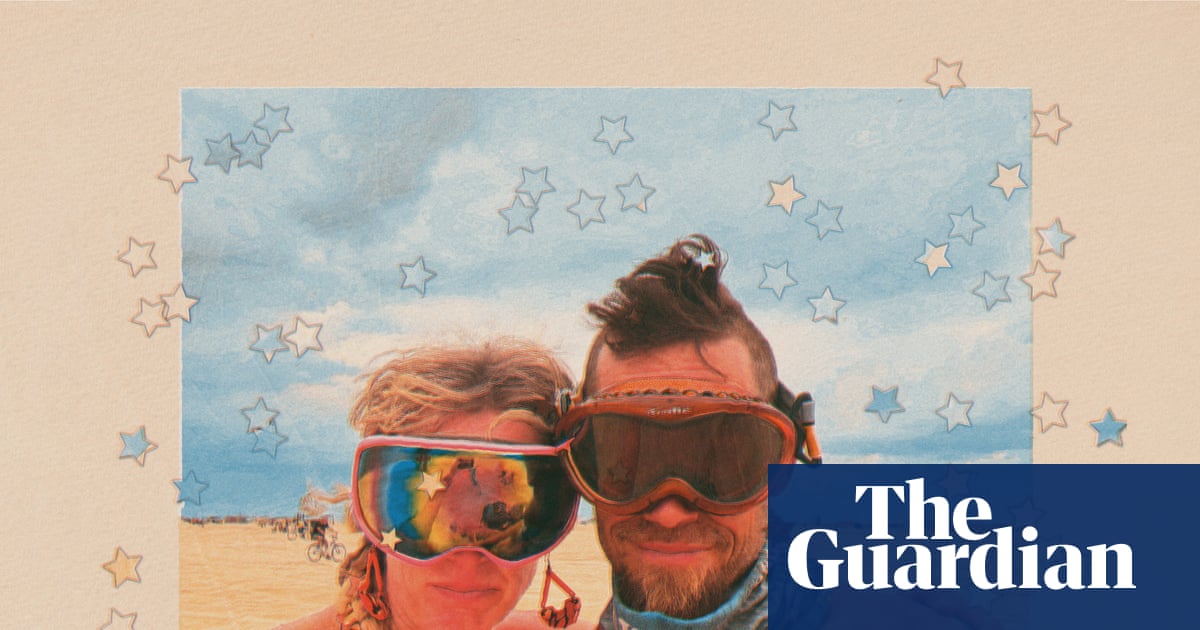
I was naked in our tent at Burning Man last year when all hell broke loose. The 100km/h (62mph) gust wrenched our tent stakes from the ground – and me from my nap.
I threw on a dress, fear coiling in my belly when I saw the midafternoon sky had turned dark.
This was not the kind of hell I had envisioned when packing for my first trip to the infamous counterculture gathering in Nevada. My husband, Rob, and I had wanted to attend Burning Man for years, but child rearing and work logistics confounded us. Last August, in honor of his 50th birthday, we finally took the plunge.
As we packed our truck to the brim with cots and coolers, shovels and superglue, pink fur coats and solar-powered disco lights, I was giddy with excitement about our first week-long, kid-free adventure together in a decade.
Rob and I spend dozens of days each year alone in the wilderness, so I felt well-equipped for the physical discomfort of camping in a hot, dry, remote desert. I also felt mostly prepared for the mental discomfort of encountering orgies or, even worse, off-key singalongs.
In fact, as we drove 14 hours on windy back roads toward Reno, the only thing I worried about was whether I had brought enough costume flair for the festival’s impromptu dance parties atop dragon-themed truckbeds, light-up roller derbies and sunrise yoga sessions.
Turns out I needed more duct tape, not sequins.
As the wind whipped dust into our 12-sq-metre canvas tent on our second night, my first concern was for Rob. We had decided to arrive early to help construct Black Rock City, the temporary money-free settlement that would be home to 80,000 for the week. When I had left Rob one hour earlier, he was building an art installation 2km away in the deep playa, standing atop a rickety 15 metre-tall tower in the 100F (38C) sun, drilling screws into mural-emblazoned wood panels.
“Keep your eye on the horizon, babe. Clouds are building,” I had called before biking away. From that point on, I had no way to contact him: my phone was dead, and cell service was almost nonexistent.
Those clouds had moved much faster than I had predicted, and they packed a more powerful punch than I had dreamed possible.
I’ve sailed more than 10,000 miles across the open ocean and regularly venture into the mountains, so I know what it feels like to be exposed to the elements at full force. At sea, I’ve weathered a category 5 hurricane, nail-biting squalls and equatorial lightning storms. Atop peaks, I’ve endured terrifying thunderstorms, tent-ripping hail and whiteout blizzards.
So you would think I would know better than to fall asleep with a storm brewing. Instead, I grossly underestimated the desert – along with my ability to deal with its extremes by myself.
Back in the tent, the next big gust of wind tore the tarp from our shade structure. I scrambled to secure the flapping tent walls, using water jugs and costume bags as weight. Above the screaming wind, I heard poles clanging as neighboring camps were blown to smithereens.
Then, in a lull, I heard a faint voice.
“Help!”
I ran to unzip the tent. Outside, the air was an opaque orange-brown, obscuring our truck parked just 5 metres away.
“I can’t see,” croaked a woman, curled into a ball at my feet.
I pulled her inside and poured eyedrops into the woman’s eyes. Rivulets of mud tracked down her cheeks as she blinked. “I’m Julia,” she said. “I was walking to the Porta-Pottis when the storm hit and I couldn’t find my way back to my camp. I crawled until I felt your tent.”
Our conversation was cut short as dust pelted us through the now open wall. Luckily, I had followed the advice given by a friend who was a frequent Burner: set up a smaller, fully enclosed nylon tent inside our large canvas tent in case of a dust storm. I dived inside with Julia, and zipped it shut.
For the next two hours, I huddled side by side with a stranger inside a tiny, windowless tent as the storm raged. I held up the flimsy poles with both legs so they wouldn’t collapse on top of us. I winced at the sounds of banging metal and ripping tarps. I envisioned rescue scenarios for Rob, buried under a meter of newly blown sand.
Julia, meanwhile, fell asleep. Ah, the luxury of blissful ignorance.
As she snored one inch from my ear, I – all-too-aware of what could go sideways – prayed. To all the gods. That I wouldn’t get hit in the head by flying shrapnel. That my belongings weren’t hitting anyone else in the head. That my husband’s head was safe, too. That the wind would please, please, PLEASE calm down.
Finally, just after sunset, it did. I emerged and surveyed the damage. Our portable home had morphed into Tatooine, Luke Skywalker’s fictional home planet. The coffee cups held two knuckles worth of dust. My toothbrush was unusable. My lotion had turned into an exfoliant. Every colorful costume I had brought was now a shade of gray.
I’ll admit it: I cried. This was supposed to be my freewheeling, fun-hogging vacation. I didn’t want to spend hours cleaning and rebuilding our tent.
Then I looked outside. The view put a prompt end to my pity party. The damage to the neighboring camps was mind-boggling. Coffee pots and cushions littered the ground. A silver dome tent rolled past like a tumbleweed. Awnings were hanging by a thread. Shade structures had collapsed into piles of tangled poles. It put my perceived plight into perspective: while sand-blown, our shelter was still standing.
The storm had hit at the worst time – the night before opening day, when Black Rock City was still mid-construction. Hundreds of hours of hard work had been undone in a single stroke. Nothing like nature to show us who’s boss.
Rob appeared an hour after the storm let up. He took shelter in the back of a U-Haul truck with a dozen other art builders. Blinded by the instant brown-out, they held hands and formed a chain to find the truck after the first gust hit.
When the wind ratcheted back to bearable, Rob donned two masks and ski goggles, then used the compass on his phone to head south-west. He plodded slowly through the grit, using decades of orienteering skills to make it back to me.
Together, we helped our neighbors re-raise downed shelters. It was a lesson in community, in self-reliance, and in resilience.
“It’s not out of the ordinary to have a 60mph wind in your face at Burning Man,” said Jason Wiener, who has attended 15 Burns. He also helps with event construction and tear-down. “The difference in the windstorm we weathered is that it lasted a really long time, and came at a really unfortunate time for the event.”
Wiener brought us stronger stakes after that windstorm – lag bolts that screw deep into the playa dirt – to replace the ones we lost. He told us that one constant during all of his many Burns was the extreme natural elements.
“It’s incredibly hostile with changeable weather. I’ve been cold. I’ve been hot. I’ve been wet. I’ve been nearly impaled by flying metal.”
Yet even amid the chaotic weather, Wiener said that storm-related injuries were rare. “If you read and follow the survival guide they send you with your ticket, then you’re prepared for most things. Very few people show up with booty shorts and nothing else.”
I was impressed with my fellow Burners’ ability to deal with whatever the wilderness walloped them with. People gladly shared their resources, whether it was drinking water or rope. Perhaps more importantly, I witnessed people sharing a shoulder to cry on or an ear to listen to their fellow festival-goers.
“Preparing socially, mentally and emotionally for Burning Man can’t be understated,” said Chandra Brown, a writer and educator who founded the Freeflow Institute. Brown has attended several Burns since 2009, and is trained as volunteer who sits with people undergoing traumatic emotional events.
“Just like doing anything hard, if we haven’t made it clear to ourselves as well as our colleagues and comrades what our expectations are, then they can’t really support us if things go awry during a Burn.”
Brown recommends going into Burning Man with a personal goal or project to keep yourself focused amid the constant stimulation and potential hardships. “When I feel lost or overwhelmed or exhausted, I come back to that very personal mission.”
My personal mission last August was to become one with the dust. That first windstorm was not our last. Severe weather rolled through the next three evenings. One had epic lightning and bone-rattling thunder. Another came with rain that turned the playa into foot- and tire-trapping gumbo. All of them relegated us to our shelter.
Between storms, we reveled in the magic of Burning Man, daypacks prudently stocked with water, snacks, goggles, masks, a compass and headlamps. We made time capsules and got our hair braided. We learned reiki and knot-tying and how to sail across the desert aboard a boat made of skateboards. We shimmered aglow into the night alongside thousands of friendly strangers to ride beside a fire-breathing giraffe and a two-story-high baby stroller.
By midweek, once I had surrendered to the elements, I began to enjoy the storms because of the intimacy and slowdown they afforded.
I returned home, more grateful than ever for indoor plumbing, and with a changed outlook on life. Burning Man convinced me that self-reliance is the best way to keep myself healthy and whole amid the cacophony of the 21st century. Adjusting to a more communal approach to life isn’t always comfortable. It requires stretching boundaries, accepting new truths, and sorting through what resonates with or repulses you.
Over the past year, we’ve invited friends in need to stay for free in our small apartment, loaned bikes or cars to neighbors, and set up weekly potluck dinners at the local park (sequins optional but encouraged).
Finding community – and offering and receiving gifts from my people – makes me feel wealthy. It has also left me infinitely better prepared to deal with political swings, technological shifts, the climate crisis, parenting frustrations and fluctuating social norms.
I figured Burning Man would be fun. But I never expected it would force me to let go of my stubborn self-reliance in favor of holding tight to the hands of others.
