


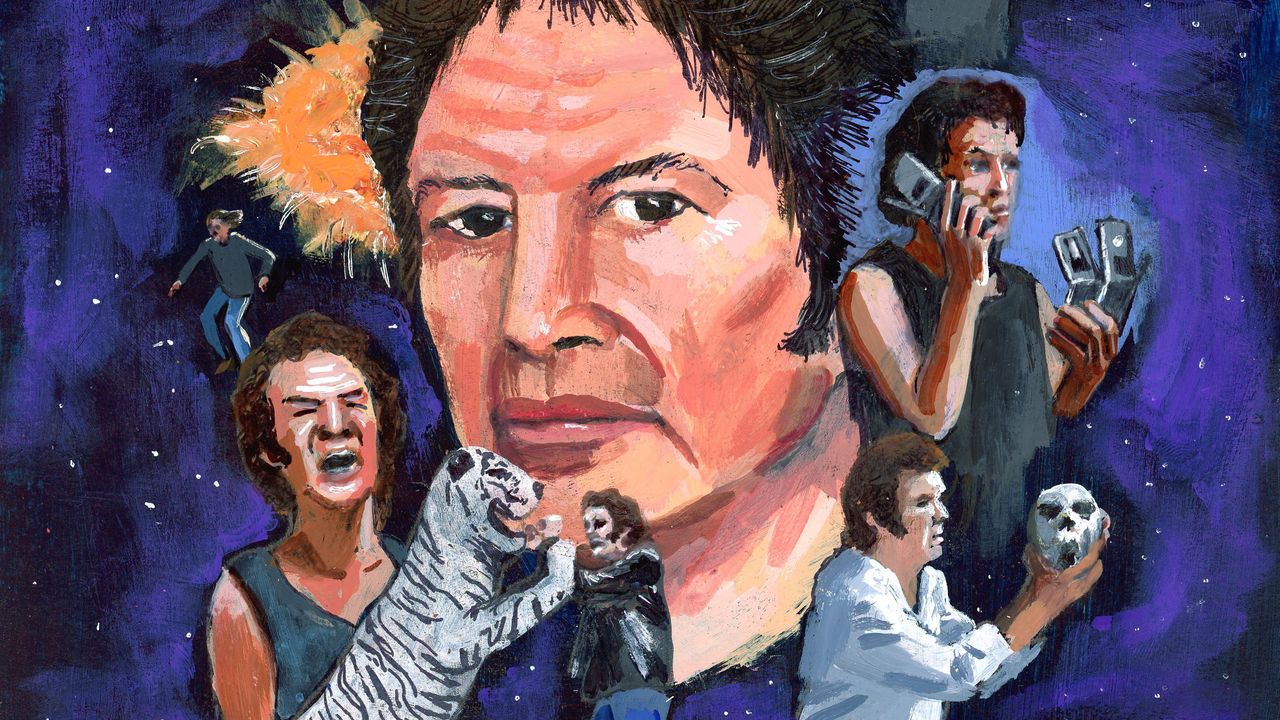
Breen enthusiasts, myself among them, often find themselves asking: what is this man’s deal? The answer is: no one knows, and everyone enjoys not knowing. Breen claims to have funded his first couple of movies with income he earned as an architect and financed his later movies with the proceeds from the earlier ones. At one point he had a real-estate license, though whether he has ever sold a house is anybody’s guess. Even his age is disputed: according to IMDb, he is sixty-seven, and obsessives who managed to dig up an old yearbook photo of one Cornelius Francis Breen allege that he graduated from high school in 1964 and that his birth year is most likely 1946, which would put him at seventy-nine. For his part, Breen says that both dates are false and that the yearbook picture (which bears a striking resemblance to him) is a different person. When pressed about his age, he said only that he is “a young man.”
It is impossible to date Breen just by looking at him; his face has the inelastic, ageless quality of a synthetic substance. When the character that he plays in his 2016 film “Pass Thru” explains that he is an alien who moves from one “time plane” to another, he is more right than he seems to know. All things considered, it is appropriate that Breen is, somehow, simultaneously sixty-seven, seventy-nine, and a “young man”: the strangeness of his work and its accoutrements warps the very fabric of space-time. The websites for each of his movies have plain backgrounds and unfussy font choices that put me in mind of pages coded in HTML and accessed on a desktop with a gurgling internet connection in the family study circa 2003. Each site features a low-res photograph of a film cover that appears to have been designed on early-two-thousands Photoshop. The associated e-mail addresses are all, appropriately, AOL. His frame of reference is a mystery: when asked about his favorite directors in Q. & A.s, he habitually dismisses the question, leading some fans to speculate that he has never seen a movie that he did not direct. “I feel like Neil never actually watched any movies,” wrote the top commenter on a popular YouTube video about Breen. “He just heard what they were and tried it for himself.”
Even if Breen has, in fact, seen a movie, he is such a sui-generis phenomenon that he may as well not have. The facts of his biography, no matter how outrageous, could not possibly explain the sheer derangement of his output. It is hard to say what, exactly, happens in any of his movies, each of which is a convoluted farrago of espionage, deceit, villainy, and futuristic imagery that makes heavy use of green screen and that—not to put too fine a point on it—makes absolutely no sense. Nonetheless, his corpus boasts certain continuities and several recurring motifs. He is fond of technobabble, and phrases like “programmable virtual reality” are often bandied about without much clarification. He stars in every movie he directs, playing a glamorous figure fighting a shadowy cabal of nefarious élites. He is, variously, a hacker (“Double Down,” “Fateful Findings”), a vigilante with superpowers (“Twisted Pair,” “Cade: The Tortured Crossing,” and somehow also “Fateful Findings”), and an alien or an A.I.-augmented warrior who hopes to purify humanity of its lesser elements (“Twisted Pair,” “Cade: The Tortured Crossing,” “Pass Thru,” “I Am Here. . . . Now”). Perhaps inadvertently, his movies tend to thematize his outsider position: in all of them, he is a savior approaching humanity from beyond its mores, with some degree of confusion. In several, he is literally from outer space.
Breen’s gestures toward political grievance never coalesce into coherent complaints—who would want them to?—but they have a vaguely libertarian flavor. His enemies are named with both absolute specificity and absolute generality in close to every film. They include “the stockbrokers,” “the C.E.O.s,” “the bankers” (sometimes also “the international bankers”), “the insurance companies,” and, especially, “the politicians.” In a notorious and oft-memed scene at the end of “Fateful Findings,” the character that Breen plays announces that he has hacked “into government and corporate systems all over the country,” uncovering what he earlier described as “national and international corruption,” and prompting the criminals he has unmasked to kill themselves onscreen. “I resign today as president of the bank,” a sallow man proclaims, as if there were just one bank in the world, before shooting himself in the head. The moment sounds darker than it is, largely because the gun looks plastic, and the explosion is obviously C.G.I. A montage with a similarly unsubtle message in “Pass Thru” has attained an exalted status among Breen devotees. This time, his character materializes at a series of gatherings where lawyers, politicians, and bankers (sometimes played by confusingly overlapping actors) nurse cocktails and amiably confess to manipulating the public. “Isn’t that corrupt?,” Breen intones. “Isn’t that corrupt?” has since become a catchphrase.
