



A record number of people attended shows on a single day at this year’s Edinburgh Festival Fringe, according to organisers.
The Fringe Society – which oversees the uncurated festival – said it notched up the highest attendance for a single day, on the second Saturday in August. More than 164,000 tickets were issued, which was 1% higher than the previous peak on Saturday 17 August 2019.
Overall, 2.8 million tickets for Fringe shows were issued during this year’s event – an 8% increase on last year.
However, the Fringe started later this year – meaning schools returned just days before – leading to performers and venues calling for it to be brought forward.
The Assembly, one of the Fringe’s largest venues, said that after listening to feedback from companies and artists, it was proposing that the dates move forward by a week next year.
It said this would allow more time before Scottish schools returned in August.
“Companies and artists have consistently raised the current schedule as a pressure point, particularly in this last week, and Assembly believes an earlier start would ease that pressure without diminishing the festival,” it said.
Susie McCabe said starting the Fringe at the end of the first week in August was “absolutely ludicrous” [Getty Images]
Comedian Susie McCabe said the Fringe Society had not considered that the Fringe “resides in Scotland”.
She said starting it at the end of the first week in August was “absolutely ludicrous” with “no consideration” given to when Scottish schools went back.
“It’s not just the schools that go back, it’s the football teams, the swimming lessons , the brownies, the scouts etc etc,” she wrote on Facebook.
“It’s the last Friday of the Fringe and people are sitting with half-full rooms.”
She added: “The data in every venue told every one of us that this year the last week was about to fall off a cliff and yet no mainstream or national advertising was implemented.
“The Fringe Society have let us all down.”
‘Built-in childcare’
Tony Lankester, chief executive of the Edinburgh Festival Fringe Society, told the BBC’s Radio Scotland Breakfast programme: “We take Susie’s point but there are two sides to that argument.
“I’ve spoken to people who love it when the school holidays end because that’s built-in childcare which frees them up to go and see some shows.
“Yes, the last week has absolutely been quieter but off-setting that, the first week was significantly more busy. So on balance, overall, the whole event has been busier than last year, significantly so.
“Audience habits may have shifted, the timeline may have shifted but they’re still coming out but they’ve just been dislocated, perhaps, to different parts of the festival from what everyone’s used to.”
He added: “We have to step back and look at the global picture – how many people attending the Fringe this year in totality versus last year or whenever.
“Looking at that picture I don’t think Susie’s argument holds up.”
When asked if the society would commit to earlier dates next year he said: “No, we wont.”
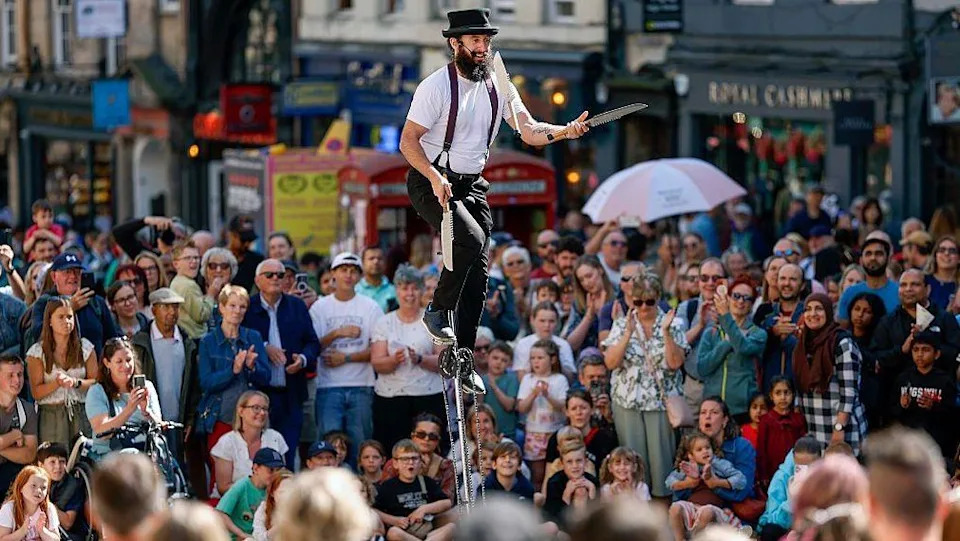
There were 334 street performers at the event this year [Getty Images]
Over 25 days, this year’s Fringe put on about 4,232 shows from 77 countries with 61,277 performances across 306 venues.
As of 11:30 on Monday, the last day of the Fringe, 2,805,395 tickets had been sold or issued for free.
Shows have explored themes including artificial intelligence, cults, the manosphere and the state of the world.
The event attracted the highest number of accredited journalists in its history, with more than 1,090 media professionals attending from 30 countries.
A total of 334 street performers, buskers and street artists performed in both the Royal Mile and Mound Precinct as part of the Fringe Street Events programme.
Lankester said: ‘”The Edinburgh Festival Fringe continues to be the world’s best platform for artists at any stage of their career to showcase their work to global audiences.
“As Richard Gadd put it so eloquently – the Fringe remains the only place where someone can arrive with an idea and leave with a career.
“For 79 years, the Fringe has thrived because of the creativity, grit and resilience of the Fringe community. There quite simply would be no Fringe without artists and the risks they take.”
Lankester added that every year there was “passionate debate and discussion” among participants and Edinburgh’s residents about every aspect of the Fringe.
“This year was no different, and while there are many divergent opinions; what we all agree on is the need to keep the Fringe affordable for artists, venues and audiences – protecting its reputation as a global marketplace,” he said.
“As we look to the festival’s 80th anniversary, it’s appropriate that we reflect on what we want the Fringe to be, and how we preserve Edinburgh’s reputation as a world-class festival city.
“That’s the challenge but also the opportunity – and we urge all stakeholders to make the most of it.”
Next year’s Edinburgh Festival Fringe will run from 6 to 30 August.

Festivals must work together
Since the Edinburgh Fringe first began in 1947, in the spaces around the International Festival, it’s been an ever-growing moveable feast.
It’s not unusual for performers to set up home in a church or community hall, only to find it out of bounds the following year.
Even the biggest organisations have faced the challenge. Gilded Balloon were forced out of their previous venue in the Cowgate by a fire in 2002, and having taken up residence in the University of Edinburgh’s Teviot building, had to relocate again because of renovations.
Dates have also been juggled for as long as I can remember.
Since 1947, the Edinburgh International Festival had run into the first week of September, and the fringe had slotted itself alongside.
But in 1998, the Fringe decided to start a week earlier, to allow the large number of English performers to finish up before the end of August bank holiday.
The separation continued for almost two decades with suggestions that the International Festival could move entirely into September, to avoid the Fringe all together. It wasn’t until 2015, that the dates were realigned with fringe, international festival and tattoo beginning together on the first Friday of August.
All the evidence – anecdotally and at the box office – suggests the biggest surge is when all of the festivals converge, explaining why that second Saturday this year, when the book and film festivals joined the mix, saw a record breaking attendance at the Fringe. The 164,000 tickets issued on 15 August, topping the previous peak on 17 August 2019.
So should the Fringe shuffle its dates again? Comedian Susie McCabe was one of a number of performers who complained the attendance dropped on the final week due to Scottish schools returning.
Next year’s event is due to begin on 6 August, just a day earlier, and one of the biggest venues – Assembly – believes it should start even earlier.
But Scottish families with school age children are just part of the picture. Many locals already take advantage of the preview week where it’s quieter and tickets can be cheaper.
The biggest issue for audiences and performers is cost, especially accommodation which has not only reached an all time high, but is now costing visitors an extra five per cent on the first five nights due to the new Visitor Levy.
William Burdett-Coutts of Assembly is right that a review is needed, to address rising costs and finding ways of working together to reduce them. Next year is the 80th birthday of Edinburgh’s festivals. There is nothing to compare them with which means this world-renowned, show-stopping offer must work together to revise, reshape and make ready for the years to come.
