


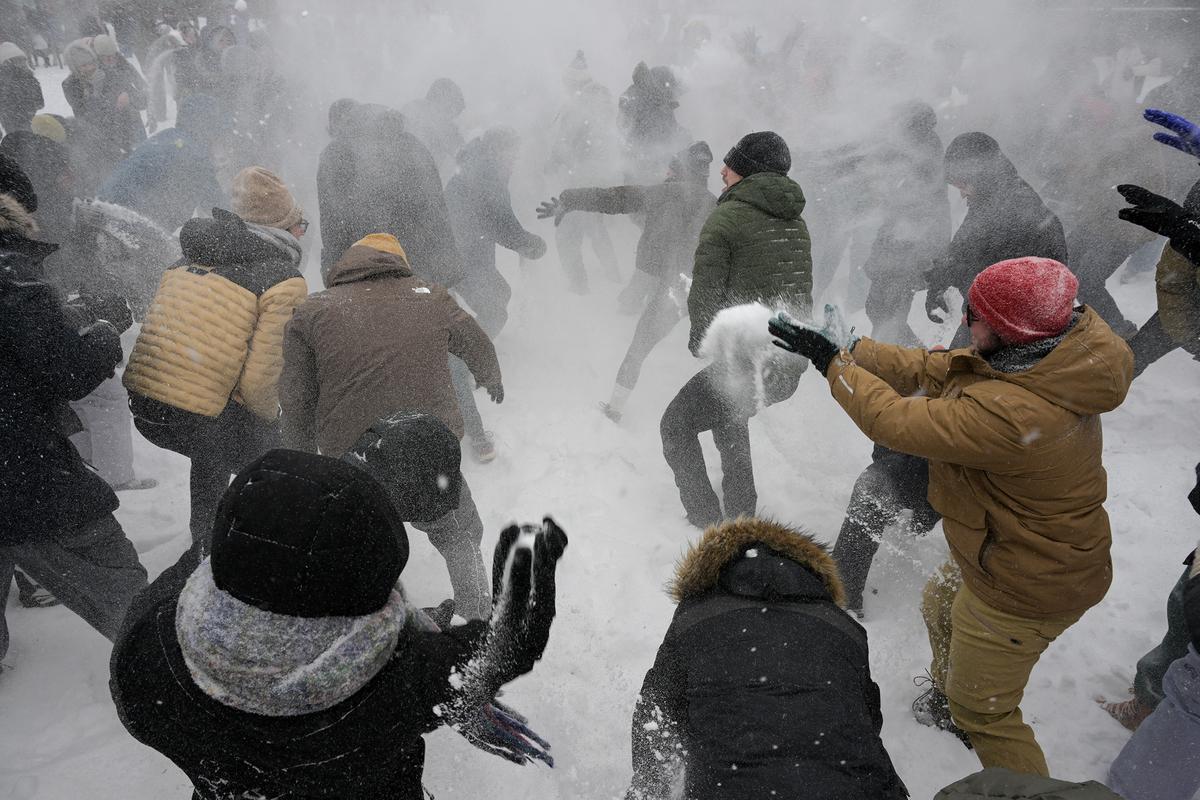
Our kids were playing Settlers of Catan over the holidays. Or rather, they weren’t. They’d rearranged the strategy game’s hexagonal tiles into an archipelago of islands that no rulebook recognises, imagined ‘bridges’ built from wood, brick and stone, and invented a purpose for the game about network connectivity that had nothing to do with earning points. They were not playing Catan. They were playing in Catan, using its materials as components to make a world the designers never imagined.
My first instinct was to reach for the rulebook and teach them how the game actually works. My next was to figure out how I could win. It took me a while to realise what I really needed to do: build up the courage to ask if I could sit in and build with them. That was the moment something shifted – not for the kids, who were already there, but for me: a 48-year-old professor sitting on the carpet, making islands and building bridges without a point in sight.
You can play a game or you can play in a game. When you follow the official rules, pursue the stated objective, and measure yourself against opponents or a scoring system, that’s competition: playing a game. The Greeks had a word for this kind of play: agôn, from the god who personified conflict, struggle and contest. But when my kids disassembled the board and turned it into a world, they were doing something older and stranger. They were engaged in what the French sociologist Roger Caillois, in his taxonomy Man, Play and Games (1958), called paidia: free, spontaneous, unstructured play. The kind with no winner, no score, and no optimisation. The kind of play that has almost no place in adult life and, arguably, the kind we need the most, especially now, when even our leisure comes with leaderboards.
The entire architecture of digital life – with its algorithmic feeds, frictionless production and the ambient expectation that we should be consuming or optimising at all times – nudges us towards chasing outputs rather than generating meaning. We track our sleep and score our calm. Fitness apps turn the morning run into a contest; meditation apps gamify stillness with streak counters; language apps award achievement badges for what used to be called curiosity. Even journaling apps nudge users toward consistency scores. The gamification of leisure has turned into work everything that used to exist as its counterpoint. Leisure has become a third shift with its own metrics, its own guilt, and its own sense of falling behind.
The philosopher C Thi Nguyen calls this ‘value capture’: the process by which a game’s simplified, legible values start to colonise the real-world activity the game was supposed to serve. Their power arises from the fact that games don’t just create worlds, but new visions of the good, telling players what to care about by virtue of what the game rewards through scores. When you’re doing Duolingo to maintain your streak, or when your place on the running app’s leaderboard replaces the reason you started running, that’s value capture. The metric ate the meaning.
A Village Festival, With a Theatrical Performance and a Procession in Honour of St Hubert and St Anthony: 1192 (1632) by Pieter Brueghel the Younger. Courtesy the Fitzwilliam Museum, Cambridge, UK
The Dutch historian and cultural critic Johan Huizinga saw this coming almost a century ago. In Homo Ludens (1938), he argued that play is not marginal to civilisation but, rather, generative of it. For Huizinga, law, philosophy, poetry and war all emerge from play’s ‘magic circle’: the bounded space where ordinary rules are suspended and something else becomes possible. Huizinga worried that the play element had been declining in Western civilisation since the end of the 18th century, eroded by industrialisation and professionalisation. What he feared has now been fulfilled. It’s not that we killed play; we captured it and harnessed it to a productivity framework. Then we packaged and sold it for passive consumption. The magic circle was instrumentalised into a dopamine hit.
What’s missing is neither ‘fun’ nor ‘competition’. We have plenty of those and, to be clear, I’m a huge fan of both. I grew up playing soccer and skiing. In my teens and 20s, I was a serious rock climber. Later I evolved into a competitive ultramarathon runner and now have 50-plus races under my belt, thousands of miles on trails in my legs, and two age-group national titles to my name. Agôn is what I do on weekends. But it’s not where I find meaning, build community, or figure out who I am.
A large part of the trouble is that we’ve eliminated the conditions in which free play arises. Watch the subway car on any morning commute. Every head is bowed to a screen. Not working, not thinking, just filling the time. Candy Crush in the checkout line. Instagram between floors in the elevator. Mere seconds of unstructured time trigger panic, and our fingers reach unconsciously for our phones. But boredom isn’t a problem; rather, it’s the condition in which the mind, left alone, begins to play by itself, to wander, associate, drift toward the transitional space where unexpected connections assemble unbidden. Every moment that we fill with a screen forecloses the free play of the mind. We don’t just need different games. We need more nothing.
Minecraft (owned by Microsoft) and Lego are corporately branded IP ecosystems framed as toys for children
Caillois saw the full spectrum of play: from agôn (competition) and alea (chance), to mimicry (role-playing) and ilinx (vertigo and disorientation). All four types sit on a continuum between paidia (complete improvisation) and ludus (structured rules). However, contemporary game culture tends to collapse this entire spectrum into one narrow band: competition plus structure. We have no category (not in the App Store and not in our cultural vocabulary) for paidia without agôn: our culture has no home for free, exploratory, contemplative play that refuses to compete.
Of course, paidia still erupts wherever people stop keeping score: kids on a playground invent rules then abandon them mid-sentence, Minecraft’s creative mode hosts millions of players building dreamworlds for the sake of building; Lego, at its best, is a pure paidia portal – recombinatory, autotelic, improvisational. But these exceptions clarify the problem: Minecraft (owned by Microsoft) and Lego are corporately branded IP ecosystems framed as toys for children. It’s not that free play has vanished, it just exists under constant threat of value capture. We do it in spite of our platforms, not because of them.
Moreover, the kinds of play that refuse to compete or optimise, or produce a measurable outcome, lack cultural prestige and social infrastructure. The British psychoanalyst and paediatrician Donald W Winnicott would have recognised this absence as a clinical emergency. In Playing and Reality (1971), Winnicott argued that play is not what children do on the way to becoming productive adults; it is a crucial part of how human beings maintain their worlds. Through play we become present to our own experience, capable of surprise, alive to the difference between going through the motions and actually being there.
Winnicott’s key concept is transitional space, though ‘space’ is misleading here because he has in mind not a location but a condition. Think of a conversation so engrossing that you forget you’re speaking and say something you didn’t know you thought until you heard it leave your mouth. You’re not entirely inside your own head (fantasy) and you’re not entirely performing for an audience (compliance). You are in between. That in-between zone – neither fully private nor fully public, neither pure inner life nor pure external task – is what Winnicott called transitional space. It’s where creativity, art and what he called ‘imaginative living’ originate.
His most radical claim still hits like an urgent diagnosis: ‘It is creative apperception more than anything else that makes the individual feel that life is worth living.’ He contrasts this with compliance, a relationship to external reality that ‘carries with it a sense of futility’. It is worth pausing to unpack this fully. Winnicott is arguing that what makes life meaningful is ultimately not achieving goals, having a family or even making art. It’s about how we see the world. ‘Apperception’ names a mode of encounter in which perception is not passive reception but active engagement. The difference is subtle but decisive: in ordinary perception, the world is simply there and the self adjusts to it; in creative apperception, we co-create the world, forging something between self and environment in the zone of play.
Compliance, by contrast, is life lived on someone else’s terms, following scripts, bowing before scores and metrics: moving through a world already defined in advance. Nothing new is risked, nothing genuinely one’s own is made. Most people, Winnicott believed, experience just enough creativity to recognise its absence, sensing that they are mostly ‘living uncreatively, as if caught up in the creativity of someone else, or of a machine.’
That last sentence, written in 1971, strikes me as the most prescient insight from 20th-century psychology for our time. Long before the personal computer, before the algorithm, and before we voluntarily installed surveillance engines in our pockets and called them phones, Winnicott worried about being caught up in the creativity of a machine. He also had a solution: play. For Winnicott, play is the condition of feeling real on a daily basis.
Friedrich Schiller, writing almost two centuries before Winnicott, made the same case from the other direction. In On the Aesthetic Education of Man (1795), he argued that human beings are torn between the pull of raw sensation and the push toward abstract order, and that only what he called the ‘play drive’ integrates both. It’s a bold claim. Schiller wrote that ‘man only plays when he is in the fullest sense of the word a human being, and he is only fully a human being when he plays.’ Winnicott tells you what play does psychologically: it makes life feel real. Schiller tells you what it does metaphysically: it makes you whole.
Simply put: adults need play as desperately as children do – a zone where inner life meets outer materiality and something unpredictable emerges. The Greeks, of course, had a term for this. Aristotle’s medieval fanboy Thomas Aquinas identified eutrapelia, the habit of knowing when and how to play well, as a genuine and discrete virtue. A person who never plays is as disordered as one who never works. I’m not talking about ‘work-life balance’, an exhausted metaphor that still treats play as recovery time for the next productive thing. To practise the virtue of eutrapelia means that a good life requires play. You don’t earn it. You practise it, daily.
The question, then, isn’t whether to play. It is where does the practice live, and how can we regain it in our daily lives, and valorise it in our culture.
For years, I’ve commuted on foot from Grand Central Station to 14th Street, 30 blocks, give or take. I told myself it was exercise, or that I was saving the subway fare, or that I liked the air. But the truth is I was thinking. Or rather, I was letting thinking happen. The lecture I couldn’t outline at my desk would assemble itself somewhere around 34th Street, the important points falling into sequence with my footfalls, the argument clarifying as if the motion itself were doing the editing. I wasn’t working on the lecture. I was walking in it, the way my kids were playing in Catan.
Walking increased the capacity to generate multiple solutions to open-ended problems by 60 per cent
The experience is ancient and well-documented. Friedrich Nietzsche reputedly walked six to eight hours every day, and insisted in his Twilight of the Idols (1889) that ‘Only thoughts that come by walking have any value.’ Aristotle’s Lyceum was called the peripatetic school for its walkways (peripatoi). Jean-Jacques Rousseau claimed that he could compose only while walking. Albert Einstein walked from his home at Princeton, New Jersey to the Institute for Advanced Study and back each day, and supposedly told colleagues that the walk was where the real thinking happened; the office was where he wrote it down.
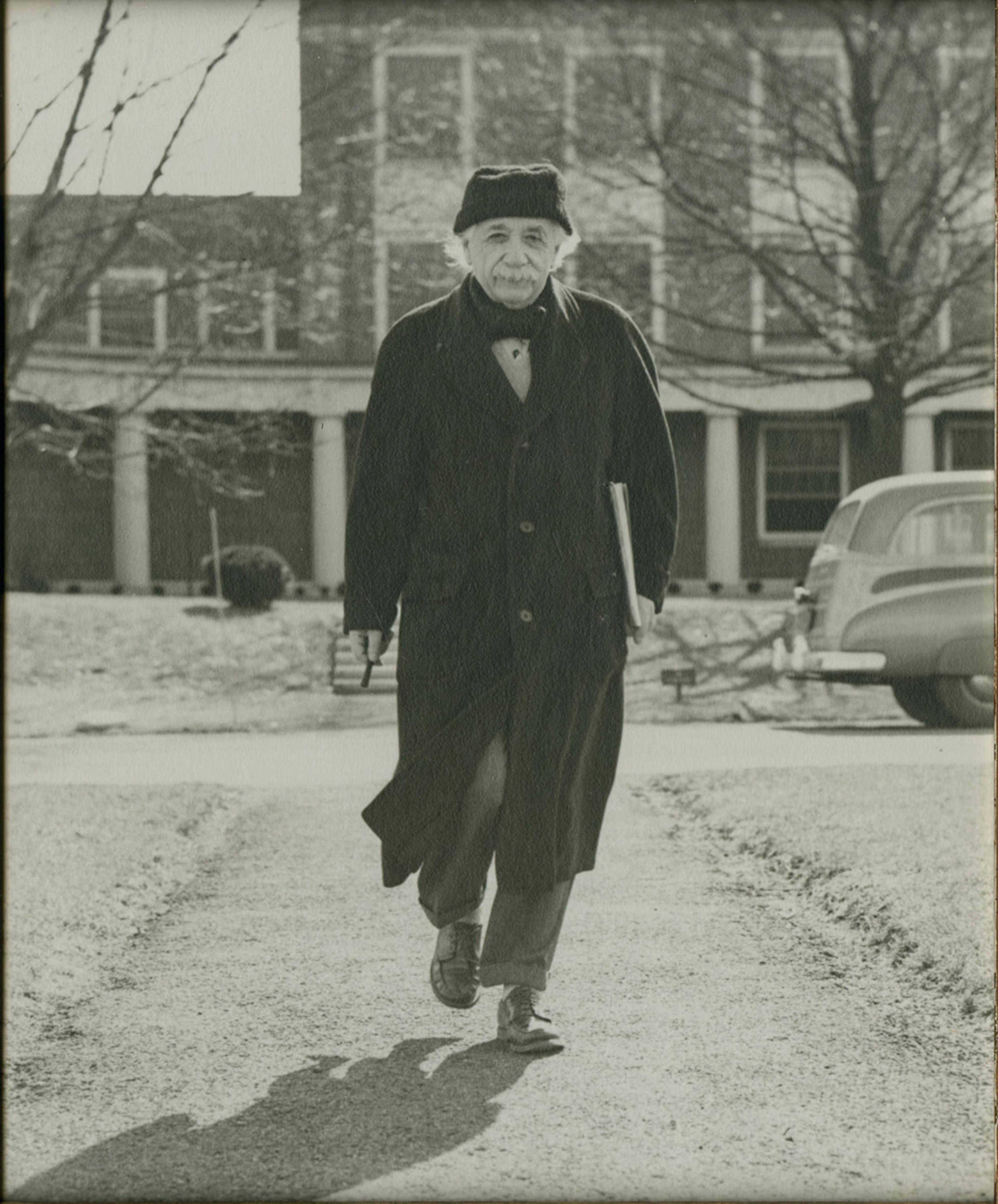
Albert Einstein walking near the Institute for Advanced Study, Princeton, US. Photo by Alan Richards and courtesy the IAS
Contemporary research confirms these intuitions, this idea that walking is a form of play for the mind as well as the feet. In 2014, Marily Oppezzo and Daniel Schwartz at Stanford University found that walking increased divergent thinking – the capacity to generate multiple solutions to open-ended problems – by roughly 60 per cent. Curiously, a treadmill facing a blank wall worked nearly as well as wandering Stanford’s campus, suggesting that it’s the exercise, not the scenery, producing the results. Metronomic motion allows the thinking to arrive.
Push the body further and something stranger happens. Caillois’s taxonomy includes a category almost nobody talks about: ilinx, the play of vertigo and disorientation. Spinning until you’re dizzy. Or running past the point where the split times stop mattering and the self loosens its grip. I know this territory from the inside. The first question at the start of a 100-mile race isn’t whether your legs are ready. It’s whether your mind is: wanting to win might get you to the start-line of your local 5K, but agôn won’t get you to the finish of an ultra-marathon. And it’s a love of trails that makes those miles magical. Nguyen would call this striving play. The goal exists to make the experience of striving possible, not the other way around. The finish line is just the means; the journey is the destination.
Our son does something similar in our basement, though his materials are metal, wood and stone rather than miles of trail. He crafts with scraps of found steel, fixes electric motors, carves wooden animals, shapes copper into jewellery and stone into rings. Nobody assigned this. No tutorial dictates the sequence. The material teaches the craft: copper tells you what it wants to become; stone suggests a shape and you listen or it breaks. At the workbench, inner vision meets the friction of the physical world and something neither planned nor accidental emerges.
Wherever adults build or stumble into transitional space, play is doing its work even if we’re not keeping score
My son doesn’t sell what he makes. He gives it away: the knife to a friend, the carved animal to a teacher. Play pursued for its own sake, with no metric and no market, overflows into generosity precisely because nothing was extracted. When something beautiful emerges from a process that asked for nothing, the most natural thing in the world is to give it away. What he makes enters the world not as commodity but as gift.
I see the same dynamic at my day job, though, again, the materials are different. I’m a professor of literary studies, and the best sessions in my seminars have nothing to do with instruction. They obey the logic of improv: ‘yes, and’. A student notices something strange in a passage (a word that doesn’t fit, a silence where speech should be) and someone else picks it up, turns it over, connects it to something from three weeks ago, and suddenly the room is thinking a thought nobody walked in with. The seminar, at its best, builds transitional space inside an institution that mostly rewards compliance. It opens up the zone between private thought and public evaluation, where a student says something she didn’t know she believed until she heard it leave her mouth.
The same dynamic lives in a jazz combo finding a groove nobody charted, a graphic designer noodling with shapes until one surprises her, a group of friends kicking a ball around with no teams and no score. It lives in my son’s basement workshop and on the trail at mile eight, and in the 30-block walk where the lecture writes itself. Wherever adults build or stumble into transitional space – where inner life meets outer material and something unpredictable emerges – play is doing its work even if we’re not keeping score.
Aristotle thought that contemplation (theoria) was the highest human activity because it was done purely for its own sake, absorbing the entire human person. For centuries, and across domains of religion, the academy and the law, that hierarchy held, ranking the contemplative life above the active life, thinking above doing. But maybe the question itself is misleading. The question ‘What is the highest human activity?’ is itself a competition, an agôn. Play doesn’t enter that contest. Play dissolves it. Play is autotelic and relational, solitary and shared, serious and free; it refuses the binary.
Schiller, Huizinga and Winnicott were not wrong; play does makes life worth living. The capacity for play – the willingness to stop optimising, to sit on the floor, to walk without a destination, to make something and give it away – embraces a virtue with an old name: eutrapelia. It is the habit of playing well. The ordinary magic of being real.
