


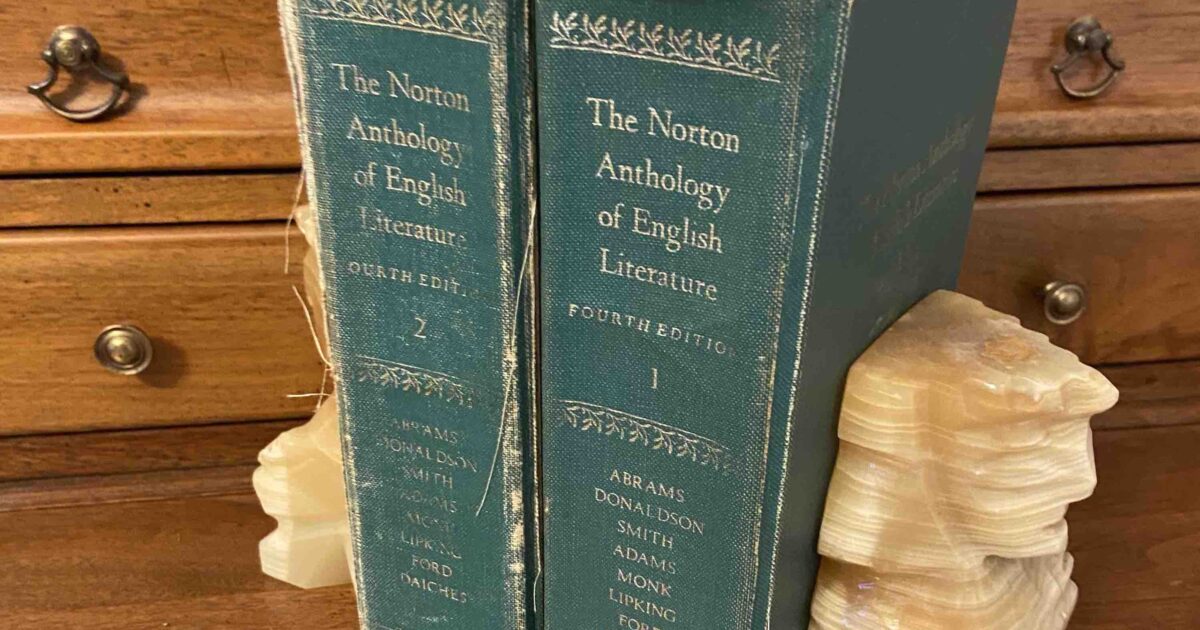
When I declared an English major at UCLA in the fall of 1980, the first thing I had to do was buy The Norton Anthology of English Literature, volumes 1 and 2. This was the fourth edition, a cloth version in solid green with no adornment, the title embossed in simple gold letters. All majors had to take a yearlong sophomore survey, English 10A-10B-10C (UCLA was on quarters with an optional summer term), which met in the auditorium of Rolfe Hall and tallied up to three hundred students at a time. The syllabus ran from Beowulf to W. H. Auden, Old English to modernism, more than one thousand years of writing from a place and time that couldn’t be farther from Pauley Pavilion, pizza joints in Westwood, and Santa Monica Beach. There was no comparable survey of American literature. Majors would have to jump to upper-division courses to find Hawthorne and Hemingway, and the department frowned on people not completing the 10-series early in their studies.
Norton was the perennial text for all three segments, 2,500 flimsy pages in each volume. The books were thick but not tall or wide, unlike other textbooks, which were the size of three-ring binders and boasted lots of colors and pictures. Inside the Norton was only cold print, austere and unvaried. Open the front and back covers of volume 1, and you’d see the sole visuals, a map of England in earlier times and a map of London that marked six theaters, Bedlam asylum, two schools, Westminster Abbey, and Marshalsea Prison. Volume 2 also showed both the whole island and the city of London, this time at the turn of the twentieth century, including the Garrick Club, Bloomsbury Square, and the Royal Academy. The campus bookstore stocked all of the quarter’s assigned texts by department and course number, and the 10-series shelf looked like a pallet in a warehouse, hundreds of copies stacked neatly and imposingly, new and used, each one costing only $15 or $20.
The syllabus of the series didn’t change from year to year. The high status of Shakespeare, Milton, Wordsworth, and others was set. The presence of lesser-known figures in the Norton, such as Thomas Gray and Thomas Carlyle, gave them similar prestige. Their inclusion was enough to prove their permanence. I glanced through the table of contents as if I were checking the roster of an all-star game. I remember purchasing two other books, The History of Rasselas by Samuel Johnson for 10B and Great Expectations for 10C, the latter of which left me with a hollow feeling when I finished, though I couldn’t pause over it for long when Gerard Manley Hopkins’s verse and John Ruskin’s prose had to be read by the following week. By then I had studied the General Prologue of The Canterbury Tales, sonnets from Sir Philip Sidney’s Astrophel and Stella, and dozens of other texts, including “The Flea,” “To His Coy Mistress,” “Il Penseroso,” The Rape of the Lock, “Tintern Abbey,” “Ode to a Nightingale,” and “Tithonus.” So had three hundred other sophomores in the same course sequence.
Overall, there were 1,700 students in the major, all of them undergoing the yearlong priming at some point. We heard a professor lecture three hours a week, attended a discussion section led by a graduate student for an hour every Friday, completed three papers per term, and took a three-hour final exam. The reading never let up and exams were exacting, no grade inflation allowed. It was said that the average grade in the 10-series was a B- (that’s what I earned in 10A), and no student I knew ever thought to complain.
You had to bring the book with you to every lecture and discussion. The professor might introduce an author with some general comments on the writer’s lifeand place in the heritage, but usually he turned to the works themselves a few minutes into the day’s meeting, pointing to specific passages and wording as we followed with eyes downward, sometimes writing a phrase in the margin that would help when it came time to review for the midterm. For forty-five minutes, only his voice and the words on the page mattered. I remember one session of 10C when Professor Kolb recited one of Browning’s dramatic monologues, “Soliloquy of the Spanish Cloister,” hamming it up as we smiled and tracked him line by line. We applauded when he finished. It was fun and effective. He didn’t move on, however. There were still details in the verse to highlight now that the entertainment was done. Though the 10-series mapped three or more literary movements per quarter, introducing students to big themes and historical conditions, such as the meaning of the French Revolution to the Romantic poets, the department set the skill of explication at the core of the major. “Close reading,” as it was sometimes called, demanded minute textual evidence taken directly from the literary work if any general claim about it was to count. Stay close to the language was the command, explain the metaphor, mark alliteration and rhythm, catch the irony, pause over loaded terms . . . each task sitting inside the book, waiting for our attention.
This was the dual function of the Norton. On one hand, it contained the individual objects an English major had to study. The two volumes were like the Periodic Table for chemistry majors. Every discipline needs a unique domain, the things in the field that must be learned. Astronomy majors studied the stars in the heavens. English majors studied canonical writers, who were in the Norton.
On the other hand, it provided a coherent account of English literature. The table of contents wasn’t just one author and work after another. It was a Big Picture, a “Grand Narrative” (as one would say in grad school), one not fabricated by English teachers but real and true, an objective reality sitting on my desk, the 10-series its unfolding. I had faith in the books, the classes, and the field, an easy posture to take when the momentous past they imparted was so superior to the trivial occasions of my daily life. When I sat down in Kerckhoff Hall and flipped to the day’s assignment—say, Byron’s Manfred—I had to get the small details clear in my head, to figure out what he meant when he said, “In my heart / There is a vigil, and these eyes but close / To look within . . . ” I understood, too, that the work had to be placed within a bigger story, into relations of comparison and contrast, and that I must set the closet drama beside or against what came before and what came after, such as the early Romantics who initiated this dive into the self and later Victorians who refined the Byronic Hero into the pose of the Aesthete. The 10-series itself fit works from across the centuries into a noble whole.
This told every kid who chose English that the field had a structure and an object, one just as distinct and sure as those of the science fields. In my last year, I read T. S. Eliot’s essay “Tradition and the Individual Talent,” which speaks of literary history as “existing monuments [that] form an ideal order among themselves,” a description that didn’t surprise me at all because I’d been living it as an ordinary undergrad every day. Eliot also said, “No poet, no artist of any art, has his complete meaning alone”—yes, of course.
Upper-division classes assigned other books, digging deeper into the periods and movements that the Norton covered in survey, but I kept the volumes through my undergraduate and graduate years, and through thirty years as a professor at Emory University as well. I still have them. They sit behind me at home with the same stateliness they had nearly fifty years ago, no matter how weak the binding and faded the color. When I was twenty, they tendered precisely the kind of meaning and purpose that a kid without a plan needed.
Before settling on English, in my first two years of college I had bounced from class to class, pondering a major in math, then film, psychology, and philosophy, never very intently. I earned some Cs and a D or two, only a few A grades. I cared more about beating USC in every sport, scrounging up money for the video game parlor off campus and a six-pack on Friday night,finding a girlfriend, and playing intramural basketball. I joined buddies in the bleachers of the main tennis court outside Sproul Hall to heckle John McEnroe when Stanford’s team came to play. I was upset for weeks when in ’79 we lost to DePaul in the quarterfinals of the NCAA tournament.
The quarters passed quickly. In fall ’78, it was calculus, microbiology, and abnormal psychology; in winter ’79, Italian cinema and physics; in spring, something else altogether. In January 1980, I was still shaken from a rejection six months earlier by a girl I loved and thought loved me.Every weekday I went to University Elementary School, part of the School of Education and Information Studies, located on the Sunset Boulevard side of campus, where I monitored 8 a.m. and noontime recess, breaking up quarrels and refereeing games, the pay enough for cheap groceries and not much more. For two summers I hawked the Los Angeles Herald Examiner at the track in Del Mar, popping a Black Beauty if fatigue set in early and heading home to my mother’s townhouse in La Costa, either having lost all the money I made that day or with winnings from the eighth and ninth races.
I didn’t believe in God, didn’t trust my parents, and liked movies with dark characters, such as Taxi Driver and The Wild Bunch. I read Nietzsche and Freud on my own and grabbed at every atheistic line. I saw Apocalypse Now at the Cinerama Dome as soon as it came out and memorized some of those forbidding lines, expecting that the steely will of Captain Willard and others might bleed into me (“terminate with extreme prejudice,” “you’re an errand boy sent by grocery clerks”). I wanted more money, a girlfriend, and a car. I changed apartments every year. I had friends who majored in engineering and (so I heard later) made a ton of money after graduation by inventing some useful program or starting a small company that a larger one bought five years before the term “Digital Age” entered public consciousness. They knew what they were about. I didn’t. There was no transcendence, no meaning in the world, nothing to live for but my meager self—and no virtue or truth that might remedy this scattered condition. I wanted to believe that my irreverence made me unusual and special, but I knew it didn’t. There were plenty of nineteen-year-old nihilists running around.
But when I opened the Norton to do homework, the world fell into place. The years had fresh meaning: 1066 (the Battle of Hastings), 1215 (the sealing of Magna Carta), 1588 (the defeat of the Spanish Armada), 1649 and 1660 (the execution of Charles I and restoration of Charles II), 1789, 1914 . . . I was keyed up and desperate enough at age twenty to take notice. The present was a scramble, but these two thick volumes on the table, staid and patient, were a silent promise. There was a destiny inside, an air of fate in the poems and plays. It filled me up. I know that sounds melodramatic, but that’s the effect it had. It was a comfort to believe that a canon of great works existed and that they formed a history with direction and momentum.
Hours in the library were no longer desolate, and the weeks were certain and full of purpose. In Rolfe Hall, where the department was housed, a meaningful past and a program to go with it were on offer. It took two-and-a-half years of study to complete. My only freedom of choice was which quarter to take this or that course. The layout was prescriptive and imposing, and I liked that. By the second quarter of the major, I opened volume 1 or 2 each day as if I were entering a museum. Here it is, this is it, the books declared, the “ideal order.” The words within had instant authority. Many lodged themselves in my head, or so it seemed, and nearly fifty years later I still remember meeting specific lines: “To burn always with this hard, gemlike flame,” “That hoard, and sleep, and feed, and know not me,” “myself am Hell,” “And leaves the world to darkness and to me,” and many more. It was a form of submission.
I wouldn’t have obeyed if the 10-series and the Norton hadn’t set things up as they did. As time passed, I realized that the editors, M. H. Abrams et al., were distinguished figures in the field. I searched each one in the card catalog of the research library on North Campus and wrote down the titles of their books. At the back of each volume was a descriptive bibliography of historical periods and each of the authors. I pored over it. It was important that I know the great writers and the astute interpreters of them, too. The sciences had their heroes—Linus Pauling, John Kenneth Galbraith, Johnny von Neumann . . . Here in the Norton were Maynard Mack, Ian Watt, and Walter Jackson Bate. For the next eight quarters, my labor would have a shape and a goal—learn the canon—and the critics would help. These things were the best, explained by the best, and it would take time and diligence before I could carry out the proper work.
Today, of course, the unified chronological model of English is over. The twenty-first-century English curriculum lets students keep largely to twentieth-century and contemporary literature. At the University of Chicago, which was the center of a mid-century school of criticism called “Neo-Aristotelianism,” the “Standard Track” for the major requires twelve courses, only two of which must be pre-1900 (“One English course in Medieval/Early Modern Literature” and “One English course in 18th/19th-century literature”). In Winter 2026, to meet the first requirement, one couldtake either “Medieval English Literature”or the special topic “Body Problems: Theorizing Fat and Thin in Early Modern Literature.” For the second requirement, the single-themed “Girlhood” would do, which has readings from Jane Austen, Mary Wollstonecraft, Louisa May Alcott, and Harriet Jacobs—or one could take the single-work course “The Problem of Huckleberry Finn.” Literary history is a casual affair: this or that, take your pick.
The model wouldn’t have appealed to me in 1980. In whatever field I chose, I wanted the subject matter to have scope, depth, structure, and dignity. My life didn’t have them, but maybe it would if I studied something that did. I had an example at home, my father, who was a math teacher, a lecturer who never earned a doctorate and found no steady job, but who nonetheless spoke of numbers, game theory, set theory, theorems, and infinity as if they formed a magical habitat, elegant and wondrous. He’d help me with geometry homework, then take a moment to tell a story of what Évariste Galois did the night before his death, or smile and ask, “Why can’t you divide a number by zero?” or “Let’s count to 50 in base 5.” He was lucky, and so was I—lucky, that is, to be at UCLA then.
I can’t say the same of today’s nineteen-year-olds with the same aspirations and bookish bent. English and the humanities generally have lost their grand allure. There’s no point in rehearsing the fall for the umpteenth time, only to say that during the ’80s canon became a bad word, a dead-white-male artifact. Perhaps the skeptics believed their takedown of the Big Picture was a liberation, and it may have been for some. But not for many. In 1970, English took one in thirteen of all four-year degrees in the United States. Now, it stands at one in sixty.
The decline of the English major offers a lesson in what young people want. Teenagers in the 2020s have a spiritual thirst that is unmet by a curriculum without order and greatness and charm. A field without a bible like the Norton doesn’t satisfy them. The Introduction to the Romantic Period cites Keats: “Great spirits now on earth are sojourning.” Matthew Arnold visits the Grande Chartreuse and asks the monks, “What dost thou in this living tomb?” Hardy’s “Hap” begins, “If but some vengeful god would call to me . . .” The long first paragraph of “The Secret Sharer” closes, “And then I was left alone with my ship.” Yeats at sixty-two: “That is no country for old men.” And so on. The touchstones are all there, with some scraggly marginalia of my own. I am grateful.
