


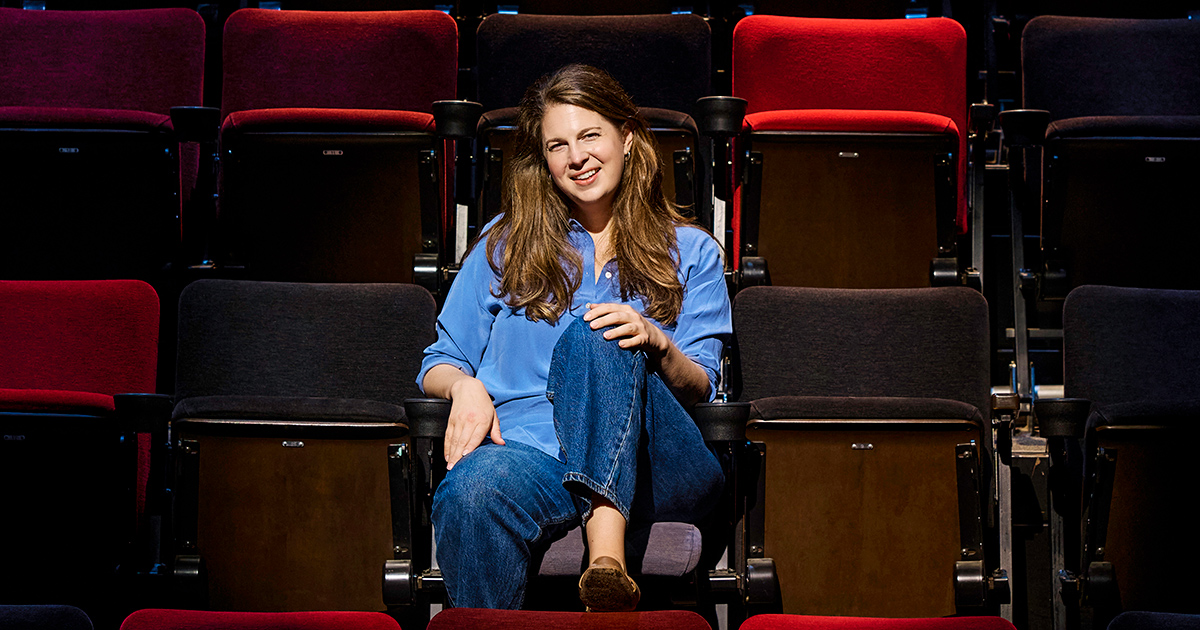
Nell Bang-Jensen says down with censorship, up with experimental Belgians and South Philly grandmas.
CEO and director of FringeArts, the producer of the Philadelphia Fringe Festival, Nell Bang-Jensen / Photograph by Gene Smirnov
Listen to the interview edition here:
Nearly two years into her job as CEO and director of FringeArts, the nonprofit organization behind Philadelphia’s 30-year-old Fringe Festival (September 8th-27th this year), Nell Bang-Jensen has revitalized the event and made it easier for artists of all stripes to participate. Here, she chats about the challenge of making the festival work in the current economic and political climate, offers some glimpses of what’s on stage, and reveals the one and only thing that’s banned at the Fringe. (Hint: It’s definitely not full frontal nudity.)
Hi, Nell. Thirty years after its founding, why do you think the Fringe is still vital?
The Fringe was founded because there was a need for a platform for live, experimental, contemporary performance in Philadelphia — and this is a platform that we still need very much today. We have artists coming to town from all over the world and other parts of the U.S., and we also amplify the work of Philadelphians.
There are Fringe Fests all over the country. How does Philly’s stack up?
We’ve actually grown to be the largest Fringe Festival in the United States in terms of the number of venues being used. This year, we have more than 350 shows at over 100 venues. We’re taking over the whole city, with performances at traditional venues and theaters but also in places you might not expect. You might see a Fringe show in a car. You might find a Fringe show in an elevator. We have such a variety of genre and scale. We have internationally renowned performers and then someone’s grandma in South Philly who’s made an autobiographical show of her own life that she performs in her basement. We’re expanding the definition of who gets to be an artist and what art looks like.
So literally anybody can be a part of the festival?
Yes, so long as they sign an agreement saying they won’t use hate speech. A portion of the Fringe Festival is “presented” work that we curate and choose — there are 11 of these shows this year — and then there’s the open-access portion where anyone can register a show and create their own performance.
No bans other than hate speech?
Beyond that, we really believe in not censoring artists in any way1.
How many of the presented shows are Philly artists?
Three. Dancer and choreographer Nichole Canuso has the world premiere of her Lunar Retreat. The Bearded Ladies are presenting their new show, Priority Hoarding: A Retrospectacle. And then the group Ninth Planet, which has been in the open-access Fringe before, is making their presented debut with their dance-theater piece The Holy Fool.
What’s one of the non-Philly presented shows you’re most interested in seeing?
Truly, all of them. But there’s this Belgian company whose name I won’t botch the pronunciation of,2 and they are doing a show in a box.
Are you like the Mummers where you start thinking about next year’s festival the day after this one is over? Or do you think about it years in advance?
It is very case by case. We have to remain pretty nimble and flexible. Yesterday, I was spending a lot of the day on site visits with two artists from France who want to make an acrobatic performance on a Philly roof in 2028. But then, sometimes, things happen more last-minute. These things can all really vary depending on scope, scale, resources, responsiveness to the moment, and what we’re hearing from audiences.
I have seen you perform in the festival several times, and now you’re running the FringeArts organization. How did that happen? And, actually, now that I think about it, I saw you in a show in a car. It was called, well, Car.
[Laughs] That was actually another show in a car, if you can believe it, and it was part of a competing festival.
Oh, I’ve been to enough Fringes and Fringe-adjacent fests that if you told me there were three shows in cars, one on a motorcycle, and another in a Radio Flyer red wagon, I’d believe it.
[Laughs] So let me go back. I was a student at Swarthmore College and had Quinn Bauriedel, the co-founder of Pig Iron Theatre Company3, as my professor. Companies like Pig Iron got started around the same time and formed a creative ecosystem. Well, when Quinn’s child was born, he had to miss a couple of weeks of class, and Pig Iron co-founder Dito van Reigersberg4 was our substitute. After meeting Dito and Quinn, I realized that there’s this whole world of people who are making art without scripts. They’re just starting with the people in the room and saying, What is the story we want to tell? How can we translate the ideas in our mind to something that exists for an audience and lives and breathes? I was really inspired by that, and in between my junior and senior years at Swarthmore, in 2010, I got together with other students, we found a venue, and we produced a Fringe show about two teenagers entering the world of dating, an amnesiac, a small child, a 19th-century explorer, and a lost homemaker. Since then, I’ve participated in many Fringe Festivals as a performer, producer, and director. So I was heavily involved in many aspects before being at the helm of the organization, and I’m really using that as my North Star in this job — trying to figure out how I can be in service to other Philly artists and especially young Philly artists trying to make their path here. Before FringeArts, I was the artistic director of Theatre Horizon in Norristown, and before that, I worked with Pig Iron.
Norristown! My birthplace! Did you eat so many Zeps5 while you were working in Norristown?
I did, but when I was pregnant, that was hard to navigate, because you’re not supposed to eat cold cuts.
My wife ate all the Zeps when she was pregnant with our two.
Right, and your kids are fine. I feel like this is true with 90 percent of the things they tell you not to do during pregnancy. It’s a wild balance of figuring out what is actually scientifically relevant versus what is just society trying to control women’s bodies.
Just lay off the martinis and Lucky Strikes.
Yes! [Laughs]
So if I’m that grandma in South Philly, how do I get into the festival?
Go online, fill out a form, and pay a $30 registration fee6. Then we do all your ticketing and we market your show.
There’s always a big, bold piece for opening night. What’s that this year?
Kramer/Fauci. Daniel Fish, the Broadway director who did a controversial and brilliant take on Oklahoma! several years back, has taken the verbatim text of a C-SPAN transcript — a fascinating conversation between Anthony Fauci and the playwright and public health and gay rights activist Larry Kramer. He has changed not a single word, but he’s staged it and added some surreal elements: bubbles, a chicken suit. He’s Fringe-ified the conversation. It’s such an interesting piece to look at in terms of civic dialogue right now. It’s very rare to see two people who vehemently disagree and yet they stay in conversation, which I think is actually a radical act in 2026. At times, they say I hate you; at times, they say I love you; Kramer calls Fauci a murderer. This all happened on C-SPAN in the early ’90s at the height of the HIV/AIDS crisis.
Earlier, you mentioned that this is a challenging time for arts funding. How bad is it?
It is very much not good. Some funders are seeing the need to fund social services more directly but don’t realize that arts are part of civic infrastructure, well-being, and community gathering. Some politicians and funders might view them as a luxury. And with us, we do work that is off the beaten path that hasn’t been approved or vetted, in terms of the open-access portion of the festival, and some corporate sponsors are reticent to get behind that because they’re worried about political and financial ramifications. State funding in Pennsylvania has shifted — they’re not giving operating support anymore as of this year. In the city’s new budget, Fringe is one of 100 organizations that no longer get funding. We never got much to begin with, but even the little we did get showed us that this mattered to the city and that the city wanted to keep these artists here, keep them performing.
One of the things I love about Fringe is that it’s like seeing a movie and thinking, I’ve never seen anything like that before, movies like Weapons or Being John Malkovich. Thoroughly unique, a new thing unto itself. And that’s what I hope to come away with from a Fringe show, whether I love it or not.
I love that you have that perspective. I have to remind myself of that all the time because sometimes I can fall into the trap of trying to be a people pleaser, but if everyone liked everything you did, you would not be Fringe. We need to push boundaries and try new things and take risks and put ourselves out there. Can I go on a tangent?
I love tangents. My editor on the other hand …
[Laughs] I’ve really started nerding out about this. We have a new board member named Anjan Chatterjee who runs the Penn Center for Neuroaesthetics, and his life’s work is about how the brain responds to art. And so he’s a great person to have in the Fringe orbit, and he helped develop this rubric of understanding and talking about art. He says many people don’t know how to talk about art, so it stops at “I liked it” or “I didn’t like it.” But he talks about how there are four distinct qualities. One is: Did you respond to it positively? Another is: Did you respond to it negatively? But two other elements are equal in the brain: One is transformation and one is immersion. So, for example, you could see something that ranks high for you on the positive side. Oh, I really liked this. But it didn’t really transform you. And you weren’t really immersed. Or you had a negative reaction to it, but you’re still thinking about it two months later. That was a helpful framework for me to learn about in terms of our brain’s response. So we need to get beyond this I-liked-it-or-didn’t-like-it thing and really start thinking about what art is doing to us in the moment and then months and years beyond.
You have two kids. Do they show any signs of being budding performers?
They are five and two and a half, and, unfortunately, yes. The arts are great for kids. We just need, you know, someone in the family to make money. We might be doomed.
How to Do the Fringe
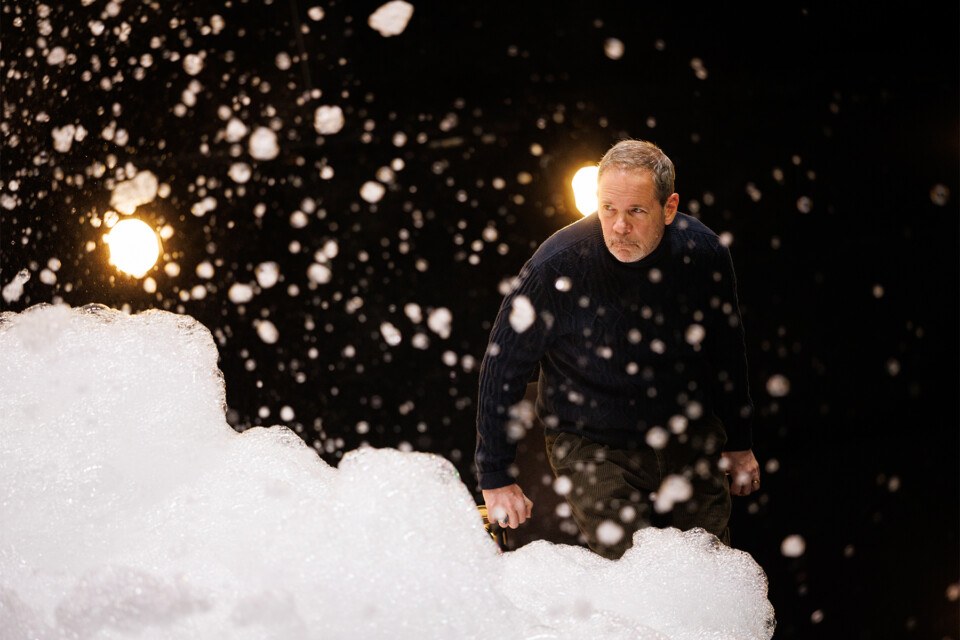
Thomas Jay Ryan in Kramer/Fauci / Photograph by Maria Baranova-Suzuki
A guide for the uninitiated, from our arts and entertainment editor and Fringe aficionado Victor Fiorillo
1. Grab a copy of the festival guide.
Every year, FringeArts prints a catalog of all the shows in the fest, both the curated and open-access portions. You need to study this. The guide includes descriptions of each show with accompanying artwork that will either catch your eye or it won’t. Maybe you think Philly power broker-turned-actor Joe Torsella starring in a one-man show about his life sounds like the most interesting thing ever, or maybe you’re more in the mood for a Peter Pan drag cabaret or a rap musical version of A Christmas Carol. The guide exists online, of course, but there’s something about paging through, highlighting, and dog-earing a physical copy that’s very satisfying. Treat it like your old Lonely Planet guidebook.
2. See two (or three) shows in a day.
This is one of the best things about the Fringe: The way shows are scheduled, you can absolutely immerse yourself from morning to night. Some venues host multiple shows, which makes it easier — sort of like hanging out at a multiplex for three movies in a day. It might seem like a lot to absorb, but be honest: How many hours have you spent on a Love Island binge day? Guaranteed the Fringe is much more edifying.
3. Mix it up.
While you’ll certainly want to check out a few of the 11 shows that are curated by FringeArts, many people feel the real unexpected magic of the festival is in the open-access portion, where up-and-coming (and sometimes well-established) artists experiment and innovate. If something jumps out at you, you can search for reviews of previous shows from the performers involved to see what you might be getting yourself into. Or just roll the dice.
4. Take some risks.
The artists in the Fringe are taking plenty of risks, and you should too. You can see conventional theater anytime — this is an opportunity to challenge yourself and experience things you might otherwise deem too “out there” or “avant-garde,” as Bang-Jensen, who has seen several hundred Fringe shows over the past 25 years, says. At the end of the day, whatever you choose, you’ll have conversation starters and the pleasure of knowing you’re supporting Philadelphia’s arts community.
Footnotes:
- She’s not kidding. Past Fringes have had everything from full frontal nudity to various bodily functions we don’t feel the need to witness again. ↩
- The company is Ontroerend Goed, which is pronounced own-TROO-rent KHOOT. ↩
- Founded in 1995, Pig Iron went on to become one of the most revered experimental theater companies in the world and has operated its own graduate school program since.↩
- Van Reigersberg, who died in June, was best known for his performances as drag queen Martha Graham Cracker. ↩
- The Zep is a hyperlocal Norristown sandwich that consists of salami, provolone cheese, thinly sliced onion and tomato, oil, vinegar — and never, ever lettuce. Get one at Lou’s, where they’ve been serving them since 1941. ↩
- The fee is down from $350, an amount that many artists revolted against in 2019, since most also have to rent venues, pay staff, build sets, etc.↩
This interview has been edited for length and clarity.
Published as “Down With Censorship, Up With Experimental Belgians” in the September 2026 issue of Philadelphia magazine.
