


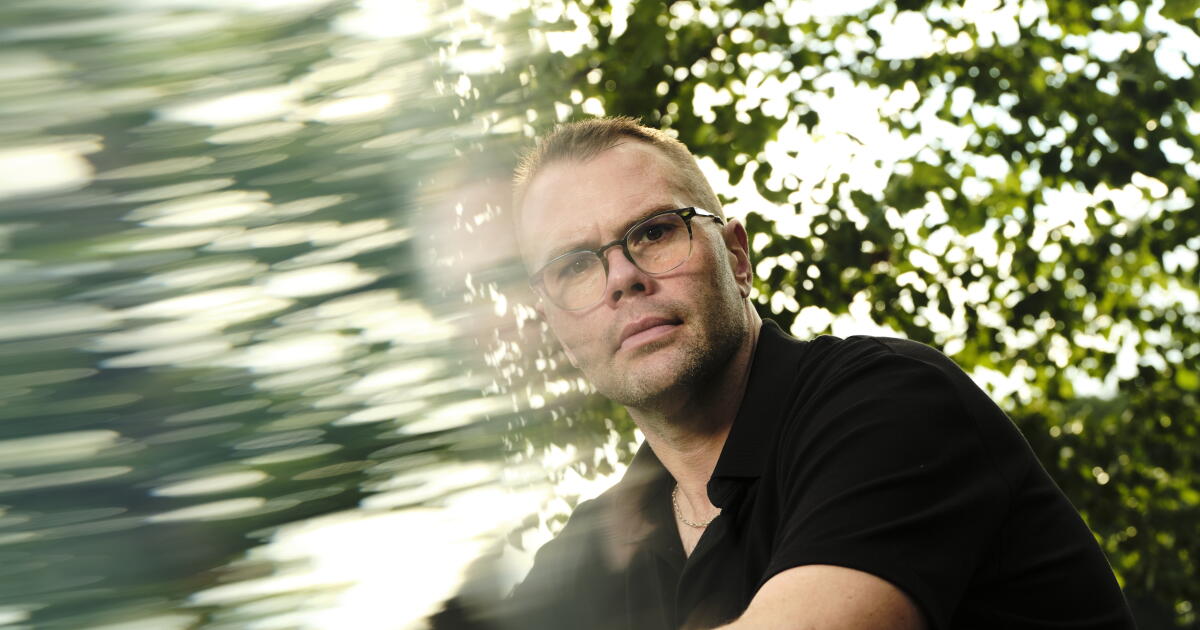
Samuel D. Hunter writes compact human dramas that pack a maximal punch. Both “Grangeville,” Los Angeles’ most acclaimed theatrical offering of the summer (extended at Ruskin Group Theatre through Sept. 21), and “A Case for the Existence of God,” which opened last weekend in a Rogue Machine production at the Matrix Theater’s Henry Murray Stage, are virtuoso two-handers.
Although modest in scale, no one would describe these plays as small. Both take in the wider world as they drill down into the behavioral dynamics that constitute the dramatic core of his work.
The bard of Idaho, where he was raised but no longer lives, Hunter is keenly aware that no one exists in a psychological vacuum. Politics, economics, religion and geography shape the inner world of his characters every bit as much as childhood trauma.
Sitting opposite Hunter at a luncheonette he frequents on Manhattan’s Upper West Side, I can’t help feeling like I’ve been cast in one of his plays. I had scribbled a few questions in advance but felt no compulsion to stick to any script, preferring that our own character dynamics might determine the plot of our interview.
Carlo Mancasola, left, and Nicholas Anthony Reid in “A Case for the Existence of God” at Rogue Machine Theatre.
(Jeff Lorch)
Drama in Hunter’s hands is built around an encounter. He doesn’t force his characters to jump through hoops. He listens to them, as they navigate their complicated feelings, closely tracking the way their intersecting paths lead them toward incremental revelation.
Hunter, who lives in the upper Manhattan neighborhood of Inwood with his husband and daughter, hails from Moscow, Idaho — the state where most of his plays are set. He moved to New York at 18 to study playwriting at NYU, but he’s been remarkably faithful to the world he left behind.
“I’ve seen extreme ends of the spectrum, from being enrolled in a fundamentalist Christian school in a small town in Idaho to being a gay playwright living in New York City,” he said. “Those are two very different lives. I value both, but it took me well into my 30s to understand that I was still wrestling with different aspects of myself.”
He included his relationship with religion as one source of tension, but the more enduring conflict for him may be the rural-urban divide.
“I’m married with a kid and two dogs,” he said. “We own an apartment here in New York City. I guess I’m very much a New Yorker at this point. But I still feel when I go into certain spaces, like the Tony Awards, or even high-end restaurants, a little uneasy. I think that’s maybe why I continue to write plays set in Idaho and put them on stages in New York City, because I’m trying to broker something both for myself and for other people.”
The dismissive attitude toward “flyover country,” perfectly caricatured in Saul Steinberg’s famous 1976 New Yorker cover in which the map of America is reduced to Manhattan and the West Coast, is personal to him.
“Recently, there was all this coverage of my hometown, because of the Idaho murders,” he said. “And I think the people who live there felt attacked. All this coastal media was descending on this small town and characterizing it in terms of this one really bad thing. And now that’s forever going to be the sort of ear tag, like on a cow, of my hometown, which has been around since my great-great grandfather was the first postmaster there.”

Brendan Fraser in a scene from “The Whale.”
(A24)
Hunter is best known for his play “The Whale,” which was adapted into the 2022 Darren Aronofsky film that earned Brendan Fraser an Oscar for his performance as the reclusive, morbidly obese writing instructor trying to reconnect with his estranged teenage daughter before his faltering body gives out. It was a heady time for a playwright thrust into the red carpet spotlight.
“I can’t believe people can do this more than once,” he said. “It just felt so insane. I was constantly on a plane. It was a lot of fun, but very stressful at the same time. I wrote that play when I was 27. And look, I love that play and always will, but it feels like a play I wrote when I was 27. And revisiting it in my 40s was a crazy experience. But it was great. I was on set the whole time. I worked very closely with Darren and Brendan, and Brendan remains a dear friend.”
“The Whale” is subtler on stage than it is on screen; its metaphors work better in the theater’s buoyant atmosphere for which they were conceived. Hunter understood that the play would have to change from one medium to the next. What caught him by surprise was the conversation around fat-phobia that accompanied the film’s release.
“It was difficult because when I was in my 20s, I was much heavier,” he said. “I was eating my emotions. Eating as a form of depression. I wrote the play partly to process all that stuff and the shame I felt. I was trying to do something positive with it, so to be shamed on the other end was difficult because it was so far from my intentions.”
Hunter’s work might seem to transfer readily to film or TV. On a superficial level, his plays, built around the emotional lives of his characters, can come off as a throwback to traditional realism. But the writing is less straightforward than it appears. The shifts that occur, not just in time but in physical space, are linked to the tectonic movement in the play’s emotional ground.
“I’d love to paint myself as a saint, who just loves people and is concerned with empathy,” he said on the subject of his craft. “While I am concerned with empathy, I think it’s an aesthetic approach more than a sanctimonious act of charity toward my fellow human beings. The reason I’m interested in playwriting is because there’s not a single point of view being expressed. It’s this broader heath of understanding, and all of my favorite plays come out of that. What’s beautiful about them is that there’s no authorial voice.”
Early encounters with Thornton Wilder’s “Our Town” and Tony Kushner’s “Angels in America” inspired him to pursue his economically precarious calling. Edward Albee’s “The Play About the Baby,” which he saw when he was a freshman at NYU, was another work that showed him just how elastic and encompassing drama can be.
“I don’t know if I had grown up in New York City that I would be a playwright today, because I think I would have been way too intimidated,” he said. “I just randomly figured out when I was 16 or 17 that I wanted to write plays, because I loved the form, not because I had encountered a bunch of new writing for the American theater. ‘Angels in America’ is really the only newish play that I knew.”
Another upside to not being raised in New York’s theatrical hothouse was the welcome he received as a young artist. “When I was 17, after I wrote my first play, I went to the local community theater and they gave me 300 bucks and we staged it with a group of very gracious local actors,” he said. “In New York City, they would have been like, ‘Hold your horses, Sam. Go do this 10-minute play workshop, then do 90 drafts of it, and then we’ll do a reading. Whereas I wrote an almost three-hour play when I was 16, and actors just went and did it.”
After NYU, Hunter pursued his MFA at the University of Iowa’s Playwrights Workshop. He then returned to New York to study further at Juilliard, where, under the influence of playwright Marsha Norman (“‘Night, Mother”), he reconciled the different approaches to dramatic structure that he had been absorbing.
“Marsha got me back in line, because her big thing is that we’re storytellers,” he said. “Everybody’s out hunting and gathering all day long, and our job is to make sense of that at the end of the day. She reminded me that it’s not just about my own whimsy. That there’s a contract with the people who are sitting in the dark for two hours. I found the middle ground between the hard dramaturgy of NYU and the more experimental direction I went in at Iowa.”

Laurie Metcalf, left, and Micah Stock in “Little Bear Ridge Road” on Broadway.
(Julieta Cervantes)
Last fall, Hunter made his Broadway debut as a playwright with “Little Bear Ridge Road,” which the New York Drama Critics’ Circle named best play of the 2025-26 season. Joe Mantello’s production, which originated at Steppenwolf Theatre Company, starred Laurie Metcalf. Hunter said he’d happily write plays for her the rest of his career if she’d let him.
In terms of critical reception and production opportunities, Hunter is one of the most successful playwrights of his generation. Yet theater isn’t how he makes ends meet.
“Our health insurance and the lion’s share of our income come from screenwriting,” he said. “But the irony is that most of my time is spent making theater. The things I’ve been paid the most to write are things that have never seen the light of day. That’s the funny thing about screenwriting. Whereas I still couldn’t make a living on the plays that have been performed around the world at this point. If we didn’t have a kid and didn’t live in New York City, then we could probably get by. We wouldn’t have health insurance. I only get health insurance because of the Writers Guild of America.”
Is there any work in his already extensive oeuvre that he would hold above the others?
“I would say ‘A Case for the Existence of God,’ not that it’s my favorite but it’s the one that I feel deeply attached to,” he said. “Partly because it’s connected to me becoming a dad and partly because it was the first play that I had coming out of the pandemic. That was a period when I didn’t write a new play, and it was scary.”
“Case” unfolds in the sterile office of a mortgage broker in Twin Falls, Idaho. Keith (Nicholas Anthony Reid), a gay Black man who’s fostering a toddler, is trying to help Ryan (Carlo Mancasola), a divorced man with a young daughter, secure a loan so he can eventually build a house on a piece of land that long ago belonged to his family.
Hunter knows that the title might seem “absurdly grand” for a play in which two single dads sit around a cubicle talking at length about loan paperwork and interest rates. But his intention is to “put audiences on the hunt for what this play is really up to” as the men come to recognize “the specific kind of sadness” they share.
“I’ve seen too many plays where money isn’t real,” he said. “Where people just live in brownstones, and that has just not been my experience of the world. Increasingly, we live in a culture that assigns our personal worth to our bank accounts. My dad was an emergency room physician in a town called Lewiston his entire career, and his whole thing is that there are so many people who are one minor injury or car problem away from total ruin.”

Jeff LeBeau, left, and Tim Cummings in the West Coast premiere of Samuel D. Hunter’s “Grangeville.”
(John Perrin Flynn)
This is the fifth play by Hunter that John Perrin Flynn, Rogue Machine’s founding artistic director, has directed. “A Bright New Boise,” the first for Rogue Machine, was followed by “A Permanent Image” and “Pocatello.” “Grangeville,” which Flynn directed for Ruskin Group Theatre, features an acting master class from Tim Cummings and Jeff LeBeau that should not be missed.
Flynn, whom Hunter called the “guardian of his plays in Los Angeles,” also appeared in the the cast of Rogue Machine’s production of “A Great Wilderness,” directed by Elina De Santos. What keeps drawing him back?
“Sam tells stories about quietly despairing people seeking to survive in our bleak world,” Flynn responded via email. “The characters he creates are nuanced, lovely and flawed, and the stories he tells evolve from their interactions with each other. His plays are very funny but the humor comes from something true about what it takes to keep going. There are big issues in his plays, but they are deeply rooted in story. The plays are not about the issues. The issues are just there, as they are in our own lives. Most importantly, in this mirror Sam holds up to show us how we live now, there is always hope.”
Since becoming a dad, Hunter said he just doesn’t have the luxury of being cynical.
“I bristle sometimes with the attitude that like, ‘Wow, we’re all going to hell, ha ha ha!’ That kind of cynicism is cheap and facile and masquerades as intelligence and erudition. It’s just irresponsible to surrender to the idea of the world blowing up. Because the world is still going to be around when my daughter is 50, 60 or 70 years old. I don’t know what that world is going to look like, but people in 1926 didn’t know what 2026 was going to look like. And we don’t know what 2126 is going to look like. And it’s going to be beautiful and awful and horrifying and sacred. I’m not offering unfettered optimism. But I think this is what ‘A Case for the Existence of God’ is about: that there is continuance. And that is what I have faith in, whatever continuance looks like.”
